
Sometimes, in the dark nights of this film critic’s soul, I wonder if I am being too harsh on Robert De Niro.
You see, I am a fan neither of De Niro’s muddled, inarticulate acting style nor his career-long attraction to grotesque parts — Travis Bickle and the like. But whenever I wonder if I am holding against him his position as the chief Never Trumper among geriatric Hollywood actors, I remember: Mike Nichols fired De Niro. Yes, Mike Nichols — the fantastically talented director who summoned stellar performances from everyone from Elizabeth Taylor to Melanie Griffith, for heaven’s sake — judged De Niro a pedantic bore when they worked on a Neil Simon comedy in the mid-1970s. In an episode recounted in Mark Harris’s biography Mike Nichols: A Life, De Niro attempted to engage Nichols in a discussion about the meaning behind a yellow set, but the director was pushed over the edge: “I will not work another minute with this,” Nichols said.
Alas, many other fine directors continued to do so. De Niro has made several great movies and many very poor ones, but my contention is that, whatever the quality of his selections, his acting remains constant. From a picture as grand as The Deer Hunter (1978) to one as pitifully sorry as The War with Grandpa (2020), De Niro tends to come across as a monosyllabic malcontent — a man who prefers mumbling to enunciating, and who mistakes scowling for intensity.
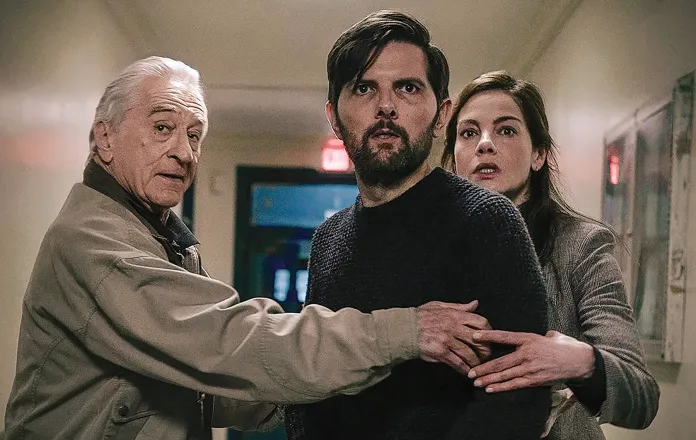
Then again, maybe I have it all wrong. Maybe Nichols had it wrong, too. So, in a spirit of magnanimity toward one of America’s most revered actors, I decided to watch De Niro’s most recent movie, Netflix’s release from late August, The Whisper Man. Given De Niro’s lifelong association of vocal unintelligibility with subtlety, I will admit that the title to this purported thriller was unpromising.
In fact, De Niro’s character is not the title whisperer, though he does plenty of muttering as Pete Willis, a former police detective who is summoned back to work on a serial killer case that comes to involve his estranged family. Early in the movie, Pete claims that he has been retired from policing for “at least 25 years.” Let me pause to make two points right at the outset: First, are the moviemakers perhaps too eager to concede their star’s elderly countenance by making Pete’s retirement an entire quarter-century ago? Second, wouldn’t a retired detective — one who is presumably drawing a cushy pension — know the exact date of his retirement without resorting to the use of the words “at least”? This is a bit like saying, upon being asked, that one has been married for “at least 25 years.”
As it turns out, The Whisper Man is full of such strange utterances, improbable plot turns, and overall dumbness. As James Joyce once wrote of snow in Ireland, dumbness is general all over this movie. This, in a sense, insulates De Niro: Since the entire cast shares in the movie’s stupidity, our star is less likely to stand out for his lukewarm, slow-poke performance.
Adam Scott costars as Pete’s perpetually aggrieved son, Tom Kennedy, a crime novelist whose family is dwindling: He is recovering from the trauma of the death of his wife — with whom he has a child, Jake (Acston Luca Porto) — and he has long avoided contact with his surly, tight-lipped father. And (sorry), who can blame him? That said, no one can doubt Pete’s paternity since Tom is inclined to make similarly brainless statements. For example, in dropping Jake off at his school one morning, Tom asks whether his son is warm enough — a question that might have been more properly asked before they left their house and not just as he is about to enter a presumably heated building. Earlier, in explaining to Jake why they have relocated to a new city following the death of his mother, Tom utters a breathless line that sounds more like a screenwriter’s exposition than something said by an actual sentient being: “Your mom always wanted us to move back to the town we grew up in.”
But this idiocy is all small potatoes compared to what happens (and what is said) once the story proper gets underway. Based on a novel by Alex Cross, The Whisper Man takes place against the background of a long-ago case in which a demented monster kidnapped and killed children — a case cracked by Pete. The perpetrator Frank Carter (Michael Keaton), whose “Whisper Man” designation refers to sinister recordings he made of his victims, has long been incarcerated. Yet, mysteriously, crimes in the same mold are being committed anew.
This is an OK setup for a thriller, although needlessly macabre. Yet when Tom spots a weird man loitering outside his house, he rushes outside while leaving the door wide open — with his son standing alone near the entryway. Is that such a smart move? Later, Tom actually runs into an intruder in his home, but his reaction is so nonplussed (“Hey, what are you doing?” he yells, lamely) that we can hardly blame the police for acting blasé when they investigate the crime. By the way, much of the action unfolds in the darkened rooms in Tom and Jake’s new home — made all the darker by the inexplicably hurricane-like conditions outside some of the time.
When Jake is abducted, none of the adults behaves any more sensibly. Asked by Detective Amanda Beck (Michelle Monaghan) for information about his child, Tom rambles about how he likes to collect rocks and scraps of paper. More reasonably, Tom also initiates contact with his father, but as played by De Niro, Pete, whose idea of gathering evidence is ambling around the woods with a walking stick and notepad, inspires little confidence. When Tom tells his father that the police will listen to him, Pete replies, approximately, “I dun — um-mum-um.” Mr. De Niro, if you are reading this, perhaps you can translate. Later, Pete intervenes when his son has a potentially fatal encounter with a drug dealer in a housing project, but De Niro’s periodic physical exertions are unpersuasive. He is more convincing when chopping an onion while making dinner. As for Detective Beck, she allows herself to be felled by a cup of hot tea being thrown in her face by the chief suspect in Jake’s abduction.
THE NEW ‘RESIDENT EVIL’ IS GHOULISH BUT STYLISH
The Whisper Man grows increasingly grisly — as Jake’s fate lies in the balance, human remains are found, and various degenerate accomplices or suspects are identified — but these seem like cynical ploys to rouse audience interest. De Niro makes faces and looks quizzical, and his infrequent displays of emotion suggest his anti-Trump jeremiads on MS Now.
So, why did I bother with this movie? My answer is simple — a matter of film critic housekeeping, you might say: The fall movie season is upon us, and I have some hope of enjoying a number of releases. Having gotten The Whisper Man out of the way — having given De Niro one more benefit of the doubt — means that I won’t have to see Focker-in-Law in November.
Peter Tonguette is the Life & Arts editor of the Washington Examiner magazine.