
Jamile Pellicer, a Florida-based immigration lawyer, remembers the evening of Sept. 19, 2025, as “one of the worst days of my life.”
President Donald Trump, in a Friday night news dump, signed an executive order imposing a $100,000 fee on any domestic employer applying for new specialist H-1B visas for foreign workers.
The move sparked panic among Pellicer and her clients, who then had a very narrow window to make sure they got to the United States before such fees might come into effect.
“It was insane, completely hectic,” she told the Washington Examiner. “I was on the phone all the time with people having kids in school and trying to get to Doha to secure their status.”
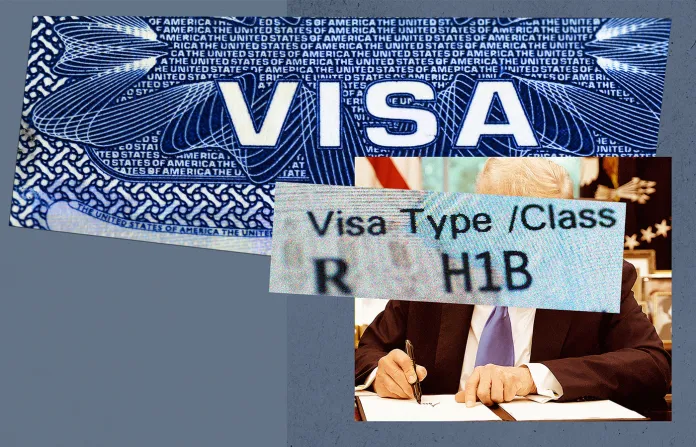
Employers typically have had to pay up to only about $5,000 to get such visas in place.
The controversial fee was struck down in late July on appeal after a June 8 court ruling that such a higher fee could not stand. Despite the court rulings, widespread concern and fear among employers lingers. The administration could still find a loophole or alternative approach to enshrine the higher fee, even as few companies have actually paid such dues.
“The scare does not disappear the day a court blocks the fee,” said Miguel Mora, a Florida-based immigration lawyer. “The administration is still appealing, and employers have now seen that an immigration cost can change dramatically with little warning. We don’t know how far the administration is willing to go to defend their position on this.”
Sure enough, the Trump administration is now proposing to impose a $103,265 filing fee for visas given to skilled foreign workers in the U.S. The new rule, proposed by the Department of Homeland Security in August, would apply to all applicants seeking an H-1B visa, with exceptions for those with positions at universities, hospitals, and other nonprofit organizations.
Domestic workers rushing in?
The Trump administration said it brought in the order because the H-1B program had enabled what it has called the “large-scale replacement of American workers.” The new fee structure was sold as a means to redress the balance and get domestic workers into such specialist roles instead.
But there simply aren’t the training schemes in place to get such domestic workers up and running, sources repeatedly said.
“What the administration’s view misses is that we aren’t graduating enough American students, particularly in STEM, to fill the specialty roles foreign workers currently occupy,” said Elizabeth Ricci, a partner at immigration group Rambana & Ricci and an adjunct immigration law professor. “You can’t redirect demand to a domestic workforce that doesn’t exist yet.”
Her thoughts were echoed by Priyanka Kulkarni, the founder and CEO of Casium, an HR tech company working directly with companies on hiring and workforce strategy.
“The gap between what the policy intends (encouraging U.S. hiring) and what it actually produces on the ground — often just added friction and cost anxiety, not a meaningful shift toward domestic specialist hiring,” she said.
As one possible solution, employers are seeking, in some cases, to hire remotely from outside the U.S. without going through the uncertainty and logistics of H-1B visas. Such moves clearly do not encourage the hiring of domestic workers.
Hire With Near is a staffing and recruiting agency that helps U.S. companies hire remote talent from Latin America. The company says the move toward such remote workers was already happening, and there is only one direction for such a trend.
In the first half of this year, U.S. companies that used Hire With Near increased their hiring of remote foreign workers by 31% over the previous six months and by a whopping 67% over the same period a year earlier, Hire With Near figures show.
“All of that is remote work, with the person staying in their own country,” CEO and co-founder Hayden Cohen said. “We’re absolutely not claiming the fee caused any of it. This was already the trend we were seeing beforehand, and it simply kept going.”
But such a trend could also be exacerbated by the administration’s decisions on the H-1B visa program and the corresponding uncertainty they have caused.
Companies may plan a year or so on such H-1B decisions amid the visa lottery and hiring timelines, Lincoln-Goldfinch Law founder and CEO Kate Lincoln-Goldfinch said. When a policy introduces such significant uncertainty and potential cost, employers need to shift focus and explore alternatives.
“In practice, that can mean expanding overseas offices, hiring talent remotely, or shifting recruitment to countries with more predictable immigration systems,” she said. “The real impact isn’t necessarily that companies hire more U.S. workers; it’s that they’re more likely to look for global talent outside the United States when the rules become unpredictable.”
No easy solutions
While remote hiring can get around the H-1B visa process, it also can’t be seen as the answer to all employment problems.
Sometimes, there is an essential need to have employees physically present at the point of work, depending on the industry. For example, some workers in the hospitality or tourism industry cannot practically work remotely.
And while many H-1B visas affect the technology industry, there are still large chunks of the workforce outside of that who may need such visas and can’t work remotely.
“I am seeing beyond my immigration practice that it is a growing trend to hire remote workers, but I don’t think it is a one-size-fits-all solution,” Mora said. “Only time will tell if that is going to be an adequate solution, at least for some sectors.”
The fee ruling is seen as a reprieve for Silicon Valley, which depends on the visa program far more than other sectors. For example, Amazon had more than 10,000 such visas approved in the first half of 2025, statistics show, with Meta and Microsoft each exceeding 5,000 in the same period.
So, the big boys may be able to press on regardless, but for many smaller employers, the uncertainty and the threat surrounding the issue are very far from beneficial.
“I don’t see how this is benefiting the U.S.,” Mora said. “Markets don’t like uncertainty, and this does not help anyone on the whole as it just creates fear and hesitation, or a wait-and-see approach.”
The Trump administration has continued to seek ways of getting around other issues that have been struck down by the legal system, and there is, of course, no guarantee it wouldn’t do something similar with this program, leaving many employers in a difficult situation.
“Many are not willing to prepare a case for filing only to learn the $100k fee is enforceable,” said Ali Brodie, a co-chairwoman of business immigration at Fox Rothschild. “Many are not willing to file without absolute certainty that the $100k will not apply now or in the future.”
FEDERAL JUDGE STRIKES DOWN TRUMP $100,000 FEE ON H-1B VISA WORKERS
Erin Berry, a manager of immigration and relocation for a Fortune 500 telecommunications company based in New York, said even the possibility of the $100,000 fee is turning off companies from hiring foreign workers.
“Our company currently will not even look at qualified talent abroad,” Berry said. “The chance that the $100,000 can be ruled enforceable makes us pause, as hiring qualified talent who are currently outside the U.S. would be retroactively subject to the fee.”
Nick Thomas (https://nickthomas.journoportfolio.com/) is a writer based in the United Kingdom.