
A congressional witness at Wednesday’s Senate Judiciary Committee hearing on protecting women’s sports told Sen. Dick Durbin (D-IL) that the transgender lobby threatening women with claims of suicide, as justification for men to enter female-protected spaces, amounts to male gaslighting.
During opening remarks, Durbin cited a statistic from the pro-transgender Trevor Project claiming that LGBT youth are at higher risk of suicide as a result of “mistreatment and stigmatization.”
“This committee should not participate in that marginalization of any children in this country,” said Durbin, the ranking Democrat on the committee. “For these reasons, I refuse to treat this hearing as a responsible exercise of this committee. I will not ask questions. The minority did not call any witnesses.”
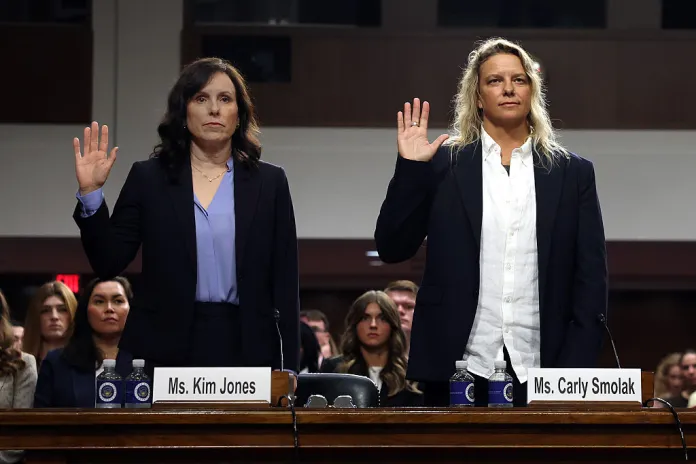
Kimberly Jones, co-founder of the Independent Council on Women’s Sports, rebutted Durbin’s claims, asserting that denying gender-dysphoric individuals inclusive accommodations, such as allowing men into women’s locker rooms, would increase their suicide risk.
“That is emotional blackmail,” Jones said. “It should never be used against women. It is the age-old story [of men] saying, ‘If you leave, if you don’t do what I say, as a man, I will hurt myself or hurt others.’ Telling women that they have to relinquish their rights, their safety, their fair treatment, in order to accommodate the desires of a man or the comfort of a man, it is abuse of women.”
In her prepared testimony at the start of the hearing, Jones said that female athletes opposed to sharing locker rooms with men have been silenced and told to “ignore their instinctive reaction to injustice, fear, and discomfort.”
“They were emotionally blackmailed and told that the feelings and well-being of a man were more important than their own. That his life depended on their concession,” Jones testified. “This emotional blackmail is no different than the age-old threat that women have always faced when trying to leave abuse.”
Jones said women and young girls should not be held responsible for carrying the mental health burdens of their gender-confused counterparts.
“When we tell our girls that they are more valuable as tools of affirmation, as shields of protection for men, when we tell women that their accomplishments, their desire to win, their hard work and feelings need to be set aside to make a man or a boy feel better, we damage them psychologically,” Jones told the committee.
A total ban on biological males
Jones also argued in favor of categorically banning biological males from competing in female sports, instead of permitting certain men to compete as women as long as they are on cross-sex hormones, take testosterone suppression, or undergo feminization surgery.
Such medication minimally decreases an athlete’s strength, Jones countered, but argued that it is beside the point.
“The postulation of the question is misogynistic,” Jones said. “The idea that an intentionally medicated weakened man is the equivalent of a woman is insulting and degrading to women.”
That question of biological advantage, the basis for why sex-segregated sports exist in the first place, was weighed by the Supreme Court in two pivotal transgender sports cases this year, Little v. Hecox and West Virginia v. B.P.J. The broader dispute centered on whether medical intervention, for instance, estrogen injections, reduces the athletic performance gap between men and women.
Feminists say that this sort of thinking, comparing men’s and women’s physiological factors as functionally equal, is regressive. Before the civil rights movement, women were long perceived as the weaker sex and as lesser or defective men. Today, it is commonly understood that women are their own beings and have a completely different developmental path from men.
Jones questioned at what point athletic associations should draw the line on allowing unathletic, elderly, medically ill, or out-of-shape men to be treated as women, saying it’s a slippery slope to permit these exceptions.
“Is a man on chemo allowed to compete against women because he’s sufficiently weak, or he’s 70 or 80, do we now equivocate that?” Jones asked. “That is not an elite female athlete or even a competitive female athlete. That is a man.”