
The Trump administration notified Congress on Tuesday it plans to accept thousands more of South African refugees into the United States than expected over the next 12 months.
In a roughly $500 million effort, the U.S. will admit 17,500 mostly Afrikaner refugees throughout fiscal 2027, which starts on Oct. 1. The development boosts the previous 7,500 refugee cap by 10,000, after the White House raised concerns that the South African minority group faces persecution.
“Afrikaners face the seizure of agricultural property without compensation; government policies designed to dismantle equal opportunity in employment, education, and business; and hateful rhetoric fueling disproportionate violence against racially disfavored minorities,” the State Department said in its notice to Congress.
“The United States anticipates that Afrikaners from South Africa will fully assimilate into the United States in a manner that preserves taxpayer resources for U.S. citizens and does not anticipate other countries resettling Afrikaners,” the notice, which was first reported by CBS News, continued.
The development comes after President Donald Trump dramatically lowered the number of refugees from the Biden administration’s 2024 cap of 125,000 to 7,500. Last May, Trump raised the limit to 17,500, with the additional spots primarily reserved for Afrikaners, or South Africans who are the descendants of Dutch, Huguenot, and German settlers beginning in the mid-17th century.
The U.S. accepted its first batch of Afrikaners, 54 people, during Trump’s term last May, after the president raised concerns that their government seized Afrikaners’ agricultural property without compensation, and that many of the farmers are being killed. South African President Cyril Ramaphosa has vigorously denied concerns that the minority group is under assault, though critics say attacks on farms are often accompanied by extensive torture, rape, and mutilation.
“They happen to be white, but whether they’re white or black makes no difference to me, but white farmers are being brutally killed, and their land is being confiscated in South Africa, and the newspapers and the media, television media, doesn’t even talk about it,” Trump said last May. “If it were the other way around, they talk about it, that would be the only story they talk about.”
Racial tensions have long troubled South Africa following the end of apartheid policies in 1993, which favored white citizens over black citizens.
South African government officials maintain that the violence Afrikaners, who are white, have experienced isn’t racially motivated, framing it as a reflection of a crime problem the whole country is battling.
But allegations that Afrikaners are facing systemic oppression weren’t helped when Ramaphosa signed into law in 2025 a policy that allows the state to seize farmland from private owners without compensation if the government determines that doing so is “just and equitable and in the public interest.”
In the U.S., Democrats have complained that the Trump administration’s assistance to Afrikaners is one that deliberately favors white people, suggesting it is racist. During a Senate hearing with Secretary of State Marco Rubio last May, Sen. Tim Kaine (D-VA) suggested the State Department has a “different standard” for accepting refugees “based on the color of their skin.”
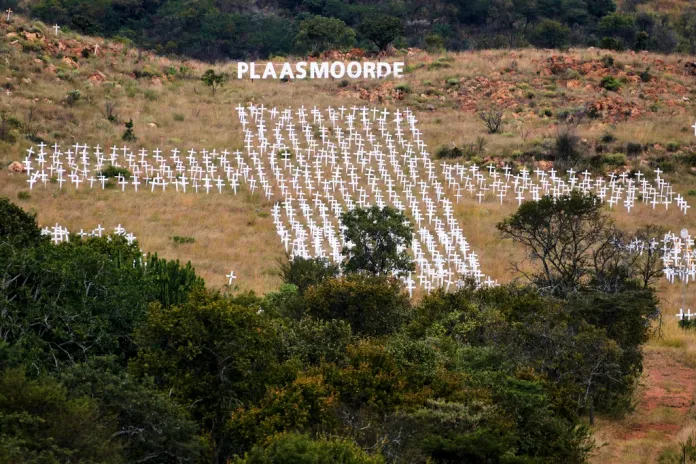
“I’m not the one arguing that, apparently you are because you don’t like the fact that they’re white and that’s why they’re coming,” Rubio responded.
“You’re the one that’s talking about the color of their skin, not me,” he told Kaine. “These farms were being burned down and they were killed because of the color of their skin.”