
Days after Canada agreed to pursue an ill-defined and counterintuitive “associate membership” with the European Union, the continental alliance is handing out further invitations to countries on the other side of the world.
European Commission President Ursula von der Leyen invited Canada on Wednesday to join the 27-nation bloc as its first associate member, framing it as an “Alliance for the Future.” EU officials have offered virtually zero explanation of what that status would mean or how it would change relations with Canada, but European Parliament President Roberta Metsola is already expanding the roster of possible candidates — and Australia is leaping to sign on the dotted line.
“This once-in-a-generation deal gives our farmers, exporters, producers and businesses access to 27 EU countries and 450 million consumers,” a government spokesperson said Friday. “Australia is a trading nation, and in a time of global uncertainty, deepening our trading partnerships makes economic sense.”
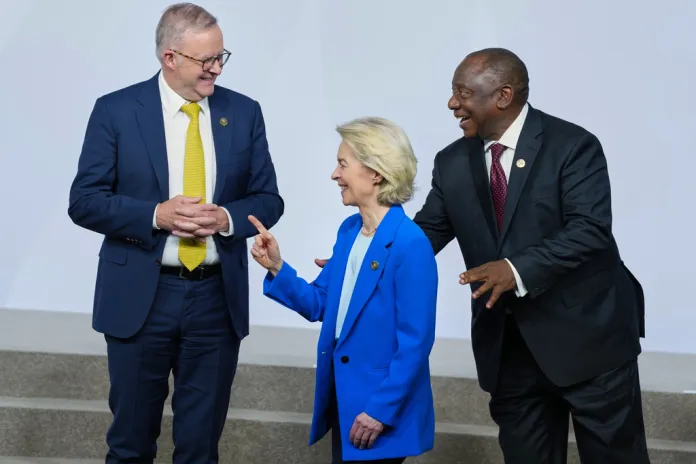
The spokesperson said while the relationship between Australia and the EU has “never been stronger or more important,” the associate membership “will bring us even closer together.”
New Zealand was also shouted out by Metsola as a possible associate member, but their response was far more muted than their Aussie counterparts.
“There have been no discussions with the EU about New Zealand becoming an associate member,” a government spokesperson said.
The situation is baffling for some diplomats who feel the lack of clarity — mixed with the EU’s ongoing lack of follow-through on its existing foreign relations — amounts to a meaningless mess.
“This ‘associate member’ stuff ain’t gonna fly — in both directions,” a European diplomat in Washington, D.C., told the Washington Examiner, calling the trans-Atlantic proposal “Middle Power bulls***” that the European Commission only “pretends” to understand.
The comment was in reference to Canadian Prime Minister Mark Carney’s embrace of middle power status, arguing at Davos this year that countries of medium size and influence “must act together, because if we’re not at the table, we’re on the menu.”
“Western Europe couldn’t even implement our free trade agreement,” the European diplomat complained to the Washington Examiner. “Nine EU countries haven’t ratified CETA.”
The CETA, an abbreviation of “Comprehensive Economic and Trade Agreement,” was signed by Canada and the EU in 2016. It was adopted on a provisional basis in 2017 but has never been formally ratified due to various member states failing to ever take up the issue in their national parliaments.
Critics in Canada have accused the associate membership arrangement of being a threat to their national sovereignty and fiscal independence.
“We are not looking to be a member of the European Union, because that is a sovereignty issue and people give up certain portions of their sovereignty [to join],” Canadian ambassador to the EU Jonathan Wilkinson told reporters. “At the end of the day, what we are looking to do is get as close as we possibly can in a manner that’s going to actually strengthen all of our respective countries without giving up significant chunks of sovereignty.”
Carney, while enthusiastic about working with the EU, has emphasized that any agreement will need democratic approval and will not sacrifice Canadian autonomy. He has also, at times, attempted to downplay the idea of “membership” on the bloc.
“President Von der Leyen used both terms, alliance for the future and associate membership,” he said. “The nomenclature is a question for Europe, what terms they use. What matters is the substance. What are we actually building together.”
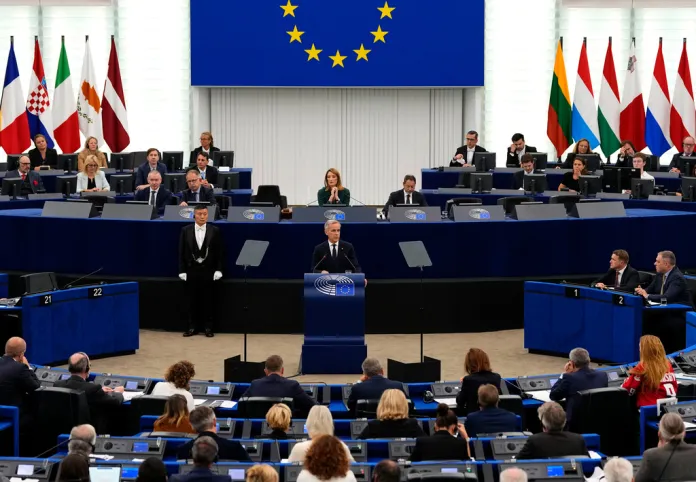
Pierre Poilievre, leader of the Conservative Party in Canada, has blasted Carney for agreeing to the proposal and accused the prime minister of flip-flopping on what the country is agreeing to.
“He has his officials tell foreign newspapers he is secretly negotiating for Canada to become an associate member of the EU. Then he has his officials tell Canadian media it’s not happening,” Poilievre complained on social media. “Then he tells Canadians we are not becoming a member, and then tells the European Parliament he welcomes it.”
MARK CARNEY TRIES TO SOOTHE US FEARS IN EU SPEECH AFTER MOVE TO BECOME MEMBER
The entire debacle comes after Canada’s trade negotiations with President Donald Trump’s administration blew up this month, resulting in yet another round of tariffs exchanged between Ottawa and Washington.
The president, reacting to the news of the associate membership proposal on Wednesday, called the situation “laughable” and dismissed Canada as a “terrible trade partner.” He said as long as the agreement is not done out of animosity toward the United States, he would not seek to punish either side.
“If it’s a good intention, that’s fine,” Trump told reporters. “If it’s a bad intention, we’ll put very heavy tariffs on Europe.”