
It’s “Australia Summer” on the streaming services — or perhaps I should say “Australia Antipodal Winter,” for those of us who still believe, in this divisive age, in a round Earth.
Panned several weeks ago in this space, Netflix’s My Brilliant Career turned a daring Aussie novel into a calculated feminist trudge, the better to soothe its spinster audience. And earlier this month, the Los Angeles Rams and San Francisco 49ers kicked off their NFL seasons in Melbourne, a lackluster contest available only to those with a streaming subscription. If, as it seems fair to expect, Apple TV’s new Down Under drama Last Seen is remembered as the best of these productions, it will have dodged a serious, um, boomerang. Might Oz’s entertainment sector be sticking it to us Yanks on purpose? The conspiracy-minded answer with a hearty “yes.”
That they’re (mostly) wrong in this case feels, at times, like a happy accident. A more-than-slightly-political lost-child thriller, Last Seen repeats the oft-heard television message that all we really have to fear are white Christian fundamentalists living off the grid. Put forth as more savory alternatives are tolerance, bureaucracy, and the vaguely spiritual consolations of self-help. The show is compelling throughout and achieves, in its standout second episode, real excellence: a perfect convergence of storytelling, acting, and melodramatic stakes. Nevertheless, I couldn’t shake the suspicion that showrunner Kris Mrksa (Requiem) holds people like me in serious disdain.
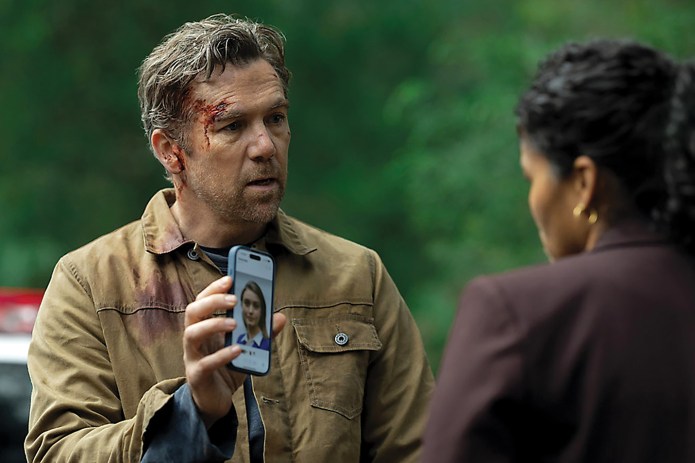
The first hour introduces us to Ian Ridley (Patrick Brammall), an emergency dispatcher whose daughter, Mags, then 3, was kidnapped more than a decade earlier. Divorced, a workaholic, and hanging on to sobriety by a thumbnail, Ian reenters the maelstrom of his family’s tragedy when a gang of teenagers discovers the skeletal remains of a small child. Like his ex-wife, Deb (Jessica Wren), Ian is desperate for a positive identification, if only to receive some measure of closure. Alas, the DNA is not a match. Although Mags’s pajamas were found with the bones, the remains themselves belong to someone else.
Well before Ian and Deb receive this news, viewers have already learned it. Concluding the first episode is the revelation that a now-14-year-old Mags (Chloe Jean Lourdes) is living as Sarah Reid in rural isolation with her kidnappers. Raised to believe that Henry (Brendan Cowell) and Jenna Reid (Maxine Peake) are her parents, the young woman has not left their farm outside of fictional Port McKenna, Victoria, since being taken there 11 years earlier. When, naturally curious about the outside world, Mags discovers a flyer bearing her birth name, old memories begin to intrude. Soon enough, the young woman has begun the devastating process of assembling the pieces of her past.
The drama thus commenced has at its heart a necessary if somewhat strained coincidence. Calling Australia’s version of 911 at the end of the second episode, Mags reaches none other than her father, Ian, working a late-night shift at the dispatch center. (This plot point is “spoiled” 20 seconds into the show’s trailer.) Ian quickly realizes who he’s speaking to, but by the time he makes his way to Mags’s location, the young woman has gone. What follows is a twisty thriller built on an irresistible question: Can Ian rescue a daughter who isn’t sure she wants to be found? Yet it is also an ideological provocation. Paranoid and obsessive in their beliefs, Henry and Jenna belong to a class of Australians (and, by extension, Americans) whom Last Seen would plainly prefer didn’t exist.
Audiences of a certain age will remember the 2007 mystery-thriller Gone Baby Gone, which asked whether kidnapping might, in extreme circumstances, serve as the lesser of two evils. Since then, a pendulum has swung, and even kindly child-snatchers must be made to seem psychologically deranged. This is all to the good: Henry and Jenna’s sincere love for their “daughter” can never make up for the ongoing cruelty of their crime, and I strongly reject their portrayal as fellow Christians. What annoys me is the ham-fistedness of Last Seen’s moral signaling. Having seemingly never met an actual believer, Mrksa and company put in Henry’s mouth a liberal atheist’s understanding of the faith, making Henry declare, for instance, that Mags’s real parents are “sinners,” when it is foundational Christian doctrine that we all are.
There is the matter, too, of Henry and Jenna’s isolation from society, which the series presents as both a tactical obligation (don’t flaunt your kidnapped child) and a condemnable peculiarity in its own right. Here is a thought experiment for the interested viewer: If Mags really were Henry and Jenna’s flesh and blood, would Last Seen portray with any more sympathy the family’s rejection of the modern world? Given that Henry’s stated preference for books over screens is itself treated as an indicator of villainy, I think we have our answer.
REVIEW: THERE’S LITTLE BRILLIANT ABOUT NETFLIX’S ‘MY BRILLIANT CAREER’
To be clear, I personally live in a suburb and send my children to school. I assume most readers of this review do, too. It is nevertheless irksome to be confronted with the implication that devout Christian religiosity is more than likely masking — and, indeed, is laying the groundwork for — some terrible crime. If, say, characters called Muhammad and Ayesha Reid had raised little Mags as Sumayyah, would the show have proceeded quite so cynically?
But enough complaining. Thanks in large part to Cowell’s exceptional ability as an actor, Henry never actually becomes the one-note caricature a lesser talent might have produced. When, in another episode, he reassures Jenna that the two of them are “good people,” I had to remind myself that they decidedly aren’t. Yet, the show’s most important work is done by television newcomer Lourdes as the “lost” child on whom the narrative turns. Making her professional debut here, the teenager gives a heartbreaking, utterly naturalistic performance as a young woman discovering that her life has been a lie. We will be hearing from her again.
And so it goes for the conservative critic attempting an honest day’s work. Last Seen appears to dislike me and most of my friends — but it is very good TV.
Graham Hillard is the TV critic for the Washington Examiner magazine.