
The Trump administration singled out Colombia and Bolivia as some of the worst violators in failing to curb illegal drug production in fiscal 2026, but voiced optimism about a change with their new governments.
In a presidential declaration, President Donald Trump put Afghanistan, Bolivia, Burma, and Colombia on its not-so-coveted list of countries that had “failed demonstrably” to meet their counter-narcotics obligations over the past fiscal year. Notably, this list was one country shorter than last year’s. Venezuela was removed this year following the abduction of former dictator Nicolas Maduro and the installation of President Delcy Rodriguez, who has tracked a pro-U.S. path.
Trump explicitly acknowledged Rodriguez’s help, praising her progress in combating drug production and trafficking in the country.
“In Venezuela, thanks to my Administration’s arrest and removal of former illegitimate dictator and drug trafficker Nicolás Maduro, we are already seeing the results of growing cooperation with the country’s interim government against cartels, including the elimination of Tren de Aragua leader Niño Guerrero,” the declaration stated. “Given the positive steps taken under interim President Delcy Rodríguez, I have determined Venezuela should no longer be designated as having failed demonstrably to fulfill its drug control commitments.”
“I expect to see continued, measurable progress from the interim government in dismantling narcoterrorist groups and stopping drug trafficking through Venezuela to the United States,” Trump added.
Despite this, Venezuela remains on the broader list of “major drug transit or major illicit drug producing countries.”
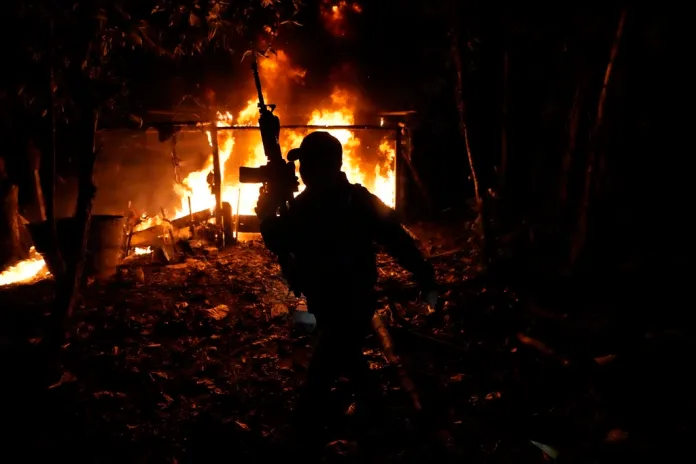
Bolivia and Colombia were at the top of the list despite U.S.-friendly right-wing governments coming to power in each spot in recent elections, though Trump noted that the two came to power recently enough that this wasn’t fully factored in. Colombian President Abelardo Gabriel de la Espriella Otero only took power on Aug. 7. These electoral changes were acknowledged, with Trump noting, “Dramatic political changes in South America over the past year have created historic openings for United States cooperation with governments in the region.”
He devoted separate sections of the presidential determination to each case.
Trump bashed the previous “decades of inept socialist governments” in Bolivia, praising the population’s “democratic choice” in last year’s elections to “open a new chapter in United States-Bolivia relations under President Rodrigo Paz.” With this new leadership, the U.S. has dramatically expanded law enforcement cooperation with Bolivia, pointing to the extradition of narco-terrorist Sebastián Marset in March as an example of “our growing friendship and cooperation.”
“However, the new government has not yet had sufficient time to reduce coca cultivation that increased under the previous government,” he continued. “Corruption in Bolivia continues to facilitate drug trafficking and impede investigations. If Bolivia can demonstrate progress in reducing illicit drug production in the coming year, and make substantive progress in tackling the endemic corruption weakening Bolivia, I will consider revisiting its status as having failed demonstrably to uphold its counterdrug commitments.”
Trump was even more optimistic in the case of Colombia, whose relations with the U.S. collapsed under the rule of former left-wing President Gustavo Petro, who was at odds with Trump on nearly every issue. He praised the Colombian people’s “courageous choice” to elect de la Espriella, noting his plan to mount an aggressive campaign against coca cultivation and cocaine production.
“Colombia is poised to resume its place as our foremost security partner in the hemisphere, and the country’s military, police, prosecutors, and courts now finally have a worthy champion in President de la Espriella. If, as expected, Colombia makes progress on aggressive coca eradication and dismantling its narcoterrorist networks over the coming year, I will consider lifting the country’s ‘failed demonstrably’ status, which remains in place solely due to the incompetence and chaos produced by the previous far-left government in office throughout the bulk of the past year,” Trump said.
In the case of Burma, Trump said the military junta “has made little discernible effort to crack down on its drug economy,” making the civil war-wracked country the world’s biggest source of opium poppy and one of the biggest centers of methamphetamine production. In Afghanistan, he said that “Despite the Taliban’s announced opium poppy ban, Afghanistan continues to supply drug markets across the world, likely funding Islamist terrorism.”
On the other end of the spectrum, Trump singled out three countries as the U.S.’s “greatest” allies in the Western Hemisphere.
IN FOCUS: TRUMP HAS THE CARTELS ON THEIR HEELS — NOW WITH COLOMBIA’S HELP
“I also applaud three of America’s greatest allies in our hemisphere – Argentina, Ecuador, and El Salvador – for their leadership, resolve, and success in the fight against narcoterrorism,” he said.
The governments of India, Peru, China, and Mexico were praised for their progress in combating drug production and trafficking. Brazil and Nicaragua were criticized for failing to combat drug trafficking properly.