
An Afghan man was sentenced to 20 years in prison Wednesday for his role in supporting the Islamic State group-K, five years after the terrorist group’s bombing at Kabul’s Abbey Gate killed 13 U.S. service members and roughly 160 Afghans during the U.S. withdrawal from Afghanistan.
Mohammad Sharifullah received the maximum sentence for his one-count conviction of conspiring to provide material support and resources to a designated foreign terrorist organization.
The sentence stems from Sharifullah’s involvement with the Islamic State of Iraq and ash-Sham-Khorasan Province, or ISIS-K, including his role in facilitating the group’s attacks in Afghanistan.
On Aug. 26, 2021, when U.S. and coalition forces were conducting a noncombatant evacuation operation at Hamid Karzai International Airport, the Islamic State group-K leadership tasked Sharifullah with surveilling a road leading to the airport.
Sharifullah traveled his assigned route and communicated to ISIS-K leadership that the road was clear, accounting to the Department of Justice. ISIS-K operative Abdul Rahman al-Logari, whom Sharifullah knew from their time together in an Afghan prison, detonated a body-worn suicide bomb at Abbey Gate. The blast killed 13 U.S. service members and approximately 160 civilians.
A federal jury in April convicted Sharifullah of participating in a nine-year conspiracy to provide material support to ISIS-K. The jury, however, deadlocked on whether he was criminally responsible for the Abbey Gate bombing.
His defense attorneys argued that a 17-year sentence was sufficient and pointed to the jury’s failure to convict him for the deaths at Abbey Gate.
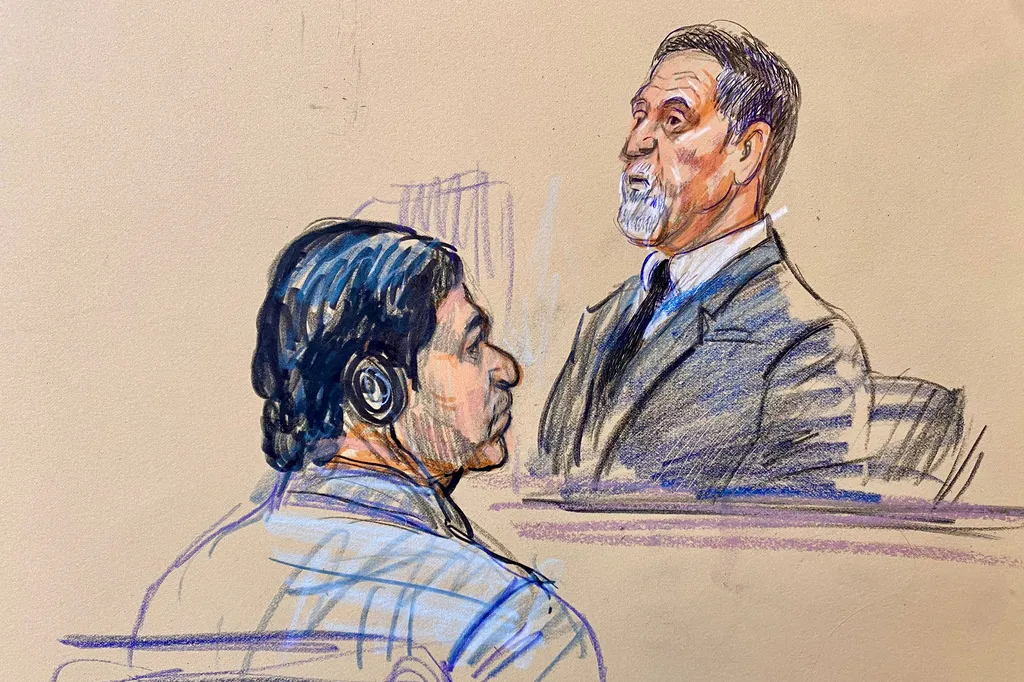
“He was brought here because the government believed he participated in the Abbey Gate attack, a theory which it was unable to prove at trial,” his attorneys wrote in a sentencing memorandum.
The defense also asked the court to consider the years Sharifullah spent in Afghan and Pakistani custody, as well as the continued detention of his wife and children.
Prosecutors urged the court to impose the maximum 20-year sentence, arguing that Sharifullah had participated in at least a dozen Islamic State group-K attacks between 2016 and 2025.
“From his teenage years, when he pledged an oath of allegiance to ISIS-K, Sharifullah’s carnage was driven by hate,” prosecutors wrote. “Hate towards Americans.
“Given the depravity of Sharifullah’s crimes, the tragic consequences suffered by the countless victims of his crimes, and the need to deter anyone who would think of supporting a foreign terrorist organization,” prosecutors argued that the maximum sentence was necessary.
The sentencing brought a measure of closure to the case, but for families of the 13 U.S. service members killed at Abbey Gate, it could not undo the loss of their loved ones.
Cheryl Rex, mother of one of the fallen soldiers, told the Washington Examiner she had followed the case but did not attend the sentencing, saying she did not believe Sharifullah’s sentence would provide justice for her son’s death. Her son, Lance Cpl. Dylan Merola, was one of the 13 U.S. service members who died at Abbey Gate. He was only 20.
“It took thousands of ISIS-K members and the Taliban to take over Afghanistan,” she said. “This one individual does not make me feel like there has been any justice or accountability for my son’s death. If he had been the conspirator for 13 lives, he should have been sent to life in prison, not just 20 years.”
Darin Hoover, the father of Staff Sgt. Darin Taylor Hoover attended Sharifullah’s April trial and said he was “upset” the jury did not find him responsible for the Abbey Gate bombing.
“He is just evil as evil can be,” Hoover said of Sharifullah in a statement to the Washington Examiner.
“He refused to say anything after we gave our impact statements, refused to look at us as we gave them,” Hoover said. “He was just a couple of feet from us as well. This fool doesn’t give a damn about anything he has done. It just doesn’t affect him at all.”
Mike Brest contributed to this report.