
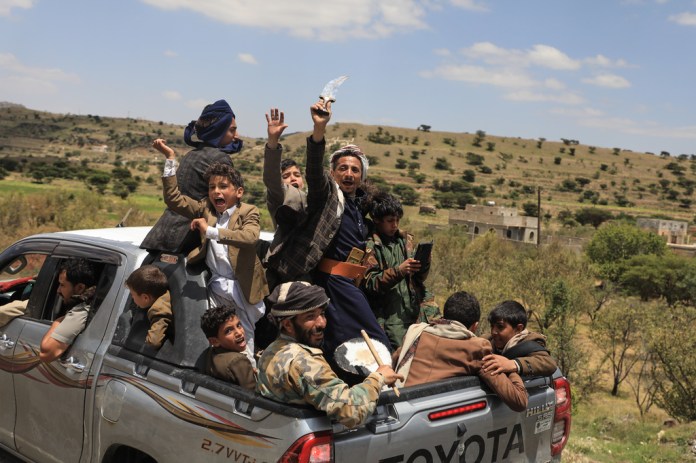
The Houthis continued their advance on Monday, seizing two more key islands in the Bab el-Mandeb Strait, as the Saudis continued their appeals to the United States for further assistance.
Saudi Crown Prince Mohammed bin Salman received U.S. Central Command head Adm. Brad Cooper in Jeddah, Saudi Arabia, according to the Saudi Press Agency. The details of the meeting weren’t disclosed, but it came on the tail of reports that Salman personally appealed to President Donald Trump for military help in halting the lightning Houthi offensive that seized Yemen’s Red Sea coast last week, an appeal that was denied. Nevertheless, the U.S. has provided extensive training, equipment, and intelligence support, the details of which were the likely subject of Monday’s meeting.
Salman appears to be looking for broader support to shore up the capabilities of the anti-Houthi coalition. While the Saudis are the crux of the alliance, they have repeatedly struggled against the battle-hardened Houthis. Despite years of reforms and a leadership shake-up that many hoped would turn around the fortunes of the force that had been humiliated in the last fight against the Houthis, from 2015 to 2022, the fiasco last week showed that much work remains to be done.
With direct U.S. support seemingly off the table, Salman is meeting with Egyptian President Abdel-Fattah el Sisi on Tuesday. Egypt is one of the largest and most capable members of the naval anti-Houthi coalition formed earlier in the summer, and could provide much-needed muscle to keep the Bab el-Mandeb Strait open.
The shock Houthi offensive and attacks on Saudi oil infrastructure continued to bear fruit in oil markets on Monday, with prices rising by over 4%. Brent crude rose to $105.66 per barrel Monday afternoon, and West Texas Intermediate rose to $101.28.
The brief shutdown of the East-West oil pipeline, which carries the largest amount of oil overland around the Strait of Hormuz, from an alleged Iraqi militia drone attack worsened Riyadh’s bad week. As of Monday, the pipeline is still offline, blocking 4 million-5 million barrels per day.
While the kingdom has intensified its efforts to diversify its economy over the past decade, under the ambitious de facto rule of Salman, it still relies on its oil wealth. Its vulnerability to Houthi attacks, along with the continued specter of attacks from Iran and its proxies, has put its oil industry at its most vulnerable point in modern history.
The U.S., focused on Iran directly, doesn’t look like it will change its mind on fighting the Houthis anytime soon. Michael Ratney, the former U.S. ambassador to Saudi Arabia, told the New York Times that this current bind is the Saudis’ “worst-case scenario.”
The Houthis haven’t shown signs of slowing down their offensive operations either. On Monday, they seized the islands of Greater and Lesser Hanish, right after government forces withdrew from the archipelago. This will further solidify their hold over Red Sea shipping.
The Saudis have been hit with much of the blame over the fiasco, as the internationally recognized Presidential Leadership Council is almost fully reliant on Riyadh for funding. After the Houthis seized the Red Sea coastline, reports emerged that many PLC units were only a fraction of their stated strength.
IRAN-BACKED HOUTHIS HAVE TAKEN OVER KEY ISLAND ALONG BAB EL-MANDEB STRAIT: YEMEN
The United Arab Emirates-aligned forces, the Southern Transitional Council, had been subsumed into the PLC after a brief fight between the two Arab powers in December and January. The STC was noted as far more effective than the PLC, and some analysts contended that the Saudi takeover left the area vulnerable.
Saudi Arabia has attempted to counterattack over the past few days, launching hundreds of airstrikes against Houthi forces. The Houthis said they responded on Monday with dozens of missiles and drones targeting a Saudi military air base in Khamis Mushait, which they claim hit hangers, radars, runways, and ammunition depots.