
The young man holding an electric guitar on stage at the Cedar Point amusement park in Ohio earlier this summer looked briefly thoughtful. “Well, I’ve played some of my originals,” he said, “and I thank you for the response, but we have a big crowd here right now, so let’s do something that you all know.” What followed wasn’t a golden oldie from the songbook of George Strait, Johnny Cash, or even Garth Brooks, but a dead-simple two-chord trotter of a tune that lived somewhere in the arid desert between country and rap. “I just wanna be her so bad, it hurts so bad, it hurts so bad,” he sang, and the crowd of a few dozen tired park-goers mumbled along in perfect time.
Be who, exactly? Take a look at the top of the Billboard Hot 100 to find out. Ella Langley and her signature song “Choosin’ Texas” have been at the No. 1 spot for 20 weeks this year. That makes it the second-highest-performing run in the chart’s history, just barely bested by Mariah Carey’s perennial holiday favorite, “All I Want For Christmas Is You.” Dandelion, Langley’s April 2026 sophomore release, has already gone platinum on the strength of “Choosin’ Texas” and its follow-up single, “Be Her” — the song the singer at Cedar Point was performing.
Langley is a frequent collaborator in duets with artists as diverse as country controversialist Morgan Wallen and 470-pound rapper BigXthaPlug. She has nearly 5 million followers on Instagram and about 33 million listeners on Spotify. Nor is her ubiquity limited to music: Langley appears in multiple advertisements for the Chase Sapphire Reserve credit card, and is the anointed successor to Sydney Sweeney as the face of American Eagle denim. In the space of just three years, she has become so universally famous that Grammy-winning rapper Doja Cat recently made headlines for not being able to identify “Choosin’ Texas” during a podcast. “This is not my vibe,” Doja Cat stated, before adding that Langley had “a very pretty voice.”
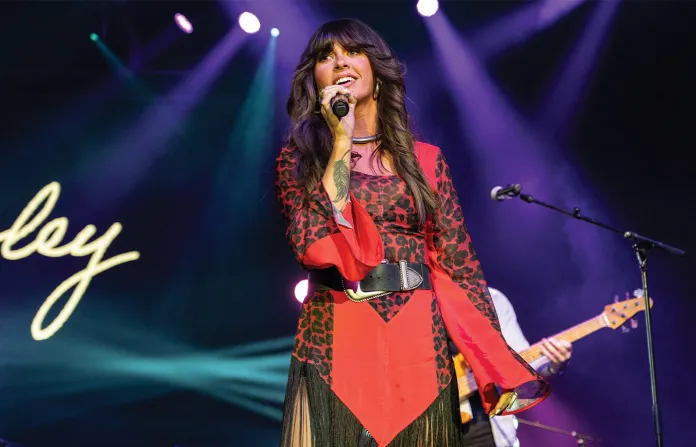
Country music has long been rife with will-to-power types, from Shania Twain to the late Toby Keith, but Langley’s utter professionalism probably resets the bar in this regard. She will not admit to a romantic partner, perceiving (correctly, probably) that it would limit her male-audience appeal to be obviously partnered. She stays almost impossibly thin, fit, and permanently made-up to the point that she has become the subject of innumerable plastic-surgery rumors. (A bit of Botox is the most she will admit, at the moment.) Her approach to making music is more Sheryl Crow or Steely Dan than Willie Nelson. “Choosin’ Texas” was workshopped via an intentional songwriting retreat and boasts, as credited co-writers, Nashville Star veteran Miranda Lambert, along with two other studio professionals. Dandelion opens with a 23-second cornpone rendition of the old folk song “Froggy Went a-Courtin’” for seemingly no other reason than to add some weight to a much-distributed claim that she learned the tune at her late grandfather’s knee before inheriting his guitar and becoming immediately worthy of it, like some homeschooled-in-Alabama version of King Arthur pulling Excalibur from the stone.
Langley’s rise to prominence has been accompanied by accusations of being “MAGA” or conservative, on fairly thin evidence: She followed Charlie Kirk on social media, and she has been willing to play music with “Trump-coded” artists such as Wallen. And, at the end of July, political commentator Matt Walsh praised “Choosin’ Texas” as “an anti-girlboss anthem.” Langley herself, as you might expect, is unwilling to alienate a major part of her audience in any direction. A Facebook post showed her wearing a shirt with a three-item checklist of “Democrat,” “Republican,” and “Country Music,” with only the last of those checked off. To paraphrase Michael Jordan: Democrats buy country music, too.
Surely they are buying plenty of what Dandelion has to offer, in part because the songwriting and production are a deliberate throwback to an era before country music became an explicitly conservative pastime. It sounds like an old record, and indeed it’s jarring to be in a bar when “Be Her” or “Bottom of Your Boots” plays between two examples of the mechanized drum-machine-and-exaggerated-twang stuff known, colloquially, as “hick-hop.” Langley might appear on duets with modern singers and rappers, but on her home turf, she stays far closer to the paths worn smooth by The Judds or even Patsy Cline. The phrase “neo-trad” appears occasionally in reviews of Langley’s work, and you can see why: Whatever the future or even the present of mainstream country music might be, Dandelion wants no part of it.
It would be a mistake to think that any part of Dandelion has not been polished to a fare-thee-well. There are 31 studio collaborators listed in the credits. This relentless attention to detail ensures that Dandelion shimmers in hi-fi while also — far more crucially, in the modern era — fading effortlessly into background noise for a session at the gym or a long night of remote work. You get a full hour of music, a value-packed tradition Langley started when she rereleased her 14-song debut album Hungover into the 19-song Still Hungover.
There’s something about the lyrics that sometimes feels just plain exploitative. “Choosin’ Texas,” for example, name-checks Hank Williams, George Strait, Abilene, Amarillo, the Smoky Mountains, Memphis, and Interstate 40, all in the space of under four minutes, introduced by a riff that is perhaps too reminiscent of the music discussed inside the text. The very existence of “Choosin’ Texas” seems like a boardroom-born decision to market the album directly to the several million people who have, ahem, chosen Texas since the beginning of the pandemic.
DOLLY PARTON: TRIBUTE TO AN AMERICAN ICON
Still, if Dandelion comes off as being a bit of a manufactured product, that shouldn’t weigh too heavily against it. Just about any album that has more deliberate forethought in it than Miles Davis and his group put into his last four Prestige records — “I’ll play it and tell you what it is later,” he rasps into the mic before starting “If I Were A Bell” for the opener of Relaxin’ with The Miles Davis Quintet — is a bit of a manufactured product. What matters more is how well the product is, in fact, manufactured. In the case of Dandelion, it’s manufactured very well, from the heartfelt-sounding sorrow of “Last Call for Us” to the Phil Spector swell of “Low Lights.” This is a great new record that sounds like the great old record it will eventually become.
Questioned after the fact about his decision to play Ella’s tune, that young guitarist at the amusement park was first abashed, then forthright. “She’s on top of the world, you know? And people know the music, they love the music. It’s an inspiration to people like me who are trying to do what she did, to take momentum from local performances and go national someday. You know, when you think about her success, you just want …” And he fell silent before the obvious completion: You just want to be her so bad.
Jack Baruth was born in Brooklyn, New York, and lives in Ohio. He is a pro-am race car driver, a former columnist for Road and Track and Hagerty magazines, and writer of the Avoidable Contact Forever newsletter.