
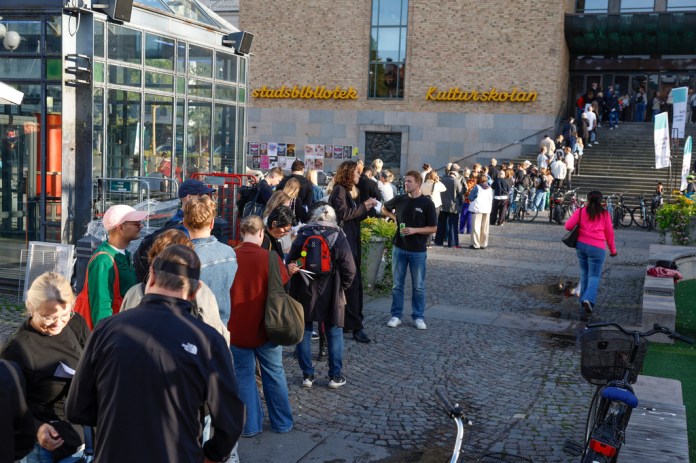
Swedish voters are already lining up to cast their early ballots for this Sunday’s election as the right-wing government prays their deal with an insurgent party could keep them in power as the left’s coalition bickers ahead of a possible victory.
Prime Minister Ulf Kristersson, who was elected to lead Sweden in the 2022 election with his Moderate Party, has cobbled together a four-party coalition with a Trumpian platform to “Make Sweden Great Again.” It consists of his own Moderate Party, the Christian Democrats, the Liberals, and the hard-right Sweden Democrats. The latter was once considered an unsavory, outsider party by the mainstream but has ballooned in support to be the largest force of the right-wing and the nation’s second-largest party.
If the government holds onto its mandate, the Moderate leader will stay as head of government and has promised that the Sweden Democrats will finally be given ministerial positions befitting their party’s influence.
“There’s nothing dramatic in that,” the prime minister said on Friday. “Everybody can see that we have been cooperating successfully for the last four years.”

Kristersson and his allies are facing off against a left-wing coalition that is seeking to reinstall his Social Democrat predecessor, Magdalena Andersson. Andersson’s backing is made up of the Social Democrats, the Centre Party, the Left Party, and the Green Party.
The Social Democrats are the largest political party in the country and have been in office for the majority of years since the end of World War II. The left-wing coalition has for weeks enjoyed a strong lead in voter intention polls, but recent surveys show the race has rapidly become much tighter than expected.
The Social Democrats are currently polling in first at 28%, supported by the Left Party, Centre Party, and Green Party, which are polling at approximately 8% each.
The Sweden Democrats are polling in second place at 19% and are joined by the Moderate Party in third place at 17%. The Christian Democrats and Liberals round out the right-wing parties at 7% and 5% respectively.
Andersson dismissed the tightening race as an expected development, telling broadcaster SVT on Friday that “the bloc differences will decrease as we approach election day, I have predicted that for a long time.”
Sweden Democrats have run a highly successful campaign with a platform focusing on nationalist priorities such as safety, promotion of native culture, and aggressive restrictions on immigration. Their rise has been compared to similar populist movements such as the Alternative for Germany and France’s National Rally.
“We who live here have the right to feel at home and to live ordinary Swedish lives without serious crime, forced mixing and political cronyism,” the party says in its official platform. “We want to build a Sweden where Swedish culture, the Swedish language and the Swedish community are at the center. Anti-Swedishness should never be excused or minimized.”
Kristersson’s four-year term has been defined by Sweden’s entry into the NATO alliance, historically low levels of immigration, and a nationwide crackdown on organized crime and gang violence.
His coalition’s ascent marked a massive rightward leap for famously progressive Sweden, which was among the European nations that most enthusiastically embraced the mass migration policies of the 2010s.
Meanwhile, the Social Democrats are portraying Andersson as a quiet and bookish technocrat who can offer stability and a positive image for Sweden after four years of uncharacteristically right-wing politics. They are characterizing their opponents’ nationalist policies as divisive and counterproductive.
The problem facing the left-wing coalition is its lack of unity or shared vision.
“The Greens and the Left would push for a less restrictive migration policy than the Social Democrats are ready to accept, having themselves tightened asylum rules when they were in power,” according to the European Council on Foreign Relations. “For its part, the Centre Party would press for deregulation and other market liberal reforms Swedish business wants—against the trade unions as well as the Greens and the Left.”
This discord could compromise the alliance even if the right-wing is outvoted. Several constituent parties are opposed to one another’s participating in a future government on the grounds of conflicting values on issues such as immigration and the economy.
“The Center Party backs Andersson as the most likely candidate for prime minister, opening a path for cooperation across Sweden’s traditional blocs,” according to a report this week from the Atlantic Council. “However, it rules out a government that includes the Left Party and opposes giving either the Left Party or the Sweden Democrats decisive influence over key policy areas. The Left Party, in turn, has declared that it will vote against any government in which it is not represented.”
Early voting in the election is already underway, with the majority of Swedes going to the polls on election day this Sunday.