
In 1997, German electronic music artist Christoph De Babalon released an angry, clanking album dubbed If You’re Into It, I’m Out Of It. It sometimes seems as if that moniker is the best, most concise way of describing the current era’s partisan politics.
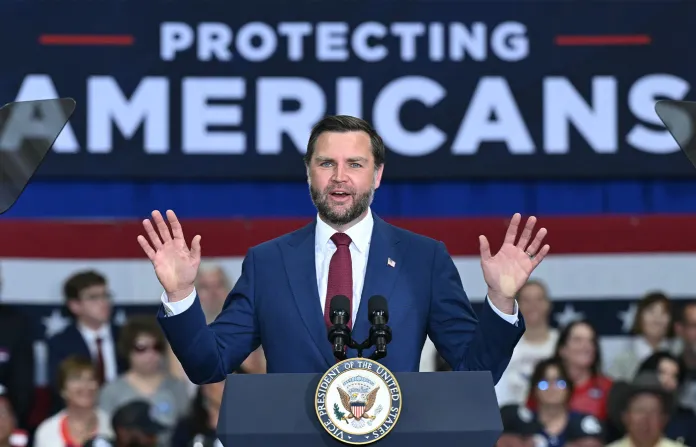
It’s a situation embodied by protectionist President Donald Trump. And Vice President JD Vance, who, in advance of a likely 2028 presidential bid, is increasingly breaking from traditional Reagan-style free-market orthodoxy in favor of using state power to achieve conservative and populist goals.
A poll conducted by the Argument in July revealed something striking: Democrats favorable to the Democratic Socialists of America were more strongly supportive of free trade than Republicans. And it wasn’t even close: 54% to the GOP’s 25%. Include “somewhat supportive,” and the gap is made less dramatic — 85% vs. 65%. But the data are illustrative of a curious switcheroo in partisan attitudes toward the free movement of goods destined for retail consumption across borders.
The 1999 “Battle of Seattle,” which saw left-wing anti-globalization (but perhaps not “anti-globalist,” a term then acceptable but which would now repel the Left) protesters in the Evergreen State clash with police over the World Trade Organization’s alleged facilitation of corporate outsourcing, environmental degradation, the McDonald’s-ization of the world, and more.
Then, tariffs were thought to be a necessary measure for protecting local producers, contrary to the Republican preference for free markets and low-to-no import taxes. It’s a far cry from today, when the DSA balks at the imposition of tariffs and makes roughly the same claim “neoliberal” economists were asserting at the turn of the century: that tariffs made everyday goods more expensive for working Americans.
“As a DSA guy I’ve been negatively polarized into supporting free trade,” wrote DSA organizer Cole Sandick on X in August. “Protectionism enriches companies far more than workers.”
Half a decade after the raucous WTO proceedings that launched the millennium, progressive (or rather “liberal,” at the time) sentiment on trade still hadn’t budged: it remained skeptical of its benefits. When 2004 Democratic presidential aspirant John Kerry accused corporate America of harboring “Benedict Arnold CEOs,” his anti-outsourcing perspective was informed by patriotism: He thought their behavior was tantamount to treason!
Fellow Democratic would-be president Howard Dean likewise complained of the “hemorrhaging” of manufacturing jobs in the Midwest due to unrestrained globalization. It was conservatives who replied with long-standing economic arguments for comparative advantage and the subsequent rising of all boats — even if unequally at any given point in time — due to globalization’s generally ascendant material tides. This is an almost total 180 from the current Republican emphasis on relative status among major geopolitical players: China’s rise is necessarily America’s descent.
It’s difficult to square the increasing Left emphasis on American borderlessness with maintaining an imposition on the movement of goods, services, and financial flows. But there’s an attempt at approximating an alignment of the two currently underway with a new generation of progressives who are repudiating the anti-consumption, anti-globalization attitude of their millennial and Generation X elders.
Conversely, conservatives are now sounding like an issue of Adbusters in the aughts, disparaging economic growth as a mere fixation on petty stock market performance, to the detriment of more communitarian sentiments. (Just as prior left-wing movements blamed murder and mayhem in Detroit as the result of Friedmanite consumer-first, as opposed to worker-first, policies.)
In 2026, the DSA is lambasting Republican “health fascism” and the trendy fixation on getting in shape among young men on the Right. The freedom to eat what you want — formerly a right-libertarian hobby horse as evidenced in criticism of former first lady Michelle Obama and businessman Michael Bloomberg’s healthy eating initiatives in the 2010s — is now the preserve of those who’d push back on the “body-shaming” implicit in taking the gym or diet seriously.
Keeping the mask on remains imperative, however, even if beneath it lies labored breathing born of obesity.
Back to the Right, Vance-supporting professor Patrick Deneen has bemoaned what he believes to be an overly individualistic society too beholden to merely consensual, voluntary efforts in the marketplace and civil society. Or in other words, too classically liberal.
“If we listen to JD Vance when he was senator, he was pro-union and anti-monopoly; that’s remarkable,” said Deneen at a conference earlier this year, where he praised the Heritage Foundation. “Restraining the libertarianism of the marketplace and correcting the libertarianism of the social sphere is where the ‘New Right’ is.”
You can see traces of traditional Republican and Democratic concerns remaining even within this seeming transference of sentiment on trade and labor. Republicans focus on relatively masculine unions such as electrical workers and dock workers, as opposed to the Democrat-friendly Service Employees International Union. And where free trade is supported by progressives, partly as Trumpian pushback, it’s couched in terms of repairing relations with allies such as Canada, a country more congenial to the American blue tribe since time immemorial.
OPINION: DEMOCRATS SUBSIDIZE IDLENESS. REPUBLICANS REWARD HARD WORK
This is not to say the United States is now just as free-market-oriented as it’s ever been, only that the two major parties have flipped. We’re in a populist moment, and thinking in terms of what’s good for an apolitical consumer-citizen is increasingly out of fashion on every side. But the American Right’s particular form of pro-globalization, as exemplified by pro-trade sentiment, is losing status at the same time the American Left’s affirmation of globalization gains steam. For the latter, the emphasis has moved from support for overseas self-determination and domestic industrial protection to support for those overseas who are determined to come to America, and a lackadaisical attitude at best toward domestic factory work. Seeing as the Left is increasingly comprised of frustrated, college-educated knowledge workers, this tracks.
If “individualist Right” and “collectivist Left” are the ideological starter packs, the booster packs are rendering everything questionably collectible.
Dain Fitzgerald (@DainFitzgerald) is a writer and “podtuber” in Diamond Springs, California, in the beautiful Gold Country of El Dorado County. His Substack is @mupetblast.