
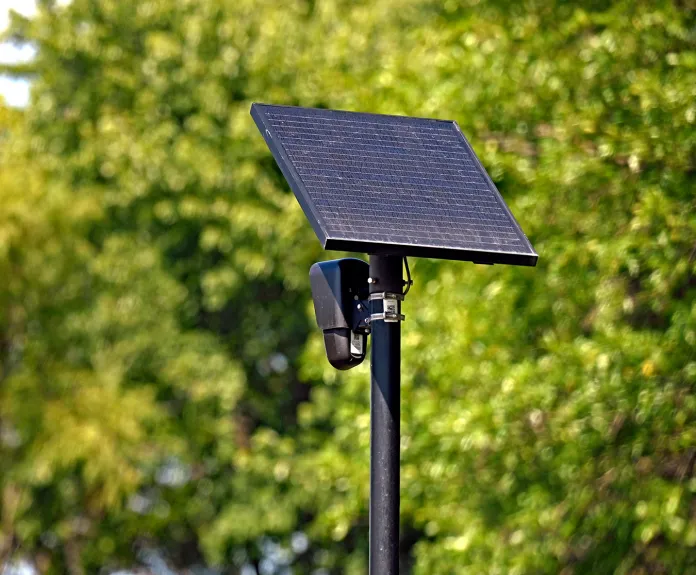
Rep. John James (R-MI) is defending Flock cameras, the automated license plate-reading devices that face nationwide backlash over concerns about privacy violations, police misconduct, and false-positive errors that have led to wrongful traffic stops.
But James, the Michigan Republican gubernatorial nominee, says that their use needs guardrails to protect privacy. “Balance is the key,” as the issue becomes a flashpoint in the 2026 elections, James told the Washington Examiner earlier this month.
“Our Bill of Rights, our Fourth Amendment, our right to privacy is nonnegotiable,” James said. “But we also need to make sure that we are working within the Constitution to keep innocent people safe and put bad actors away.”
Misuse of the cameras, which have quickly proliferated as tools for state and local law enforcement, has drawn nationwide criticism and raised questions about whether 24/7 monitoring of license plates is constitutional in the first place.
Several bills have been proposed in the Michigan statehouse that would limit data retention and who can access it, but some communities are scrapping the cameras altogether. Across the country, a growing number of candidates for governor have followed suit or promised to do so.
In Pennsylvania, both Gov. Josh Shapiro (D-PA) and his Republican opponent support a ban on Flock cameras. Gov. Greg Abbott (R-TX) recently blocked state agencies from spending money on them.
James’s view puts him closer to Vivek Ramaswamy, the Republican candidate for governor in Ohio, and his Democratic challenger, Dr. Amy Acton. Both have expressed concern over the possibility of abuse without calling for a ban.
“Again, the Bill of Rights and our right to privacy is nonnegotiable, and I’ll be doing everything that I can to protect the privacy of Michiganders and also enforce the law,” James said on Wednesday, fielding the question in a press call organized to express support for the education freedom tax credit.
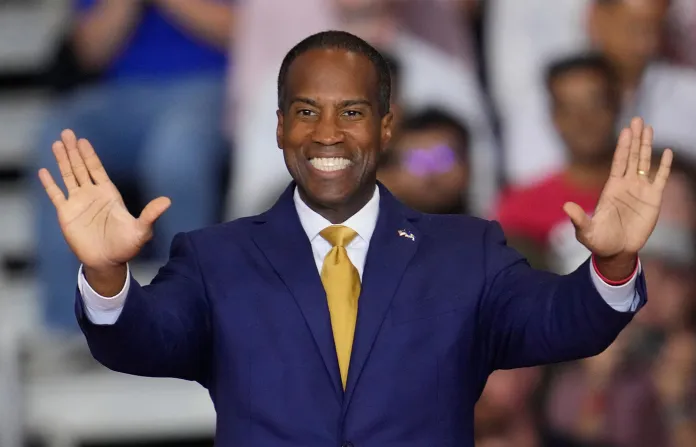
James, 45, was first elected to a Macomb County-based House district in 2022. Before entering the political fray, he was fabulously successful in military service and business. He graduated from West Point in 2004 and served eight years in the Army, participating in multiple tours of duty in Operation Iraqi Freedom as an AH-64 Apache pilot.
James received a master’s degree in supply chain management from Penn State University’s business school and an MBA from the University of Michigan. He then worked for a global supply chain management service company.
His political career has had more ups and downs. He lost Senate races in 2018 and 2020 but rebounded to win the House seat he’s now relinquishing in another bid for statewide office.
The Michigan Democratic gubernatorial nominee, Secretary of State Jocelyn Benson, brings a legal and academic background to the Flock camera debate, particularly its implications for encroachment on privacy and civil liberties.
Benson, 48, is a Harvard Law School graduate who was dean of Detroit’s Wayne State University Law School from 2012 to 2016. After winning Michigan’s top elections and administrative post two years later, in the midst of President Donald Trump’s first, nonconsecutive term, she became a prominent Resistance figure of sorts. She made regular appearances on MS Now (then MSNBC) and other national media outlets. That set her up in Michigan to win reelection in 2022, before easily claiming the 2026 Democratic gubernatorial nomination in a bid to succeed Gov. Gretchen Whitmer (D-MI), who is retiring due to state term limits.
When asked for her view on Flock cameras, Benson said in a statement shared by her campaign that she would work with the Michigan legislature if elected to “pass clear rules for how these cameras are used, who can access the data, when it can be shared, and when it must be deleted.”
JOSH SHAPIRO CHALLENGER SUPPORTS BAN ON FLOCK CAMERAS IN PENNSYLVANIA: ‘INVASION OF PRIVACY’
“We can protect public safety and personal privacy when government is transparent about how it uses technology and accountable for the power it has,” Benson said.
Flock cameras join data centers as a hot-button issue in the midterm elections and represent one of the few areas of bipartisan common ground in Lansing and Washington. Both James and Benson support a temporary moratorium on data center construction.
David Sivak (@DISivak) is Congress and campaigns editor at the Washington Examiner.