
HARDEEVILLE, South Carolina — Gov. Gavin Newsom (D-CA) is returning to South Carolina on Thursday with something to offer and something to gain.
The governor, who is term-limited at the end of the year and widely expected to launch a 2028 presidential campaign, begins a three-day swing through South Carolina and North Carolina. The trip marks his latest visit to the Palmetto State and gives him another opportunity to introduce himself to voters in one of the Democratic Party’s most important presidential primary states.
For South Carolina Democrats, Newsom’s visit offers something more immediate. It gives them attention, volunteers, and energy for state legislative races as the party attempts to field candidates in every House district for the first time in decades.
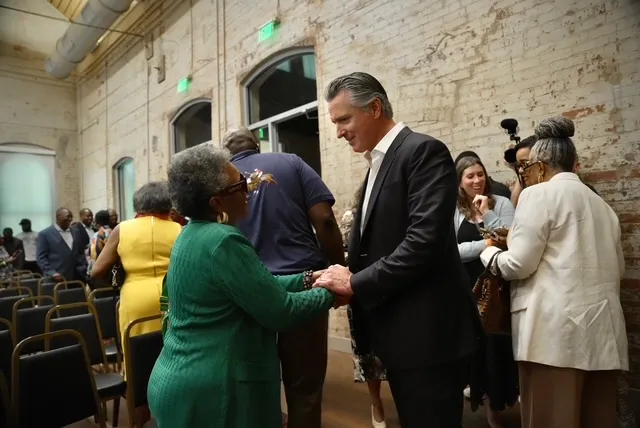
Republicans, however, are using Newsom’s visit to draw a contrast between California and South Carolina. Drew McKissick, chairman of the South Carolina Republican Party, told the Washington Examiner that the governor’s presidential ambitions would not make his record more appealing to voters in the state.
“Gavin Newsom can come to South Carolina as often as he likes, but changing the scenery doesn’t change his failed, liberal record,” McKissick said. “Californians have been leaving a state defined by high costs, high taxes, and liberal government, while people and businesses continue moving to South Carolina. He’s welcome to come and try the barbecue, but voters here aren’t buying what he’s selling.”
Jay Parmley, executive director of the South Carolina Democratic Party, disagrees. He told the Washington Examiner that Newsom’s visit reflects a two-track strategy as possible 2028 presidential candidates begin making their way through the state.
Newsom has already visited South Carolina three times.
The trip to the first presidential primary state on the Democratic nominating calendar comes days after California lawmakers conclude their final legislative session under Newsom. He will travel through more than 10 counties, including six in South Carolina that President Donald Trump carried in 2024, meeting with voters and local leaders while campaigning for Democrats in competitive state House races.
This week’s swing, Parmley said, will let the California governor further familiarize himself with the state’s voters while helping Democrats expand their outreach to rural communities and compete in Republican-held territory.
Even though Newsom and other possible Democratic presidential contenders, including Gov. Andy Beshear (D-KY) and Gov. Wes Moore (D-MD), have not announced campaigns, Parmley said there is little mystery about why they are spending time in South Carolina.
“They are all good governors on the cusp of running for president,” Parmley said.
The party expects more possible candidates to begin arriving in the coming months.
“I think there’s a couple others that may come in October,” Parmley said. “I don’t know if we’ll get many in November, December, but I think in January they’ll start trickling back. They will be running back.”
For the South Carolina Democratic Party, however, the visits are about more than giving possible presidential candidates an early introduction to voters.
“Right now, sort of everything,” Parmley said when asked what the party gets out of hosting Newsom. “We’re roughly 60 days here before a critical election. It brings attention.”
Because the possible contenders have not yet declared their presidential campaigns, Parmley said the party views them as surrogates and is asking them to use their appearances to draw attention to competitive races across the state.
“With Governor Newsom, we asked him very specifically to go to counties that have really important state legislative races,” Parmley said.
The visits generate excitement while giving Democrats an opportunity to strengthen volunteer operations in communities where the party is trying to make gains.
“It brings a lot of Democrats and some other people together to hear him,” Parmley said. “It also gives us an opportunity to reinforce our volunteer effort on the ground in each of these places, and it brings attention to races in South Carolina.”
Parmley said Newsom’s trip follows the same formula Democrats have used with Sen. Cory Booker (D-NJ), former Chicago Mayor Rahm Emanuel, and Moore.
“It does two things,” he said. “It helps us introduce these potential candidates to South Carolina in very different places, and it also helps us strengthen our grassroots efforts on the ground in these elections.”
That strategy is particularly evident in Beaufort County and the surrounding Lowcountry, where Democrats see an opportunity to grow their share of the vote in several state House districts.
Among the candidates are Korey Williams in state House District 122, Ann Shippy in District 123, and Shauna Bishop in District 124. The districts are not equally favorable to Democrats, Parmley acknowledged, but he said the region is changing.
“Some of those districts are more Democratic than others, but these are growing Democratic areas,” he said.
The stakes extend beyond individual legislative races. Growing the Democratic vote in the Lowcountry, Parmley said, could eventually help the party in statewide contests and in South Carolina’s 1st Congressional District.
“It’s sort of an opportunity to take Governor Newsom into the most localized races we have, which are state House races, and him get a feel of those communities and those communities energized because of his visit,” he said.
For Democrats, the larger objective this year is simple: Give voters a choice.
Parmley said the party has candidates running in all 124 state House districts, which he said is the first time in roughly 50 years Democrats have fielded a candidate in every district.
“In some places, they’ve not even had a choice,” Parmley said. “We don’t really know how voters feel in that county because they have one person on the general election ballot.”
NEWSOM BREAKS WITH USUAL TRUMP CRITICISM TO TOUT TRUMP ACCOUNTS
After decades of Republican control, Parmley said voters dissatisfied with the state’s direction now have an alternative.
“If you like the way things are — for 30 years Republicans have had total control in South Carolina — if you like that, you’re probably going to stick with them,” Parmley said. “But if you think we can do better on any front, there is a choice that you can make at the ballot box.”
The strategy doesn’t necessarily depend on persuading large numbers of Republican voters to switch parties. In many places, Parmley said, the challenge is convincing Democratic voters that their vote can matter.