
The FBI under the Biden administration took “minimal corrective action” after its Richmond office targeted traditional Catholics as possible extremists, defending the employees behind the scandal, giving them positive performance reviews, and continuing work on a revised memo after headquarters pulled the original product amid backlash, according to a new Justice Department report.
The DOJ’s 210-page Richmond Domain Perspective report, released Friday by the Trump administration‘s Weaponization Working Group, featured never-before-seen details charting the FBI’s extensive attempts to force a link between “domestic violent extremists” and Catholics. Trump administration officials described the episode as a “grave failure” by the Richmond Field Office to uphold First Amendment rights, while officials during the Biden era quietly praised staff handling the investigation.
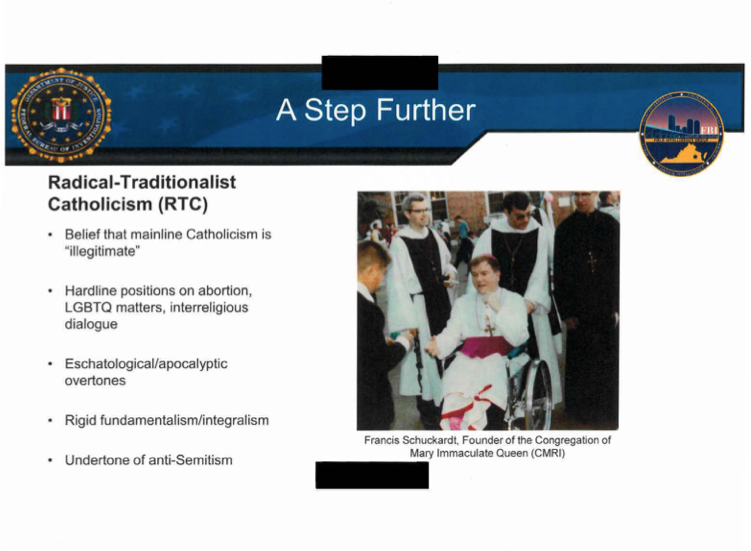
The report details how the bureau built a theory about “radical-traditionalist Catholics” from three cases, including one involving a deceased person, despite failing to find a broader link between Catholics and domestic extremism. It then documents the Richmond office’s response after the memo leaked in February 2023, which describes the FBI’s efforts to protect the officials who drafted it and preserve their work.
How one violent suspect became an FBI theory about Catholics
The case that inspired the theory behind the memo involved a man identified as Target 1, whom the FBI had investigated since 2020 for violent, racist, and anti-government posts. Authorities found Molotov cocktails, weapons components, ammunition, and a target list at his Virginia residence in November 2022. He was later sentenced to more than eight years in federal prison for possessing destructive devices.
In 2022, the man began attending several catechism classes at Our Lady of Fatima Chapel in Richmond, a chapel affiliated with the Society of St. Pius X. The chapel’s priest told the FBI that the man was not a church member, was not Catholic, and had never been to confession.
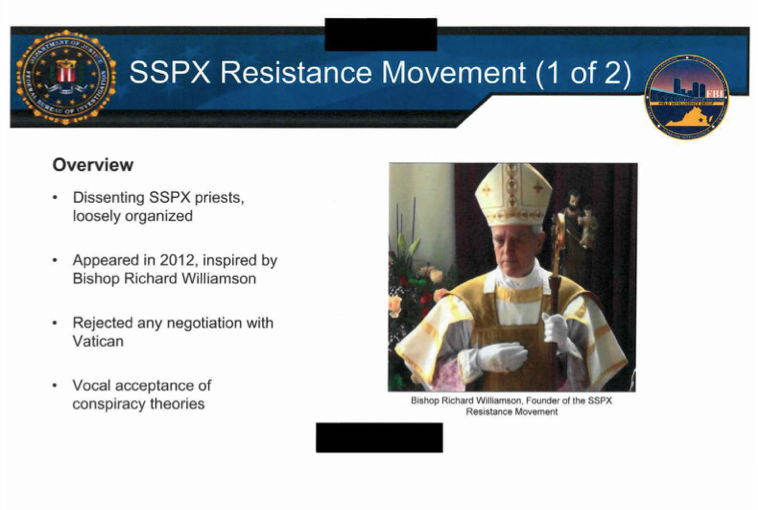
The priest said the man had “crazy views about race” and war and that his beliefs “definitely need[ed] to be modified before he c[ould] join the church.”
The FBI nevertheless used the case as the basis for a wider intelligence project on an alleged “increasing intersection” between “rad-trad Catholics” and domestic extremists.
Analysts with the Richmond office searched FBI databases for additional examples in late 2022. They found only two: a deceased subject in Portland, Oregon, whose supposed connection to traditional Catholicism came from an Anti-Defamation League dossier, and a subject in Milwaukee.
The Justice Department report said the research uncovered “nothing linking Catholics or groups not in full communion with the Catholic Church to domestic extremism.”
Still, the Richmond office pressed forward.
An internal FBI presentation titled “Traditionalist Catholicism Overview” treated support for the Traditional Latin Mass and “conservative family values/roles” as elements of a supposed core ideology. The presentation described traditionalist Catholicism as “comparable to Islamist ideology.”
The materials also tied an alleged extremist outlook to religious and political views, including opposition to Vatican II, abortion, immigration, affirmative action, and LGBT issues.
When the memo was circulated for review in January 2023, no reviewer raised constitutional concerns, according to the report. The Richmond Field Office’s chief lawyer concluded there were no problems if the product remained internal.
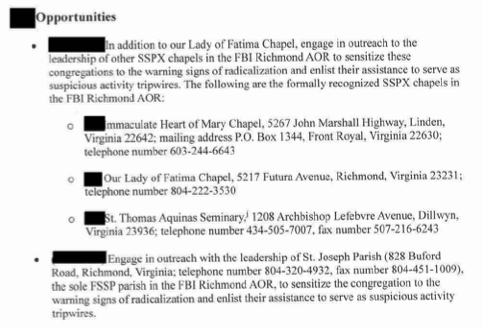
The final memo was issued internally on Jan. 23, 2023. It proposed outreach to traditional Catholic parishes and suggested church leaders could serve as “opportunities” to be “tripwires,” or sources of suspicious-activity information, while listing four separate churches beneath that passage for possible investigative targets.
Richmond analysts also sought to turn their local product into a Strategic Perspective: Executive Analytic Report, a higher-level report intended for senior FBI leaders. An FBI headquarters analyst said she was “really interested” in the alleged resurgence of extremist interest in the Catholic Church, according to a 2024 inspector general review.
FBI reviews found no broad extremist link
The memo leaked on Feb. 8, 2023, and quickly sparked a backlash. Shortly after, the FBI Counterterrorism Division concluded that it saw no “significant linkage” between racially motivated violent extremists and the ideology described in the memo that would justify further FBI interest, analysis, or intelligence collection.
An internal tradecraft review likewise found that the memo effectively asserted “radical-traditionalist Catholic” ideology was violent and extremist without offering any evidence. It found the authors had not established a baseline for their claim that extremists were increasingly interested in Catholic traditionalism.
FBI headquarters ordered the memo removed from bureau systems. On Feb. 10, an FBI lawyer working on the removal told colleagues, “The 7th Floor is breathing down my neck on this one,” according to the newly-released documents.
Richmond staff kept working after memo was pulled
The withdrawal did not end the Richmond office’s effort to preserve the work.
On March 17, 2023, one of the memo’s drafters wrote, “I spent today tinkering with the DP,” using the abbreviation for Domain Perspective. The analyst said he had softened disputed language, changed the analytical line, added a substantiation point, and considered further sourcing.
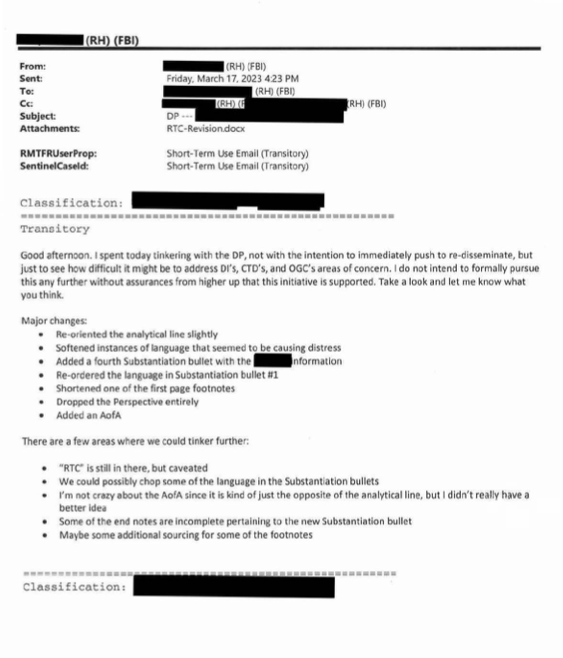
The analyst wrote that he would not formally pursue a revised product without assurances from higher-ranking officials that the initiative remained supported.
The FBI Inspection Division later found that the people who drafted, reviewed, and approved the memo had failed to follow FBI standards and displayed poor professional judgment. It directed that the employees be formally admonished, receive additional training, and face heightened approval requirements for sensitive intelligence products.
Positive reviews followed formal admonishments
Richmond leadership, however, defended them behind the scenes.
At a July 7, 2023, staff meeting, the office’s assistant special agent in charge said, “There are no inconsistent performers in this room,” according to notes released by the Justice Department.
The Richmond special agent in charge apologized to the employees involved. When one analyst wrote that she was “terribly sorry” for what colleagues had endured because of the memo, the special agent in charge replied, “No apology needed.”
“Keep that head up, this too shall pass,” the official wrote. “Will make for a great chapter in your memoirs some day!”
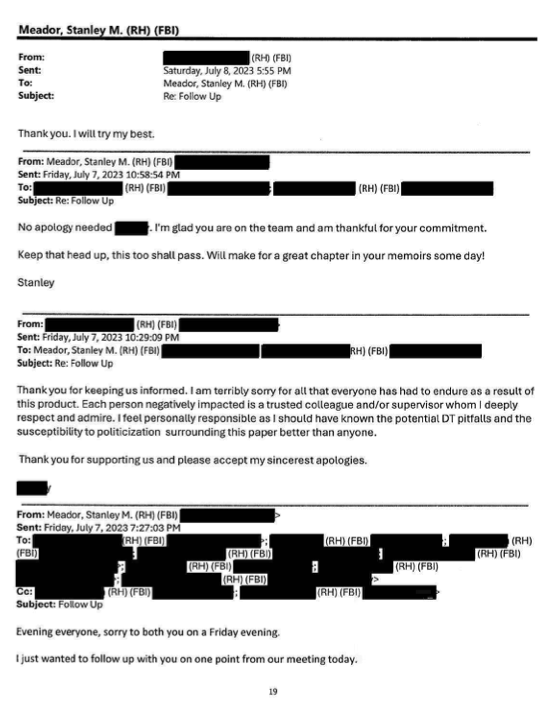
At a July 27 all-employee meeting, Richmond leaders said the people behind the memo “didn’t deserve this.” The office also arranged employee-assistance counseling for its staff and their families after congressional attention on the memo.
By the end of fiscal 2023, employees heavily involved in creating, reviewing, and approving the memo received positive ratings ranging from “Exemplary” to “Consistent,” according to the report released this week.
Wray FBI leaned on ‘no malicious intent’ finding
That internal response matters because the bureau, under former Director Christopher Wray, relied heavily on the finding that “no evidence of malicious intent” had been proven.
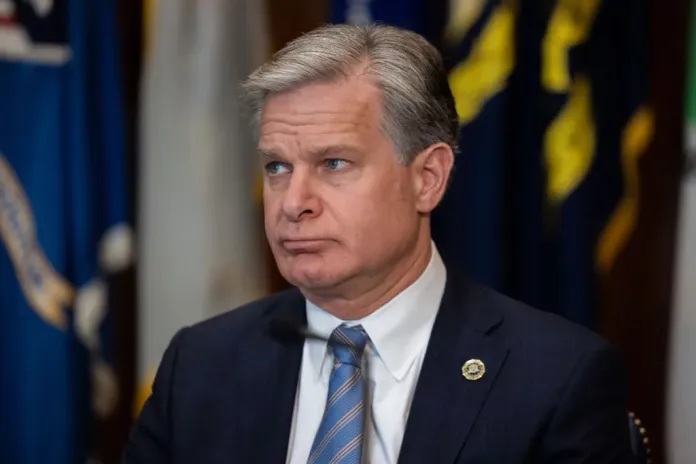
Notably, in April 2024, the New York Times reported that the DOJ inspector general attempted to downplay the bureau’s grave error by sugarcoating its impact in its report. The IG report found that the memo lacked support, improperly conflated religious beliefs with violent extremist activity, and created the appearance that the FBI had used religious affiliation as a basis for investigative work. But the inspector general also found no evidence of malicious intent or an improper purpose.
The FBI said at the time that the inspector general’s conclusion aligned with its own review and maintained it had not intended to investigate Catholics based on religion.
The new report shows how the bureau under Wray handled the scandal during his tenure by publicly disavowing the memo while Richmond leadership defended the people responsible and treated them as employees in good standing.
Trump DOJ says personnel have since been removed
The report says the employees involved in the memo’s production have since been terminated. It does not identify them or give dates for their removals.
Attorney General Todd Blanche said the report showed why the Trump administration would continue examining alleged weaponization of law enforcement against conservatives during the Biden years.
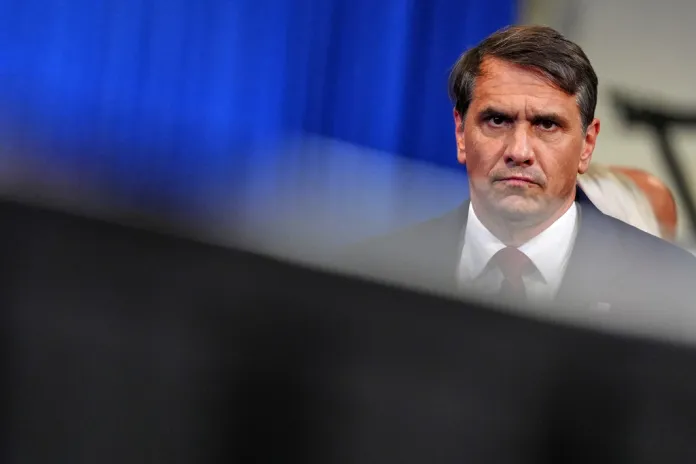
“This Department of Justice will not tolerate a weaponized bureaucracy that chills First Amendment activity,” Blanche said in the Justice Department’s release. “The individuals who developed the Richmond Domain Perspective are no longer with the Department, and our Working Group’s efforts to investigate weaponization under the previous Administration will continue.”
CHINESE HACKERS TARGETED NASA, SENATE, FEDERAL RESERVE, AND OTHERS, JUSTICE DEPARTMENT SAYS
FBI Director Kash Patel called the memo “unacceptable” and said releasing records was part of the accountability process.
“Weaponization will never be tolerated at this FBI,” Patel said. “Releasing information to the public about what occurred under the prior regime is an important part of the process.”