
Can one spoil a TV series based on a 125-year-old novel? I won’t, but let the record show that I badly want to. Netflix’s My Brilliant Career, a six-part adaptation of the book by Australia’s Miles Franklin, seems so obviously to be doing one thing that its reversal is a gut punch. I watched the full run with some interest, then went away wishing I hadn’t.
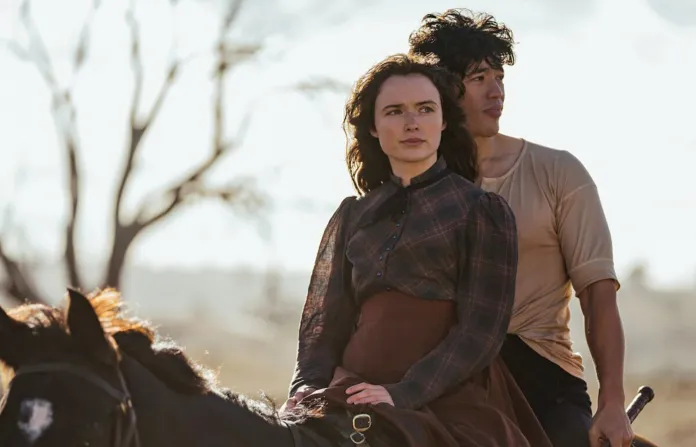
Like the 1901 tale from which it is adapted, Netflix’s series presents audiences with a romantic fable set Down Under. Our protagonist, Sybylla Melvyn (Philippa Northeast), is a 20-something farm girl living in contented poverty in the Australian bush. Sent by her parents to visit a grandmother and aunt, Sybylla yearns only to write and vows to use the trip to fuel her fiction. Her mother and father, however, have other ideas. The homestead is in debt, the lenders are closing in, and only Sybylla’s successful marriage can save the family from ruin.
Readers of George Eliot and Charlotte Brontë will recognize some of these plot points. What is more surprising — indeed, what has the tinny ring of contrivance — is Sybylla’s slogan-based feminism, a belief system whose particular expression wouldn’t have been out of place on the Bryn Mawr quad in 1965. “I want to create, not procreate,” the young woman tells her sister, practically brandishing a handmade placard. “Women should swim, they should swear, they should eat like a man.” Um, if you say so.
(Courtesy of Netflix)
Given Sybylla’s ideological starting point, the series would appear to have only one direction in which to go. And, as if on cue, two gentlemen do in fact present themselves immediately upon our heroine’s arrival at Caddagat, her grandmother’s tony estate in New South Wales. The first, played by the talented Christopher Chung (Slow Horses), is Harry Beecham, a well-meaning young landowner from a family of “colonial royalty.” The second, the tersely mustached Frank Howden (Jake Dunn), is a visiting Englishman with a parental mandate of his own: marry soon, or be cut off from the ancestral purse.
Viewers might roll their eyes at both of these admirers if the onscreen chemistry between Northeast and her costars were not so pronounced. Having played a maniacally narcissistic IT bro on Apple TV’s spy thriller for six seasons, Chung would seem an unusual choice for a romantic lead. Reader, he smolders. Dunn, meanwhile, might have stepped out of a novel by E.M. Forster, so powerfully does he summon a dashing Empire man abroad.
As in all period romances, Sybylla’s budding relationships are beset by problems. Taking a page from Jane Austen, the young woman overhears Frank discussing her in abominably blunt terms (“There is a kind of uncouth spirit about her that is at once attractive and repellent”). Harry, for his part, may well be engaged to someone else, a mésalliance at which Sybylla is understandably annoyed. Yet the firmest impediment to the happiness of one pair or the other is art itself: Sybylla’s notion, unsupported by the evidence, that she was born to put pen to page. “I would love the freedom to write whenever I want,” our heroine declares. Whatever one thinks of that monkey’s paw of a wish, it presumably isn’t the longing of a bride-to-be.
The irony here — and it is a deep one — is that Sybylla is a painfully bad literary stylist, forever muddling about in the land of ambiguity and cliche. “Black ink drips across the sky,” she scrawls in a representative scene, sounding for all the world like a chatbot trained on undergraduate prose. “He was a distinctive man,” she writes of her short-story protagonist … and then proceeds to share no distinctives. Watching this show, I wondered more than once whether the production was in on the joke. Did series creator Liz Doran (Barons) know that she had on her hands a scribbler of no great skill? In the end, I suppose it doesn’t really matter. Sybylla’s career goals are political rather than pragmatic. They exist for dramatic purposes to give the sane viewer something to oppose.
If My Brilliant Career fails, it is because these elements shake out very differently in 2026 than they did in 1901 — or, for that matter, in 1979, when director Gillian Armstrong adapted the book into a well-received film starring Judy Davis and Sam Neill. In those innocent days, a woman forsaking marriage for her work still rowed against the cultural tide. Now, such a figure sweeps blissfully in its foam.
REVIEW: HULU’S ‘FURIOUS’ IS A RIVETING, BRILLIANTLY ACTED CHARACTER STUDY
To put it another way, dismissing one’s beau a century and a quarter ago was entirely shocking. Whatever the winds of fashion, it was hardly less so in late-1970s Oz. Today, the bolder move — which is to say, the narratively interesting one — would be to do the opposite, affirming with one’s actions a way of life that transcends the self.
Does Sybylla make that hard and excellent choice as the series ends? I shouldn’t say. If she doesn’t, however, no career, no matter how brilliant, will be worth what she gives up.
Graham Hillard is the TV critic for the Washington Examiner magazine.