
“I will always love you …” If you have been alive in America at any point in the last half-century, you have heard those words in one of two voices — Dolly Parton’s original, a spare country farewell written as a professional goodbye, or Whitney Houston’s cover. Both belong to the same woman: the songwriter from a one-room cabin in the Great Smoky Mountains who refused to surrender half the publishing even to Elvis Presley, kept the copyright in her pocket, and watched it become one of the best-selling singles of all time.
Parton, who died Aug. 25 at the age of 80, was the rare American celebrity who seemed to be loved by everybody. Country purists claimed her. Pop audiences loved her. Hollywood fawned over her. Children who never bought a record cited her when a free book arrived in the mail. In a country that agrees on almost nothing, almost no one had a bad word to say about Dolly Parton.
Dolly Rebecca Parton was born on Jan. 19, 1946, in Sevier County, Tennessee, the fourth of 12 children in a household she later described as “dirt poor.” Her father, a sharecropper who never learned to read or write, paid the doctor who delivered her with a sack of cornmeal. The family lived for years in a one-bedroom cabin without electricity or running water — “two rooms and a path,” she liked to joke, “and running water if you were willing to run to get it.” Her mother sewed clothes from feed sacks and scraps. When schoolmates mocked a coat stitched from leftover rags, Avie Lee Parton told her daughter not to say they were poor: they were rich in kindness, love, and understanding. Parton turned the episode into “Coat of Many Colors,” the 1971 song that made her childhood American folklore.
She had been writing songs since childhood; her first, an ode to a corncob doll, went into a shoebox her mother kept. The day after she graduated from high school in 1964, she boarded a bus for Nashville. Three years later, she joined Porter Wagoner’s television show and became one of country music’s most visible duet partners. The partnership made her famous and then too large for it. She left in 1974, marking the departure the way she marked most turning points: by writing a song. “I Will Always Love You” and “Jolene” came on the same day. Both went to No. 1.
What distinguished Parton from many singer-celebrities was that she treated the songs as a business as well as an art. She founded a publishing company in the 1960s and held on to her copyrights. When Colonel Tom Parker told her that Elvis would record “I Will Always Love You” only if she gave up half the publishing, she said no. “These are my songs — they’re like my children,” she later explained. “And I expect them to support me when I’m old.” They did. Whitney Houston’s 1992 cover spent 14 weeks at No. 1 on the Billboard Hot 100; because Parton still owned the song, the royalties came home to her. She never found herself having sold the catalog young and needing to buy it back.
The same hard head for deals built an empire around the wigs and rhinestones. “9 to 5,” written for the 1980 workplace comedy she starred in with Jane Fonda and Lily Tomlin, topped the country and pop charts. In 1986, she opened Dollywood in Pigeon Forge, a theme park meant as a jobs engine for the mountains she had left. It became one of the South’s major tourist destinations. She sold more than 100 million records, notched 25 No. 1 country hits, won 10 Grammy Awards plus a Lifetime Achievement honor, and wrote more than 3,000 songs.
The money went back out as readily as it came in. Inspired by her father’s illiteracy, she launched the Imagination Library in 1995, mailing a book a month to children from birth to age five. The program has given away more than 330 million books in the United States, Canada, the United Kingdom, Ireland, and Australia. In 2020, she donated $1 million to Vanderbilt University Medical Center. She counted her blessings more than her money, as she liked to say.
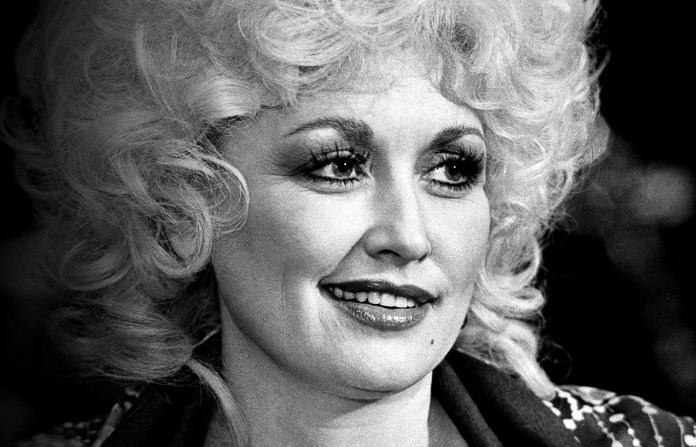
She designed the towering blond hair and cartoon silhouette herself, then disarmed anyone who sneered at them. She knew the look was a costume, and that the costume was a strategy: she described herself as “a workhorse dressed up as a show horse.”
For all the sequins, the life she built argued that glamour and grit were not mutually exclusive. The girl from Locust Ridge made the whole country sing her songs, read her books, and, against considerable odds, like her. She once suggested that the line most likely to end up on her tombstone was the one she had been delivering for decades: “It costs a lot of money to look this cheap.”
Daniel Ross Goodman (@DanRossGoodman) is a Washington Examiner contributing writer and teaches theology and religious studies at St. John’s University. His next book, Dante’s Guide to Life: How The Divine Comedy Can Change Our Fortunes, Our World, and Ourselves, will be published this fall by Angelico Press.