
The United States is taking a victory lap after a Syrian paramilitary group previously backed by Washington against the Islamic State agreed to dissolve its organization and integrate into the national government.
The Syrian Democratic Forces, formed by Kurdish fighters in 2015 to combat insurgent Islamic militants, will dissolve and integrate into the Syrian national armed forces, which enjoys the backing of President Donald Trump’s administration. SDF commander Mazloum Abdi made the announcement at the presidential palace in Damascus on Tuesday, striking an optimistic tone as he explained that the “circumstances have changed” and Syria has “entered a new phase” of “peace and participation in building a new Syria.”
“We announce today the end of the mission of the Syrian Democratic Forces and declare, with full responsibility, their dissolution as an independent military force,” Abdi said.
The arrangement lends legitimacy to Syrian President Ahmed al Sharaa, an ally of Trump who is positioning himself as a great unifier of the various ethnic groups that make up the modern state, after years of negotiations overseen by the U.S.
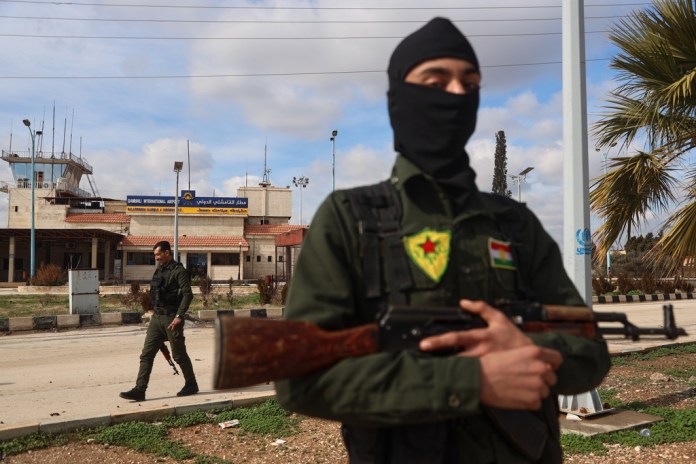
“We want to build a new Syria for all its people — the Kurds, Arabs, Turkmen and Assyrians,” Abdi said. “A unified and stable Syria that protects the future of its children and ensures a dignified life for its youth.”
The SDF enjoyed U.S. backing for years leading up to the fall of former Syrian President Bashar Assad in 2024. The paramilitary organization was seen as the most professional and well-regulated force actively fighting for a secular and democratic Syria.
After Hay’at Tahrir al Sham forces led by al Sharaa seized Damascus and forced Assad out of the country, the U.S. redirected its support to the new Syrian presidency. The SDF began negotiating alignment with the new government, but a Washington-brokered peace deal collapsed in January, resulting in an all-out conflict between the SDF and Syrian government in the city of Aleppo.
Government forces eventually gained the upper hand on the much smaller SDF and began eating up territories formerly held by the Kurdish paramilitary group as they suffered immense losses. The U.S. pressured its former allies to make a deal, and, by the end of the month, Abdi announced they would cease their resistance and lay down arms “to stop the bloodshed.”
In a gesture of peace, al Sharaa enshrined key rights for Kurds via presidential decree, such as protection of the Kurdish language and recognition of Kurdish holidays.
The SDF will now cease to exist as an independent organization, instead integrating its resources and personnel into the national infrastructure.
“We want this day to mark a real transition — from the battlefield to the field of development, from the era of arms to the era of peace, and from defending Syria to building Syria,” Abdi said.
Experts see the union as evidence that Syria might actually be putting the era of sectarian violence behind it.
“The complete integration of the forces in Syria, a single unified government, and a stable security situation, combined with the lifting of the sanctions, gives Syria a real chance at moving forward and recovering from the years of the Assad regime’s damage,” Alex Plitsas, a senior fellow for the Atlantic Council’s Middle East Programs, told the Washington Examiner.
Tom Barrack, Trump’s special envoy to Syria, hailed the dissolution of the SDF as “absolutely historic” as a “united Syria for all takes shape.”
“This is what real integration looks like: not winners and losers, but former counterparts with differing points of view crafting a diplomatic solution to strengthen the sovereign nation of Syria,” Barrack said. “One army, one government, one state.”
With al Sharaa’s government enjoying virtually uncontested legitimacy and firmly rejecting the idea of any form of theocracy, the U.S. has extended a hand to pour investment into the once-troubled state and build a lasting economic partnership.
The U.S. ended Syria’s categorization as a state sponsor of terrorism on Monday following a 45-day congressional notification period. Hay’at Tahrir al Sham will also no longer be designated as a terrorist organization.
“In the past year, the Government of Syria has taken significant steps to counter terrorism, to include formally joining the Global Coalition to Defeat ISIS in November and conducting operations to disrupt the terror networks of ISIS, al-Qa’ida, Hizballah, and Iran-aligned groups,” Secretary of State Marco Rubio said of the decision. “Rescinding Syria’s designation as an SST and HTS’ designation as an SDGT eliminates the final major barriers for private sector investment in Syria and promotes Syria’s economic recovery and reintegration into the global economy.”
The loosened restrictions will not empower Washington to pursue investment and economic cooperation with al Sharaa’s government, which could transform the impoverished country.
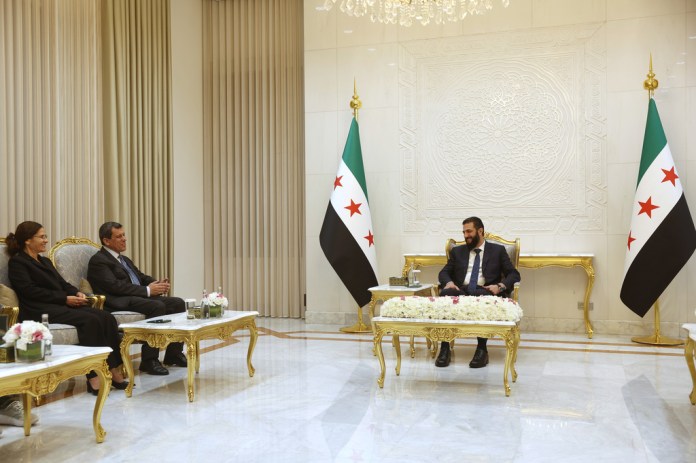
“The integration and the sanctions relief collectively right now is going to serve as a catalyst for foreign investment and economic investment in Syria, and it’s basically only up from here,” Plitsas said. “And now it’s going to be up to the government to ensure that they adhere to policies that are in line with the values that they’ve espoused and the freedoms that they said that they would give to the people who are there.
“As long as they do that, Syria has got a bright future.”
Some of Syria’s neighbors have also lauded the decision as a landmark step to normalizing the geopolitical situation in a country ripped apart again and again by civil conflict. Turkey and Saudi Arabia are particularly pleased that the SDF will be disbanded due to its historic relationship to the Kurdistan Workers Party, a group widely condemned as a terrorist organization.
“At this stage, the dissolution of the SDF represents an important step forward in strengthening state authority across the country and uniting the various segments of society,” the Turkish president’s office said in a social media statement. “It is essential for establishing lasting stability that the Syrian administration continues to adopt an inclusive approach.”
US REMOVES SYRIA’S STATE SPONSOR OF TERRORISM DESIGNATION
Saudi Arabia and Qatar stepped in to clear Syria’s $15.5 million debt to the World Bank in May 2025, making the country once again eligible to utilize the international fund.
The World Bank has poured hundreds of millions of dollars into grants for modernizing the Syrian financial sector, restoring water access, and bolstering its healthcare system.