
Prediction markets have come of age. Kalshi, the industry leader, is enjoying its biggest year ever. Monthly trading volumes surpassed $37 billion in July, boosted by the World Cup. The startup is raising new capital at a $40 billion valuation, about four times what it was worth just eight months ago, and the CEO speaks of an initial public offering as soon as 2027. With this impressive growth comes heightened risk. Looming questions concerning its regulatory status and market integrity threaten to upend Kalshi’s business model, while mounting state and federal lawsuits suggest an eventual date with the Supreme Court.
Kalshi was founded in 2018 by Tarek Mansour and Luana Lopes Lara, who met at MIT and serve as CEO and chief operating officer, respectively. As undergraduates, the founders secured various Wall Street jobs and internships: Mansour worked as a derivatives analyst at Goldman Sachs, while Lopes Lara held roles at Bridgewater and Citadel. On Wall Street, the founders observed how institutional investors sought to trade such uncertain binary outcomes as Brexit and the 2016 presidential election through proxies such as swaps, options, and other risk curves. In their telling, Kalshi was established to resolve a simple question: Why not just trade on the binary outcome itself?
Kalshi’s business model depends on volume and trading fees. “Kalshi doesn’t care who wins or loses,” a company spokesperson told me. “Every trade matches a buyer and a seller, same as matching a buy and sell order on a stock exchange.” The events contracts are structured around binary yes-or-no outcomes such as “Will the Republicans win or hold the Senate in 2026?” or “Snow in New York City from Jan 24–26?” and are priced between $0 and $1, reflecting the likelihood of the underlying event. A contract with a 23% probability will thus sell for $0.23, and pay out either $1 or $0 depending on the outcome.
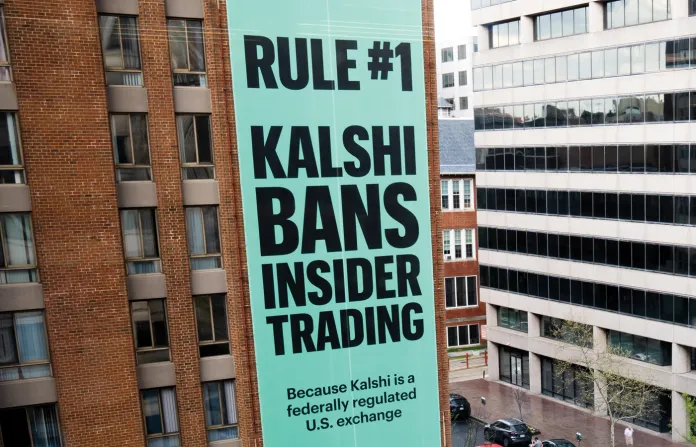
Jeffrey Bandman, a former Commodity Futures Trading Commission official who led Kalshi’s regulatory strategy from 2019 and has returned after a two-year hiatus, told me that the founders were determined to build the business in close cooperation with regulators. “They understood early on that taking regulation seriously could be a competitive advantage,” he said.
In 2020, the CFTC, the body that oversees U.S. derivatives markets, approved Kalshi as a designated contract market, the same license category as the Chicago Mercantile Exchange, enabling it to offer events contracts nationwide. Kalshi launched its public exchange in 2021. CFTC approval subjects the business to the Commodity Exchange Act, rather than state gambling laws or the Unlawful Internet Gambling Enforcement Act, which contains an explicit carve-out for CEA-regulated products. The question at the heart of an escalating showdown with state and tribal regulators is whether some of these offerings constitute gambling.
At the moment, a duopoly of Kalshi and Polymarket controls 97.5% of the industry. While Kalshi was born in close cooperation with federal regulators, requiring know-your-customer and presenting itself more like a traditional fintech, Polymarket has taken a more libertarian approach, accepting crypto wallets in lieu of identification and handling international business from an offshore entity registered in Panama.
Kalshi has the backing of Silicon Valley kingmakers such as Sequoia Capital and a16z, while rival Polymarket has been financed by Founders Fund and Intercontinental Exchange, the company that owns the New York Stock Exchange. Given the level of investment, it seems doubtful that the long-term play is a regulatory arbitrage on sports betting. Investors believe that prediction markets could become a massive new asset class, both a forecasting tool that aggregates dispersed knowledge and the infrastructure for a new kind of financial instrument that can price and hedge risk for retail investors and institutions alike.

Kalshi told me that roughly 75% of its site visitors come for the real-time odds and information, while a mere 25% come to trade. They recently launched a “Midterms Hub” to serve such visitors, aggregating odds, polling, news, and Federal Election Commission data into a single dashboard. Mansour often describes Kalshi’s market data as “the wisdom of the crowds.”
This isn’t marketing hyperbole. Certain markets are followed very closely by investors, revealing expectations on things such as inflation, payrolls, and Federal Reserve interest rate decisions. In February, the Fed published a working paper titled “Kalshi and the Rise of Macro Markets,” arguing that prediction markets constitute a valuable complement to existing forecast tools and describing Kalshi as “the most mature and comprehensive prediction market for economic forecasting.”
These platforms are also tied to politics. Donald Trump Jr. advises both of the leading markets, and the Trump administration has generally embraced them. But the previous administration could be outright hostile. In 2024, the Biden-era FBI raided the apartment of Polymarket founder Shayne Coplan while the CFTC repeatedly attempted to constrain its expansion into new markets. After Trump returned to office, the regulator voluntarily dismissed its appeal over political events contracts and abandoned a proposed rule that would have prohibited trading on political and sporting events. Kalshi began offering sporting events contracts in January 2025, a category that now accounts for up to 90% of its trading volume. Congress, meanwhile, has not yet made any attempt to regulate them independently.
The markets themselves are determined ad hoc, ranging from politics and sporting events to economics and the weather. Kalshi has weekly brainstorming sessions to design new offerings — recent examples include those dedicated to FDA drug approvals, and one devoted to airport flight delays, which would, in theory, enable traders to “hedge” travel disruptions the same way that an orange grower might hedge against a devastating freeze by buying weather derivatives. Meanwhile, any user can submit a market request via a portal on Kalshi’s website. These are then reviewed to ensure that they are legal and “not easy to manipulate.”
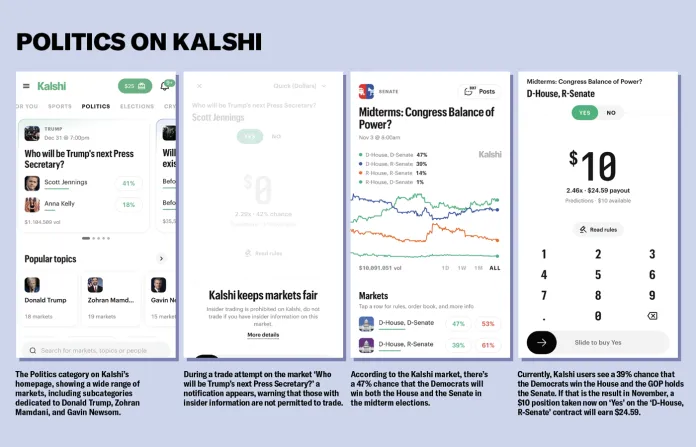
In November 2025, the ex-investment banker Mark Moran traded on a Kalshi market titled “Who will run for public office this year?”, a market in which he was listed as an outcome. He later announced a Senate run in Virginia, then traded on his own primary. In April, Kalshi suspended him for five years and fined him $6,229.30, while punishing two other candidates who had traded on their races in Texas and Minnesota. In a disciplinary filing, Kalshi wrote that Moran “qualified as a direct decision maker” for the contract and had “direct influence” over the outcome. Moran, who said he wanted to get caught, told me he plans to sue.
Moran demonstrated that, while a person can eventually be caught and disciplined for breaking Kalshi’s rules, the underlying market was vulnerable to manipulation. Barring the decision maker from trading is one thing, but what about traders with money riding on that outcome? It raises the question: Why are such pliable contracts allowed to trade as derivatives in the first place?
The regulators now seem to be wondering the same. In mid-August, mention markets, in which users are able to trade on whether a specific word or phrase will be spoken aloud during a given event, were removed from Kalshi’s exchange amid an active inquiry from the CFTC.
Similar cases involving Donald Trump’s teleprompter operator and former Rep. George Santos suggest that Moran’s is not an isolated incident. Given the scale of these markets, one can’t help wonder how much slips through the cracks. The CFTC’s capacity for enforcement is much weaker than that of the Securities and Exchange Commission, and Kalshi told me it has just 20 in-house enforcement personnel out of about 150 total employees. In February, it claimed to have opened 200 investigations over the previous year. While they police their exchange and may refer serious cases to the CFTC and the Justice Department, it’s worth asking if the rapid ascent of prediction markets has left regulators in over their heads.
While the insights derived from its markets might make Kalshi a valuable tool for investors, they seem to play a lesser role in the company’s overall business model. Beyond major election cycles, political markets are similarly marginal. The real driver of Kalshi’s impressive growth has been sporting events such as the World Cup.
In the 2018 case Murphy v. NCAA, the Supreme Court struck down the Professional and Amateur Sports Protection Act of 1992, which prohibited states from authorizing or licensing sports betting except in special grandfathered cases such as Nevada. The ruling did not, however, contemplate federally regulated exchanges trading on the same outcomes. In Justice Samuel Alito’s majority opinion, he summed it up: “Congress can regulate sports gambling directly, but if it elects not to do so, each State is free to act on its own.”
Kalshi has always maintained that it is not a gambling entity, an opinion shared by the CFTC but widely rejected by the states. To the surprise of no one, the gambling industry is among Kalshi’s more vocal critics. DraftKings and FanDuel each represent about a third of the regulated sports betting market that emerged post-2018, with Fanatics and various casino brands splitting most of the remainder. Matt Kalish, the co-founder of DraftKings, believes that Kalshi’s early success is due to regulatory arbitrage, offering sports markets in 12 states where sportsbooks cannot operate, including Texas and California.
“Kalshi can LARP as a finance company all they want,” Kalish told me. “Ninety percent of its volume is sports betting, and much of that is coming from markets where sports betting is not authorized. The second that they lose sports markets, Kalshi is irrelevant. It’s their entire business.”
Such criticisms have not prevented the sportsbooks from adopting the same model, however. Since December 2025, DraftKings has operated a CFTC-regulated prediction market of its own, with FanDuel following suit in a joint venture with CME Group.
Chris Colombo, a veteran bookmaker and the son of slain mob boss Joe Colombo, believes that sports prediction markets closely resemble his old line of work. In 2008, a federal judge sentenced him to a year and a day in prison after he pleaded guilty to running an illegal gambling ring in New York. “It’s gambling, plain and simple,” Colombo told me. “I don’t have a problem with it. But promoting it the way they do is unacceptable.”
This year, concerns about sovereignty and lost tax revenue have led to a number of state suits. Minnesota introduced legislation making it a felony to operate or create a prediction market, only for a federal judge to block enforcement days before it took effect. Nevada won an injunction barring Kalshi from sports, political, and entertainment contracts. After an investigator from the Nevada Gaming Control Board kept trading after it had been prohibited in-state, the board threatened Kalshi with $120,000 daily penalties for failing to implement a geofence by Aug. 12. The board has since argued that Kalshi missed the deadline and is pursuing its claim in state court. A similar geofencing deadline in Washington looms on Sept. 2.
In late July, New York Attorney General Letitia James sued Kalshi, seeking $36 billion in penalties, more than its current valuation. “Prediction markets like Kalshi are gambling platforms,” James said. Massachusetts, Michigan, Wisconsin, and other states have filed similar suits, with Arizona Attorney General Kris Mayes even going so far as to press criminal charges. Several tribes have also sued, citing the Indian Gaming Regulatory Act. Meanwhile, 44 state attorneys general sent a letter to the CFTC, arguing that it has no authority over sports prediction markets. The CFTC has stepped in to defend its jurisdiction, issuing a directive on Aug. 11 ordering Kalshi to ignore a temporary restraining order sought by New York, ostensibly to “maintain orderly trading.”
This pushback foreshadows a confrontation with major implications for the future of both Kalshi and the CFTC. Prediction market cases are pending in eight of the 13 federal appeals courts and could reach 10 by the end of the year. It seems only a matter of time before one of these reaches the Supreme Court, where a decisive ruling on CFTC preemption could either prove to be a serious problem or a godsend for Kalshi.
In April, the 3rd Circuit Court of Appeals ruled in favor of Kalshi and the CFTC after Kalshi sued New Jersey’s gambling regulator over a cease-and-desist order. The decision upheld that Kalshi’s sporting events contracts are “swaps” and are not subject to state oversight.
“The Supreme Court will have several cases to choose from,” said Daniel Wallach, a gaming attorney and lecturer at the University of Miami Law School. “It’s either going to be the New Jersey case right out of the gate, or the next federal appeals court decision which is in conflict with the 3rd Circuit’s ruling.”
Such a Supreme Court ruling will not happen overnight. “It is possible that the Supreme Court could grant cert as early as this December, schedule it for oral argument in the spring, and potentially have a ruling by June 2027,” Wallach told me. But it could easily slip into 2028.
In a recent interview, Mansour brushed off the growing litigation against Kalshi, comparing it to the early days of Uber, when bitter incumbents used everything at their disposal to halt the disruptor. “Monopolies use the legal system to thwart competition,” said Bradley Tusk, who ran Uber’s regulatory campaigns during its early expansion and whose consulting firm also advises Kalshi. “Here, the state is the monopoly. They’re upset that they don’t derive the tax revenue from prediction markets and can’t tell them what to do.”
KALSHI CRACKS DOWN ON CANDIDATES ABUSING PLATFORM AS PRITZKER TARGETS INSIDER TRADING
Apart from a direct intervention from Congress, which seems a bit more likely if the Democrats sweep the midterm elections, or a change of heart at the CFTC, which seems unthinkable until 2029, a Supreme Court ruling seems to be the only way this standoff gets resolved. If the Supreme Court were to decide that the CFTC is not the proper regulator, then the states have the upper hand. “All of the state litigation is designed to prod the Court to take up the case,” Tusk said.
Kalshi seems to be racing the clock to grow large enough, fast enough that tearing down the edifice becomes unthinkable. But to justify ever-higher valuations, prediction markets must deliver on their promise to become permanent. For now, this is not certain. With $40 billion on the line, Kalshi’s investors will either own the infrastructure of a revolutionary new asset class or a betting exchange of contested legality, a binary outcome in its own right.
Carson Becker is an American writer.