
President Donald Trump‘s Secretary of State Marco Rubio should have the final say when U.S. diplomats and other Foreign Service employees appeal their firings or discipline, according to Justice Department legal guidance issued Friday.
The DOJ’s Office of Legal Counsel concluded that an independent panel known as the Foreign Service Grievance Board cannot retain final authority to overrule the State Department in those cases. The board will continue to hear employee appeals, but its decisions in favor of an employee will become recommendations subject to either the president or the secretary of state’s final review, according to the opinion.
“Accountability for American foreign policy flows from the people to the foreign service through the President,” Assistant Attorney General T. Elliot Gaiser, who authored the opinion, said in a Friday release. “Our advice today restores that essential through-line.”
The Foreign Service Grievance Board is an independent panel that hears workplace appeals from U.S. diplomats and other Foreign Service employees, and its power to overturn firings and other discipline has made it a consequential check on State Department management.
The DOJ highlighted a 2013 ruling involving a Peace Corps IT worker who downloaded sexually explicit material onto his government computer as an example of why the independent board should not have the final word.
Case materials obtained from a source by the Washington Examiner show that the board ordered the Peace Corps to reinstate the employee for the rest of his contract, award him back pay, and remove his termination from his personnel records.
The board found the worker had downloaded six sexually explicit videos and one image onto his government workstation. It called the conduct a “clear violation of the trust” placed in an IT specialist responsible for protecting the agency’s computer systems.
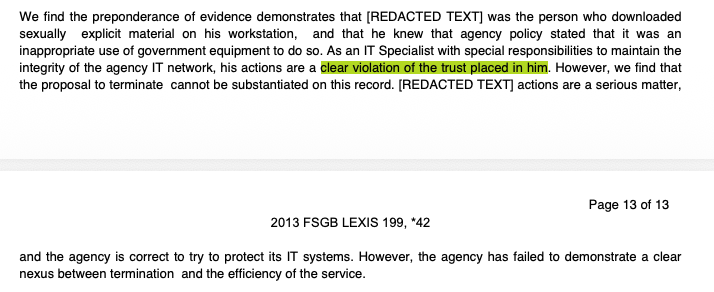
But the board found that the Peace Corps had not proved its principal claim that the worker viewed the material at his workstation. It also found the agency relied on additional allegations and aggravating factors that were not included in the original termination notice.
The DOJ cited that result to underscore its argument that an unelected board should not be able to overrule the executive branch on personnel decisions involving the country’s diplomats.
OLC said the problem could extend far beyond a workplace-misconduct case. The memorandum warned that an ambassador fired by the president could seek reinstatement by persuading the board to rule in his favor.
APPEALS COURT UPHOLDS LETITIA JAMES SUBPOENA BLOCK AS DOJ VOWS TO APPEAL TO SUPREME COURT
The opinion relied on United States v. Arthrex, a 2021 Supreme Court decision that rejected unreviewable executive authority exercised by lower-level officers. It also cited Trump v. Slaughter, the Supreme Court’s June decision emphasizing presidential control over executive officials.
OLC advised the State Department to stop enforcing provisions of the Foreign Service Act that limit the secretary’s review and let the board have the final word. The DOJ said the change would preserve the board while putting final responsibility for its decisions with Rubio.