
British Prime Minister Andy Burnham is insisting that the conversations he had with a scammer impersonating a top White House official were of “zero consequence” and did not present a security concern despite a recent leak of multiple ministers’ phone numbers.
Burnham messaged back and forth with a phone number claiming to be White House chief of staff Susie Wiles. The premier became suspicious after only a few messages and subsequently reported the interaction to British authorities. Talking to broadcasters in Wolverhampton on Tuesday, Burnham defended his handling of the situation.
“All politicians are, you know, receiving these pressures and these challenges, but I did everything right,” Burnham told reporters. “There was a minimal exchange of information of zero consequence, and it was quickly reported.”
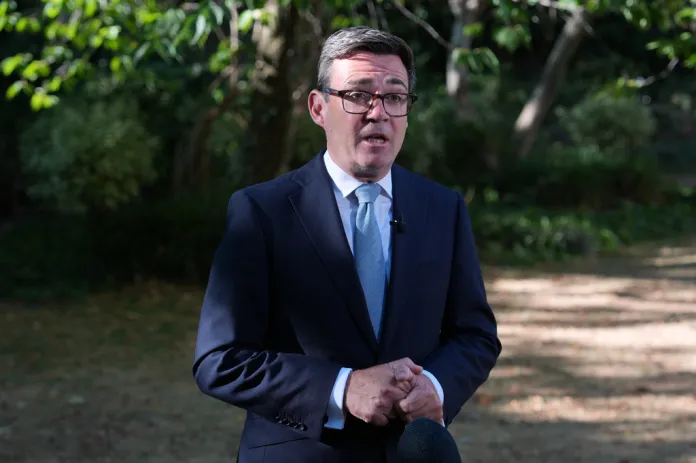
“I realized that this needed to be reported, and I did so. So I handled it in the right way,” he added.
Burnham only exchanged messages with the unknown impersonator and never spoke with them on the phone. The prime minister and his team have repeatedly emphasized that only a “few messages” were sent between them and that they were of “no significance.”
But phone numbers belonging to at least three ministers in Burnham’s Cabinet have appeared online since the scam — including those belonging to Defense Minister Wes Streeting, Justice Secretary Alex Norris, and Northern Ireland Secretary Chris Bryant.
Officials at the British Embassy then transmitted a report about the incident to the U.S. government out of national security concerns.
The debacle initially sparked speculation whether Wiles’s phone had been hacked again. The chief of staff’s personal contact list was compromised last year, leading to a flurry of calls and text messages from an impersonator reaching out to government officials and top Republicans.
The FBI launched an investigation into that 2025 breach, which allegedly utilized artificial intelligence to mimic Wiles’s voice.
Would-be victims reportedly clued in on the scam because the messages’ language was unlike Wiles and contained questions that the chief of staff would already know the answers to.
But the White House is denying any gaps in security on its end, with an official previously telling the Washington Examiner that the Burnham affair “had nothing to do with the Chief of Staff’s devices being hacked.”
President Donald Trump has also downplayed the incident. Asked on Monday whether he was alarmed by the incident or was questioning the integrity of trans-Atlantic communications, the president dismissed the notion.

“No, I’m sure that he had a miscommunication. I spoke to him,” Trump said of the snafu. “We had a good conversation. A couple of them.”
James MacCleary, a liberal Democrat member of the British Parliament, issued a letter to the legislature’s Intelligence and Security Committee on Tuesday, asking the body to launch an investigation.
US INVESTIGATING ALLEGED CHINA-LINKED FUNDING OF ‘PRO-HAMAS’ PROTESTS IN UK
“This is an unacceptable breach,” the letter stated. “The security of the Prime Minister’s communications ought to be an absolute priority — and yet it appears, in this case, that routine measures to guard against these kinds of breaches were not followed.”
MacCleary requested that, if an investigation is not possible, the matter be referred to the Independent Review of the Use of Non-Corporate Communications Channels in Government.