
Results from a recent poll of German voters showed that a significant majority opposes the long-standing “firewall” policy that prohibits major German political parties from working with the right-wing Alternative for Germany, or AfD, party.
German polling firm Infratest dipmap, in a survey conducted between Aug. 3-5, found that 59% of eligible voters in the country support abandoning the political “firewall” and working with the AfD. Approximately 37% of that group supported ending the firewall on a case-by-case basis, while 27% said mainstream parties should actively seek cooperation with the right-wing group.
“In a long-term comparison, the strict rejection of cooperation with the AfD among German citizens has decreased, while support for parliamentary cooperation has increased,” Infratest dipmap said of the results.
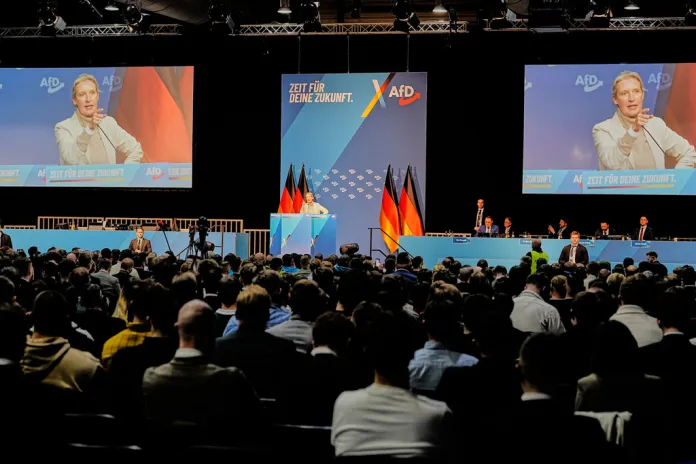
The mainstream parties, such as the governing Christian Democratic Union and the Social Democratic Party, have become increasingly concerned by the AfD’s surge in popularity across the country as the next round of elections approaches in September.
The AfD is currently leading German polls of parliamentary voting intention, sitting at 28% compared with the CDU in second place with 21% and the Greens in third place with 15%.
The party has particularly strong support in the Eastern German provinces, which hold an aversion to left-wing politics due to decades of Soviet governance.
Chancellor Friedrich Merz, who is also the leader of the CDU, has categorically ruled out any cooperation with the “far right” of German politics, invoking memories of Nazi Germany and asserting that his country is uniquely dangerous with such ideologies.
“If a far-right party were to enter the government in Germany, it would have a completely different significance than if that were to happen in another country,” Merz said at a press conference last month. “This is also tied to our history, and that’s why, for me, it’s neither a benchmark nor an example, nor something to learn from. It is, quite simply, something different. I will do everything in my power in Germany to prevent it.”
Parliamentary elections in the East German state of Saxony-Anhalt will take place on Sept. 6, and voting in the state of Mecklenburg-Vorpommern will take place on Sept. 20. The AfD has commanding leads in both and sees potential to win an outright majority in the former.
The situation has pushed some members of Merz’s party to break ranks on the “firewall” issue and advocate cooperation.
Michael Kretschmer, CDU premier of Saxony, previously told reporters that “anyone who still talks about firewalls hasn’t recognized the signs of the times … We need to talk to anyone who wants to talk.”
The support for bringing AfD into the political mainstream can be tied directly to the party’s stance against mass migration. The same Infratest dipmap poll found that 71% of respondents supported extending novel border controls implemented in 2024 to curb irregular immigration.
BERLIN’S ‘QUEER COMMISSIONER’ CONDEMNS ISLAMIC ATTACK ON PRIDE PARADE AS ‘CONSERVATIVE’ VIOLENCE
Approximately 59% of German voters believe a unified agenda across the European continent is the best avenue for immigration reform, but the polling firm said “this view is declining, and it does not preclude support for national action,” tying it specifically to the recent bull-rush of Ceuta, a Spanish territory, by Moroccan migrants.
“With the influx of migrants into the Spanish exclave of Ceuta, the issue of immigration has returned to the European agenda,” Infratest dipmap wrote. “A majority of Germans (59%) still believe that joint European solutions to the migration problem are more sensible than unilateral national actions. However, this view is declining, and it does not preclude support for national action.”
Merz spoke out during the Ceuta crisis to demand Morocco “take the illegal migrants back immediately.”