
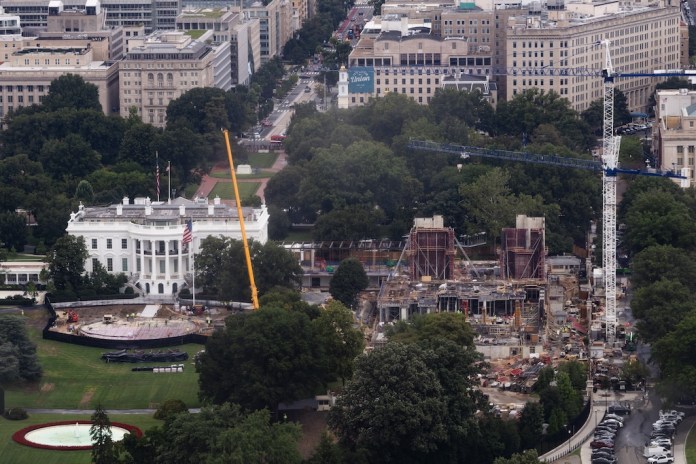
A federal appeals court ordered Friday that the construction of the proposed White House ballroom must get congressional approval to proceed, dealing President Donald Trump another setback in his ambitious project for the executive mansion.
The U.S. Court of Appeals for the D.C. Circuit ruled 2-1 that construction must stop on the extensive renovation of the East Wing, which includes a new ballroom, because Congress has control over how the White House may be changed, not the executive branch, despite it being the executive mansion. The two judges sided with the National Trust for Historic Preservation, a preservationist group, which sued the Trump administration late last year when construction on the ballroom began.
“The Constitution assigns Congress—not the Executive—the responsibility to decide whether proposed changes to the physical design of the White House may proceed, even where those changes are said to serve security interests,” the ruling said. “The Defendants have not shown that Congress delegated that authority to either the President or the National Park Service. Whether or not a massive ballroom should be constructed is for Congress to decide and is not a matter for Executive self-help.”
The majority opinion did leave open the ability for the ballroom to be built, but said it would need to be with the approval of Congress.
“This holding has nothing at all to do with whether the proposed ballroom is desirable, or not, as a matter of policy,” the ruling said. “This ruling does not even necessarily mean that the Defendants may not ultimately construct the ballroom. What it does mean is that the Defendants may not do so during the district court’s expeditious litigation without securing Congress’s authorization, as the Constitution and laws require.”
“At this preliminary stage, the National Trust has shown, compellingly, that Congress has not ceded unfettered authority to the Executive Branch to dramatically redesign, reshape, and reconstruct the White House—the People’s House—to fit a particular President’s desires,” the ruling continued.
U.S. Circuit Judges Patricia Millett, an appointee of former President Barack Obama, and Brad Garcia, an appointee of former President Joe Biden, were the two judges in the majority ruling that construction must be suspended barring congressional approval.
The two-judge majority said their ruling would be paused for 14 days to allow for the Justice Department to appeal to the Supreme Court, meaning construction will have to halt in two weeks, unless the high court extends the pause on the D.C. Circuit’s ruling.
U.S. Circuit Judge Neomi Rao, a Trump appointee, was the lone dissenting judge, where she called the lower court’s order to halt construction “a blatant abuse of discretion” and disagreed with the majority’s decision to “affirm this judicial overreach.”
“Because the injunction is beyond the proper province of the federal courts, construction should be allowed to continue. I respectfully dissent,” Rao said, arguing that the National Trust for Historic Preservation had no standing to stop construction of the new East Wing.
“The ballroom is also likely within the President’s authority to make improvements to the Executive Residence at the White House. Finally, the balance of equities overwhelmingly favors the government,” Rao said in her dissent. “The district court elevated the aesthetic displeasure of a single passerby over the government’s security interests in the ballroom and the security risks of leaving an open construction site at the President’s home and office. These errors in equitable judgment require vacating the injunction.”
DC CIRCUIT GRILLS DOJ OVER WHITE HOUSE BID TO CONTINUE BUILDING BALLROOM
The Justice Department had hinged its arguments largely on the security improvements included with the new East Wing project, claiming that halting construction would jeopardize the security and safety of the president and the White House complex.
Trump’s proposed ballroom project has been met with uproar from Democrats and left-wing activists since it was announced last year. The preservationist group’s lawsuit is the main effort to halt the project. While Trump had insisted the project would be fully financed by private donations, his administration attempted to secure federal funding from Congress for the security improvements to the White House complex as part of the East Wing project, but has been unsuccessful.