
Senate Republicans have yet to find solutions to overcome hurdles on key policy proposals, putting their annual August recess travel plans at risk of going up in flames.
The chamber’s final scheduled working days before a monthlong break, set to begin at the end of the week, are clouded in uncertainty over threats from Republicans to block their own adjournment unless they can pass the framework for their latest party-line reconciliation spending legislation with parts of the GOP’s SAVE America Act voter ID bill.
Sen. John Kennedy (R-LA), an Appropriations Committee member, emerged from a closed-door GOP lunch Tuesday that he described as a “worthless meeting” despite having only a few days to address issues including government funding, Iran war spending, crypto regulations, and Russia sanctions. The reconciliation framework was not discussed in detail or substance, according to several senators.
“I have no idea. Don’t know what we’re doing,” Kennedy told reporters. “I’m not saying that there’s not a secret plan. … I’m just saying I don’t know what it is.”
None of the Senate GOP’s priorities are up against hard deadlines, except for a House-passed government funding bill to avert an Oct. 1 shutdown.
Still, President Donald Trump has repeatedly called upon Senate Majority Leader John Thune (R-SD) to keep the chamber in session until it overcomes Republican opposition and passes the SAVE America Act to require proof of citizenship when registering to vote. More than a dozen other GOP senators have suggested they could, if it comes to a vote on a motion threatened by Sen. Mike Lee (R-UT), block the Senate from adjourning.
Thune spoke with the president on Tuesday and pushed back to reporters on the notion that he was increasingly isolated from the president. But he also offered his latest blunt assessment on the Senate math.
“I wouldn’t say I’m isolated, no. I’ve been very clear about the prospects for the SAVE America Act,” Thune said. “Seems to me, some days, I’m the only one here who can count to 50 in this town. But we don’t have the votes to get rid of the filibuster, and we aren’t flipping 10 Democrats to vote for the SAVE America Act.”
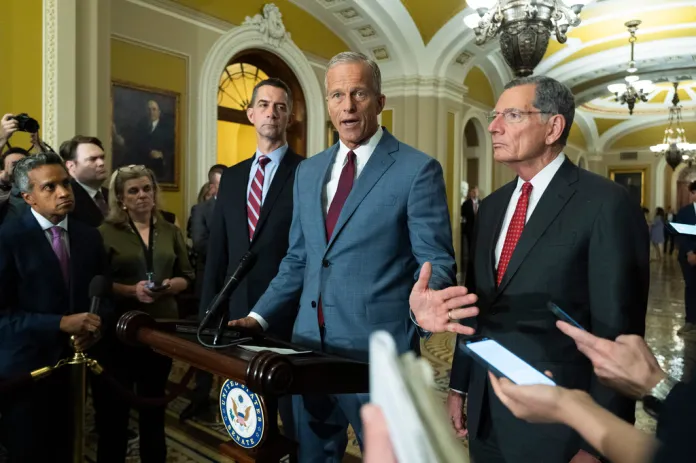
Senate Republicans remain at odds over changes to a $95 billion House-passed budget framework for what the party hopes will amount to its third party-line reconciliation bill in Trump’s second term. The proposal needs only a simple majority and skirts the filibuster. Senate Budget Committee Chairman Ron Johnson (R-WI) met Tuesday with panel members about negotiations and was set to meet that evening with Armed Services Chairman Roger Wicker (R-MS) about the proposal’s defense spending levels.
“The ones that attended, I think we’re all pretty much in agreement that we really do need to … pass a budget resolution before we leave town,” Johnson told the Washington Examiner.
HOUSE REPUBLICANS PASS BUDGET FRAMEWORK FOR $95 BILLION PARTY-LINE SPENDING BILL
It remains unclear which, if any, portions of the SAVE America Act could be included and survive the Senate’s strict Byrd rule reconciliation process. But without at least some parts of the elections bill, which also includes stricter voter ID laws and state voter roll oversight by the federal government, enough Senate Republicans suggest they could force the chamber to remain in session.
“I don’t think we’re going to go home unless we do a budget resolution,” said Sen. Rick Scott (R-FL), a leading SAVE America Act proponent.
David Sivak contributed to this report.