
Nostalgia, the old joke goes, ain’t what it used to be. I thought of the line while revisiting Woody Allen’s Midnight in Paris, released 15 years ago to a nationwide theatrical run throughout the summer of 2011, in a very different America. Watching it today is an exercise in paradox, because it’s aged well precisely because its own thesis is wrong.
Perhaps the last Allen movie that will ever be permitted to become a true hit, the film tells the story of successful Hollywood screenwriter Gil Pender (Owen Wilson) during a trip to Paris with his rich, vapid fiancee, Inez (Rachel McAdams). Gil has pretensions to become a highbrow, literary-minded writer with his in-progress novel about a man working in a nostalgia shop. (Wilson does a great job splitting the difference between inhabiting his own winning, “wow”-ing mannerisms and those of Allen himself.) At night, Gil takes walks alone through the City of Light, letting his thoughts turn to the greats who once stalked the same streets. The magic starts when he finds that as the bells of Notre Dame strike 12 each night, he is whisked away to the salons and parties of the artistic set of 1920s Paris that he so romanticizes. There, or then, he learns lessons about the pointlessness of wishing to have lived in an earlier time he imagines to have been a golden age, as well as about whether he is really in love with the right woman.
It’s a charming, easygoing premise that allows Allen to cast 21st-century A-listers as equally beloved A-listers from the 20th century, including Tom Hiddleston as F. Scott Fitzgerald, Adrien Brody as Salvador Dali, and Kathy Bates as Gertrude Stein. Surely it’s fun to make up a great character, but even more fun to whip up dialogue for some of modern history’s most famous artistic personas. For instance, Allen writes an off-the-wall Dali interrupting himself to babble about rhinoceroses, or Ernest Hemingway (Corey Stoll) speaking like a Hemingway novel, full of self-consciously spare run-ons and musing about manhood and truth in between drunken challenges to boxing.
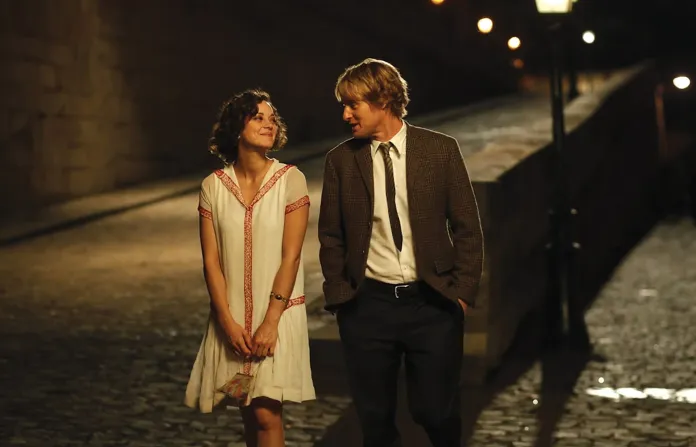
The movie’s message, unsubtly wrought, is that nostalgia is a dead end. The film takes aim at, as one character puts it, “people who live in the past — people who think that their lives would be happier if they lived in an earlier time.” Those who permit themselves to dwell in the belief that the past contains golden ages are necessarily permitting themselves a delusion. There is something pitiable about them. We must inhabit our own time, the movie tells us, without wasting so much energy imagining that we were cheated by being born too late. If the present is “a little unsatisfying,” Gil concludes, it’s merely “because life is a little unsatisfying.”
This is one of those ideas that is true in one sense and false in another. Certainly, there is a personality type that can become obsessed with past ages. And yet, it would be a little silly to imagine, like some cultural relativist, that all times are the equal of all others. From time to time, I have encountered the idea that the only reason people love the movies and music from, say, the 1970s or the 1990s is that they were children in those years, and things hit differently when you’re a child. But surely even those of us who were children at the time of the release of The Phantom Menace (1999) can agree that the original Star Wars movies were actually a better collection of work than the prequel trilogy, right?
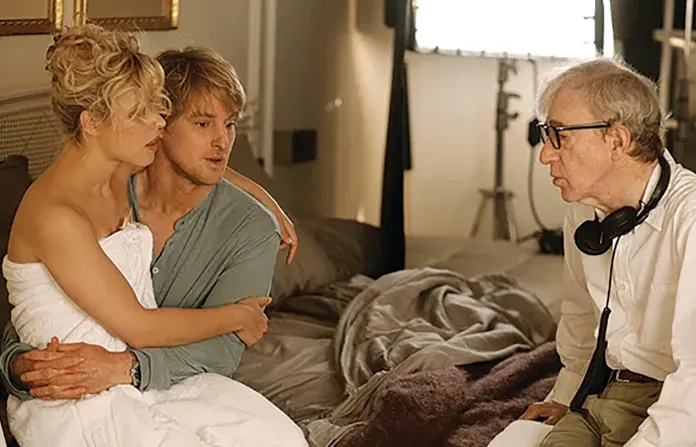
Another paradox of Midnight in Paris is that what made it so appealing in the first place is the very nostalgia it takes aim at. Much of the film is set among the famous Moveable Feast set, and no doubt audiences get as much of a kick from the feeling of hanging around with the likes of T.S. Eliot (David Lowe), Pablo Picasso (Marcial Di Fonzo Bo), and Cole Porter (Yves Heck) as does the film’s main character. However delusional the pull of nostalgia may be, it still pulls. Yes, it is unproductive to wish to return to the past, as time’s cruel arrow will fly in one direction whether we want it to or not. But it should nonetheless be admitted that some moments in the artistic, political, social, and civic culture of a society are simply better than others.
By 2023, Allen’s 50th feature film, Coup de Chance, was released almost exclusively in France, and was in French, so unwelcome was he in American pop culture and society. How’s that for escaping to Paris? So rewatching Midnight with the perspective of 15 years, I can’t help feeling the opposite of how Allen wants me to. This is now so clearly a movie from the Before Times that it made me nostalgic to watch it. I look back now at former New York Times film critic A.O. Scott warmly reviewing “Woody Allen’s charming new film” in 2011 in the same way that I look at Egyptian hieroglyphics.
Indulging in my own bit of nostalgia, I remembered going to see it at the now-closed Lincoln Plaza Cinemas on the Upper West Side, where Allen movies always premiered, and which had appeared in several of them. It’s right across the street from where Annie Hall (1977) ends. Or it was. Midnight in Paris, coming most of the way through the “postcards from Europe” phase of Allen’s filmography — that is, Match Point (2005), set in London, Vicky Cristina Barcelona (2008), Midnight, and the highly forgettable To Rome With Love (2012) — was the biggest box-office success for Allen, as it played all summer long in theaters. Allen won his last-ever Oscar for the film’s screenplay. In 2026, an age whose cultural currents swirl evermore around political narratives, not cultural ones, it is not clear that the titan of cinema would be honored in the Oscars’ In Memoriam reel if he were to die. (See, not unrelatedly: the career of Ronan Farrow.)
WOODY ALLEN IS MAKING THE BEST OF IT
As George Orwell once praised “good bad books” in an essay, we should praise Midnight in Paris for being a great bad movie, and even a perfect summer comedy. But we should remember not to take its moral too seriously, or we will be left confused about whether we only think 2011 is culturally superior to 2026 due to some misbegotten nostalgia. After all, if you want to know about the health of a liberal society at a deep level, you should look at the following markers: how it treats its Jews, its accused criminals, and its comedians. Which makes the career of Woody Allen something of a yardstick for America’s cultural coherence, if that is not too much to put on a guy who you can go on YouTube and see boxing a kangaroo.
Hey, don’t judge the guy. It was a simpler time.
Nicholas Clairmont is the editor of the international section of the Free Press and the former Life & Arts editor of the Washington Examiner magazine.