
A small group of Republicans from high-tax states held the fate of the biggest tax legislation in nearly a decade in the palm of their hands.
With a wire-thin majority in the House, the group of five knew that leadership needed all of their votes. If they banded together, they could use the entirety of the One Big Beautiful Bill Act as leverage to get President Donald Trump and Republicans to agree to raise the $10,000 cap on deductions for state and local taxes, or SALT — the biggest tax priority for the group of Republicans, which included Reps. Mike Lawler (NY), Nick LaLota (NY), Andrew Garbarino (NY), Young Kim (CA), and Tom Kean (NJ).
But they knew they would face massive pressure from other Republicans — the overwhelming majority of whom wanted to limit SALT deductions, which mainly benefit Democrat-run states — and from Trump.
Indeed, Trump ratcheted up the pressure. In late May, the president addressed the Republican House conference, in which he lambasted the SALT deduction and told the group of Republican holdouts to fall in line.
Yet Trump’s badgering, which even featured him telling Lawler that he knew his Hudson Valley district better than the congressman did, backfired.
LaLota told the Washington Examiner that Trump had a prepared speech to deliver to the conference, but threw it aside and launched into his own 45-minute speech, about half of which was a diatribe against the SALT deduction.
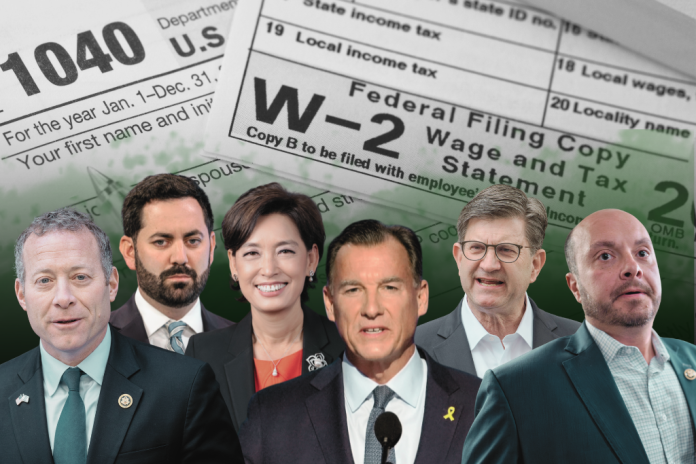
LaLota said Trump used the moment to raise the temperature on those five “saltiest” holdouts in the SALT caucus. LaLota recalled that, after the 45-minute haranguing, he was “a bit anxious that maybe our coalition might be fractured a little bit.”
But instead, the pressure campaign made the group “circle the wagons,” Garbarino told the Washington Examiner.
The group huddled in the back of the conference room after Trump spoke. There, Kim dug her heels in and rallied the others to join her in terms that belied her reputation as a soft-spoken lawmaker.
“She pointed at all of us and says, ‘Nobody talks to us like that,’ and ‘We’re not folding, we’re going to get everything we need out of this,’” LaLota said.
Kim, a South Korea-born lawmaker who represents one of the competitive districts in the country, normally avoids swearing in public, she told the Washington Examiner. But she broke that rule.
“And I said, ‘Bulls***,’” Kim recalled. “I’m using the four-letter words, and I’m supposed to be a very nice, submissive, quiet Asian-American female, you know, but I just, I guess, shattered all of their thinking.”
“Like, ‘Oh my God! If she’s using four-letter words, this must be really serious,’” Kim said.
LaLota said it was a “rallying cry” for the saltiest five negotiators.
During an interview with the Washington Examiner, Lawler recounted that Trump locked eyes with him during the fateful speech.
“I was sitting kind of fourth row, dead center, looking at the podium that he was speaking from, and a few minutes into the meeting, he, you know, caught my eye and effectively started going down the path of telling me that I just have to accept that SALT wasn’t going to happen in the bill,” Lawler said.
“He kept going on and on and on about SALT and how bad the blue states are, and it’s a tax giveaway to the blue states,” he added.
HOW THE BIG BEAUTIFUL BILL BECAME LAW: READ MORE FROM THE WASHINGTON EXAMINER’S 10-PART SERIES
House Majority Whip Tom Emmer (R-MN) characterized the Trump-Lawler exchange as “a great back and forth.”
After Trump said he knew Lawler’s district better than he did, the congressman, who is known to take on lawmakers on both sides of the aisle, said that there was a “quite extensive” back-and-forth. At one point, then-Rep. Marjorie Taylor Greene (R-GA) jumped into the fray and said the president never promised to lift the SALT cap.
“And I corrected her and pointed out that, in fact, he did campaign on lifting the cap on SALT when he was in Nassau County doing a rally,” said Lawler, who represents a district won by Kamala Harris in 2024. “He talked about it.”
Lawler said that as Trump met with the conference and spoke about SALT, he was actively texting House Speaker Mike Johnson (R-LA) and Trump’s staff to make it clear that he was not changing his position.
“And in fact, if they proceed forward without changing the text from what the Ways and Means Committee put forth, I would be a no on the bill,” Lawler said.
Garbarino and LaLota told the Washington Examiner that they would also have voted no on the One Big Beautiful Bill Act if it didn’t contain agreeable changes to the SALT cap.
“Would we have voted against the bill if it didn’t have SALT in it? I would,” Garbarino said. “I know I would have. I mean, if it kept the cap at 10, I would have had to have — I would be packing my desk up already.”
In 2017, a dozen House Republicans from high-tax states such as California and New York voted against the first Trump tax cut bill because it capped the SALT deduction.
‘You get the football, you run as hard as you can’
Negotiations over the SALT cap were some of the trickiest that Republicans faced in advancing the fiscal overhaul through reconciliation, a legislative process that allows bills to bypass the filibuster and pass with only a simple majority in the Senate.
The majority of House Republicans and all Senate Republicans not only oppose raising the cap on SALT deductions but also favor eliminating the deductions altogether. They argue that allowing filers to deduct state and local taxes from their federal taxable income only subsidizes excess spending on the part of liberal states such as New York and California.
And to raise from $10,000 to $40,000 was a big process.
The SALT agreement is an increase from the amount the Ways and Means Committee approved during markup. That bill agreed to increase the $10,000 SALT cap to $30,000 for married couples and set an income limit of $400,000. While the proposal would have tripled the SALT cap, the five “saltiest” Republicans remained steadfast, maintaining that $30,000 was too low.
Still, the only supporter of raising the SALT cap who was also on the Ways and Means Committee during this process was Rep. Nicole Malliotakis (R-NY). She told the Washington Examiner that $30,000 was a good get given the makeup of the committee, and compared the process to a football or a basketball game.
“One out of 27 wanted SALT,” Malliotakis said of negotiations in Ways and Means.
“You get the football, you run as hard as you can, and then you know somebody else takes it,” she said of her efforts.
Still, the core five saltiest members wanted more than what Ways and Means had proposed.
Malliotakis joked that at one point she was almost evicted from the SALT caucus. “I was voted off the island,” she quipped.

Kim said that, for her in particular, the stakes were high, which was why she and the other four “saltiest” members were so dug in on getting an even higher cap.
That is because, similar to New York, California is a high-tax state whose residents would disproportionately benefit from raising the cap, unlike those in states such as Texas. And while New York had representation in the caucus from Lawler, LaLota, and Garbarino, she was the only one from the Golden State.
“I was representing the entire state of California by then,” Kim said.
She said that there was a lot of weight on her shoulders.
“I knew we needed to get this done, even to much of the criticism that I was hearing back home: ‘Why are you holding up the bill? What’s wrong with the whole bill?’ I go, ‘I’m not voting it down; it’s just I’m fighting for you guys,’” Kim said. “This is something I ran on.”
‘Raised voices’ in the negotiations
Garbarino said the negotiations would get quite passionate at times.
“There’s always raised voices when you deal with a bunch of New Yorkers,” he joked. “Definitely people walked out, people, you know, didn’t come back — I mean, you had different people fighting at different points.”
Garbarino said that the only people who kept their calm most of the time during negotiations were the leadership suite — Johnson, Majority Leader Steve Scalise (R-LA), and Whip Tom Emmer.
“I don’t think we yelled at each other, that’s not right, but we definitely got frustrated and passions — I mean, I heard Kim curse once, I mean, Young Kim doesn’t curse, so … people definitely got heated, passionate,” Garbarino said.
Homeland Security Secretary Markwayne Mullin, who was then a GOP senator from Oklahoma, acted as a go-between during negotiations with SALT members and the Senate. Notably, no Republicans on the Senate side were fans of raising the $10,000 SALT cap, but negotiators knew there had to be changes because, without the SALT caucus, they wouldn’t have enough votes in the House to pass the bill.
LaLota described Mullin as “an ambassador of sorts” who had a “high degree of trust” among House members. Before Mullin became a senator in 2023, he spent a decade in the House and had forged relationships with many who are still in the lower chamber.
“He was great to work with,” Garbarino said of Mullin. “I mean, he knew we had to get something done, so he was trying to convince his colleagues that this was something.”
During the meetings and during her interview with the Washington Examiner, Kim wore a pin featuring literal salt. She even had salt packets that she would hand out to remind everyone exactly what her priorities were.
Everyone had ‘a different role to play’
As a deal was closing in, Lawler said the team was at the Treasury Department three times within 24 hours. There was a strategy to the negotiations, and the SALT team was in constant communication.
“Nick, for instance, can be a hard-charging bull at times, and you know played that role appropriately throughout,” Lawler said.
For instance, LaLota said that he skipped the last of the three meetings that led to the deal being inked. He said that was partially a negotiating tactic.
LaLota said that, after the second meeting, he felt the other side was trying to paint the SALT lawmakers into a corner, so he boycotted the next meeting in protest. He said that, with the benefit of hindsight, that “kind of solidified our position.”

“Everybody in the negotiating team had a different role to play,” he said. “I was the bad cop a couple different times.”
Kim said that despite LaLota’s absence, he was still listening in on the meeting on speaker phone.
Lawler said that Kim, who is always “very professional, very courteous,” got “heated” at times during the negotiations.
“And I think, frankly, that was good — it showed that we were not going to buckle and not going to cave,” he said.
The group also had a couple of different group chats to discuss strategy.
“We started with the larger SALT caucus group chat, and then it started getting smaller and smaller,” Kim said, until it was just the “big five.”
Kim said one of the group chats was titled “saltiest” and consisted of her, Lawler, LaLota, Garbarino, and Kean.
LaLota said that the group chats evolved over time.
“Different members throughout the last couple of years had expressed an interest to be supportive, but ultimately the five of us were the ride-or-die group, ultimately, the five of us weren’t going to cave in until we got the $40,000 that we were bargaining for,” LaLota said. “So yes, there was a decent group chat amongst us.”
A deal is struck
In the end, the deal that was reached raised the SALT cap to $40,000 for five years and included a $500,000 income threshold.
Garbarino said getting the cap to $40,000 was a big deal for his district, even with the five-year sunset.
“I think we’re very happy with what we got, rather than $30,000 forever, because the $40,000 really covers a lot of people, especially my district and other districts,” Garbarino said.
He pointed out that the standard deduction for a married couple is now just over $32,000.
“So, I mean, it would have been less than what the state deduction is,” Garbarino said.
He also said the $500,000 income threshold cap helped dispel arguments that the changes primarily benefited millionaires and billionaires.
Ways and Means Committee Chairman Jason Smith (R-MO) said that several SALT members have told him since passage that his permanent remedy “would have been better” than the final version. “No one knows what’s going to happen in five years.”
Kim made a point of highlighting how Rep. Elise Stefanik (R-NY), a close ally of Trump, got significantly involved near the end and helped the caucus reach a deal.
“She came in, and then of course, in one of our last few meetings, it really helped that she was there,” Kim said.
Treasury Secretary Scott Bessent, who was heavily involved in the SALT talks, noted that the House had to battle with the Senate, which “had no interest in SALT.
“Those blue-state Republicans did a fantastic job of representing their constituency,” Bessent told the Washington Examiner.
Sen. James Lankford (R-OK) said of the House SALT members, “We all understood their perspective, where they were, and what their constituents are feeling. They’re representing their constituents.”
Garbarino recalled that after the deal was finally reached, he was happy to be done but “mentally exhausted.” Still, a group of those who negotiated the deal went out for drinks at Joe’s Seafood, a high-end hot spot near the White House that is popular with lawmakers, lobbyists, and Washington power brokers.
“A few of us from the SALT states, as well as the White House … we walked out to [Joe’s] and got a martini or a drink,” Garbarino said. “It was mentally exhausting, so we went and had a nice cocktail afterwards — we earned it!”
While Garbarino had a martini, Lawler said he didn’t remember exactly what he ordered, but surmised that it was probably a glass of red wine, if anything.
Kim said she didn’t go out after the win because she doesn’t drink.
“And I’m like, ‘Just don’t do anything I wouldn’t do’ — I’m a mom, I’m a grandma,” Kim joked. “‘You know, I’m watching you even though I’m not there.’ And then I sent them off to celebrate because we thought we got a good deal there.”
Lawler said he saw the president again the day after a deal was reached while in the Cabinet room to discuss other provisions in the bill.
“The president once again kind of caught my eye, and he looked at me, says, ‘You know, Lawler, you did a good job. You cut a good deal. You knew when to say yes, but you made it too big of a deal. All I heard was SALT, SALT, SALT, SALT.’”
“And I looked at him, and I said, ‘Mr. “President, I read The Art of the Deal,” and he paused and said, ‘You did a good job,’” Lawler recalled with a laugh.
Lauren Green and Bob Cusack contributed to this story.
Members of the Washington Examiner’s staff who have worked on this series over the past several months are Haris Alic, Hailey Bullis, Bob Cusack, Christian Datoc, James A. Downs, Gabrielle M. Etzel, Lauren Green, Zach Halaschak, Chris Irvine, Joseph Lawler, Naomi Lim, Maydeen Merino, Callie Patteson, Mabinty Quarshie, Samantha-Jo Roth, David Sivak, and Ramsey Touchberry.