
Secret Service officials on Tuesday outlined major security modifications to the White House perimeter, including removing swords from statues and replacing temporary fencing with permanent access control measures.
Their remarks came during a meeting of the U.S. Commission of Fine Arts, which is tasked with “giving expert advice” to the federal government on “matters of design and aesthetics.” President Donald Trump stacked the committee with political loyalists who have overseen his centerpiece building projects, including the White House ballroom and Triumphal Arch.
“Our goal is to get rid of lots of the different temporary fences and barriers that we have that we need to maintain control of different security events,” Andy Stohs, a Secret Service technical adviser, told the committee.
The Secret Service’s proposal would see the current piecemeal network of temporary fencing replaced with a permanent solution around Lafayette Square, which Stohs described as the White House’s “front yard.”
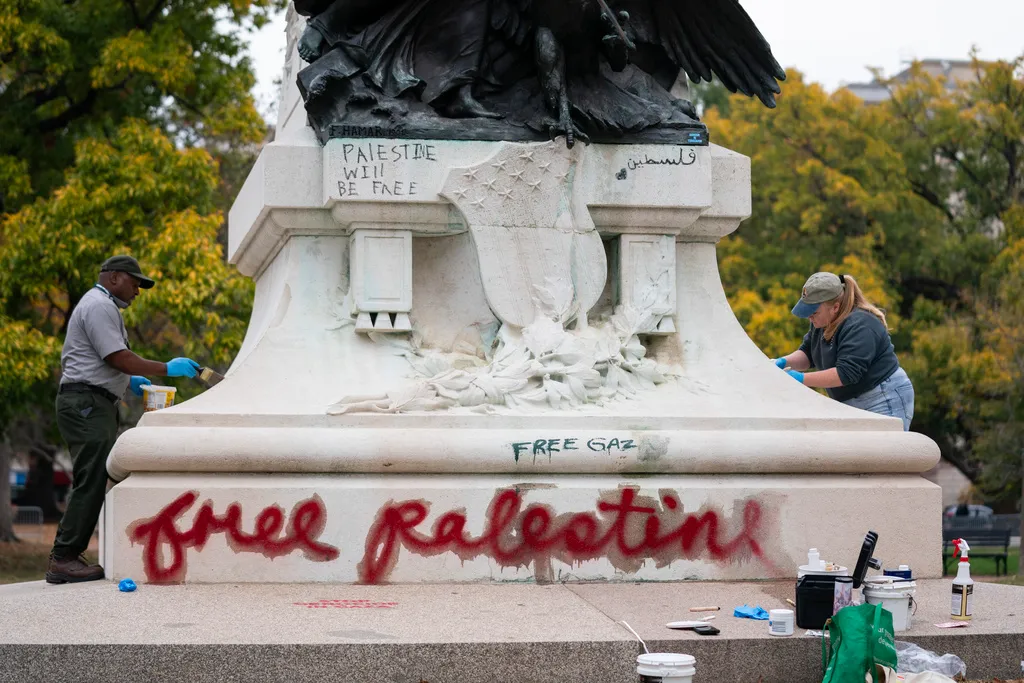
Committee members also discussed the possibility of removing swords from statues around the White House. Richard Macauley, chief of the Secret Service’s Uniformed Division, briefly referred to the idea as something “we have to do” for security reasons.
“I’ve witnessed multiple spontaneous mass incursions where officers and the public were injured as a result of a demonstration,” Macauley added.
Lafayette Square was previously the closest pedestrians could get to the White House. Trump issued an executive order a year before in which he bemoaned “vandalism” to statues in the park after the Oct. 7, 2023, attacks in Israel.
Then, in January, the National Park Service sealed the area for maintenance projects ahead of the U.S. semiquincentennial. The park was set to reopen around May 31, though it remains closed.
The Secret Service presented renderings of two possible public entrances at the end of 16th Street. One would see a series of rotating fence posts that could be opened and closed based on security conditions. The other would include two larger gates on the preexisting sidewalks approaching Lafayette Square.
The committee said it received “quite a bit of” public comment on the measure, including “well over 100 messages coming in relatively late.” It read out one message from the White House Historical Association, which owns the Decatur House on Lafayette Square, and two from members of the public.
One of the two public comments argued the changes will “suppress free speech and peaceful demonstrations in a key public forum,” adding that “claims of security risk are a pretext.”
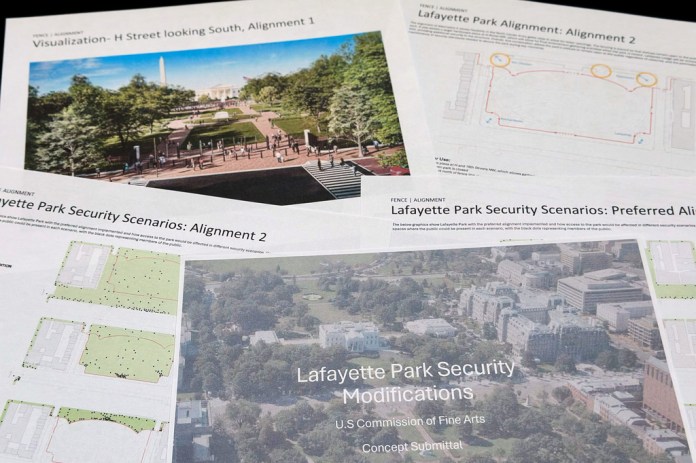
The committee also heard from Nord Wennerstrom, who represented the Cultural Landscape Foundation. Wennerstrom said the renovations have not followed the review process prescribed under Section 106 of the National Historic Preservation Act, which requires the government to consult with stakeholders over preservation concerns.
He added that, as a result, the commission has “not benefited from the input, context, and reviews by those with preservation expertise who can advise on how to avoid, minimize, and mitigate adverse effects” of the project.
KENNEDY CENTER TRIES TO REGAIN UPPER HAND IN RENOVATION WAR: ‘HAS INSTITUTIONAL SUPPORT’
In addition to the Lafayette Square renovations, the committee considered a proposal to replace the White House’s security tents with a permanent screening facility underneath Sherman Park.
The Secret Service referred the Washington Examiner to the National Park Service, which did not respond to a request for comment.