
The explosive feud between the Israeli government and the nation’s supreme court has found a new point of conflict after judges froze a bill granting ultra-orthodox believers temporary exemption from military service.
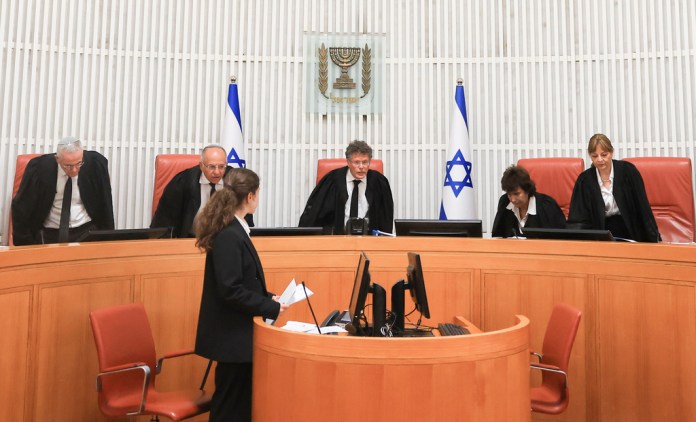
The High Court of Justice issued an injunction on Thursday blocking the implementation of the law, which was passed by the governing coalition in the Knesset on Tuesday. The law, which passed the parliament with a vote of 58-54, immediately suspended law enforcement and military authorities’ capacity to arrest or prosecute ultra-orthodox draft dodgers.
Justice Ofer Grosskopf wrote in his injunction that the law ran contrary to the High Court’s recent jurisprudence regarding the conscription of ultra-orthodox Jews.
“Given this court’s longstanding case law on the issue of drafting yeshiva students, the significance of freezing arrest, investigation and enforcement proceedings only with respect to certain segments of the population, and the serious arguments raised by the petitioners regarding the law’s validity, a temporary order is granted suspending the law’s entry into force until a further decision is made.”
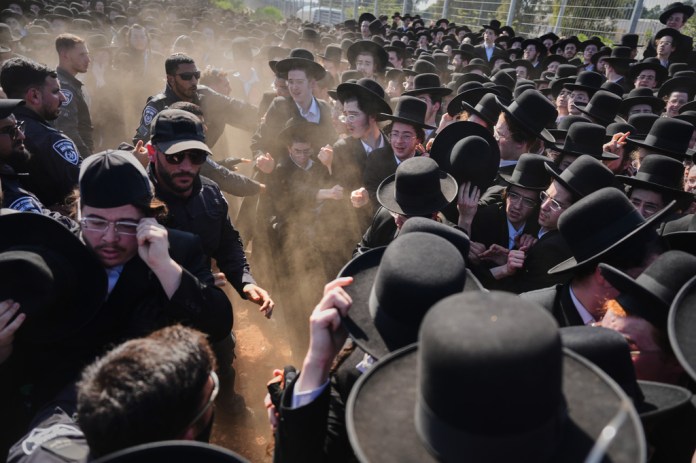
The High Court previously ruled in 2024 that the government lacked a constitutional basis for the continued exemption of Haredim from military service, finding that conscription cannot be treated differently toward the various segments of Israeli society.
Housing Minister and United Torah Judaism lawmaker Meir Porush decried the court’s intervention as “illegal” and claimed, “any police officer or soldier who arrests Torah scholars is acting unlawfully.”
Porush previously warned that any decision by the High Court to overturn the law would have “no legal validity,” threatening that if the military, police, and courts do not abide by the bill, it “will lead to civil rebellion on a scale never before seen.”
Aryeh Deri, chairman of the right-wing ultra-orthodox Shas party that helped push the legislation through the Knesset this week, scolded the court for interfering with the law. He claimed that the temporary pause on enforcement against draft dodgers was intended to provide breathing room for a greater discussion on the future of ultra-orthodox objectors.
“The speed with which the Supreme Court issued an interim order against a law passed by a majority in the Knesset is another expression of judicial activism,” Deri said. “Instead of allowing a process intended to prevent further deterioration and create time for broad consensus in Israeli society, the court has chosen to deepen the crisis.”
The temporary carve-out benefiting ultra-orthodox draft dodgers spurred immense pushback from opposition lawmakers and even some inside the governing coalition.
Deputy Foreign Minister Sharren Haskel resigned her position following the passage of the law, saying that “by passing this law, the government harmed the most important people who have been standing with us for three years for the security of Israel.”
She produced a handwritten letter to Foreign Minister Gideon Saar, asserting: “You lied to me. You lied to the people of Israel. I am resigning from my position as your deputy.”
“I feel that I can no longer support a government that harms the security of the country during wartime,” she told reporters.
The kerfuffle surrounding the draft dodging legislation dovetails with the Israeli government’s ongoing scorched earth campaign against the High Court.
Communications Minister Shlomo Karhi has called the justices “drunk with power,” while Justice Minister Yariv Levin decried them as a “gang of dictators” and Bezalel Smotrich lambasted them as a “judicial mafia.”
“The High Court justices will judge solely according to the laws that we enact (Yitzhak Rabin, may his memory be a blessing). A court order that annuls a law or ‘suspends’ a law has no validity,” Karhi said on Thursday. “There is no legal authority for such action. It is forbidden to obey lawbreakers. The law enforcement authorities in the State of Israel must obey the law. We are removing from ourselves the shackles of judicial dictatorship. Democracy.”
President Isaac Herzog has warned that failing to abide by rulings from the High Court is a “red line” that must not be crossed.