
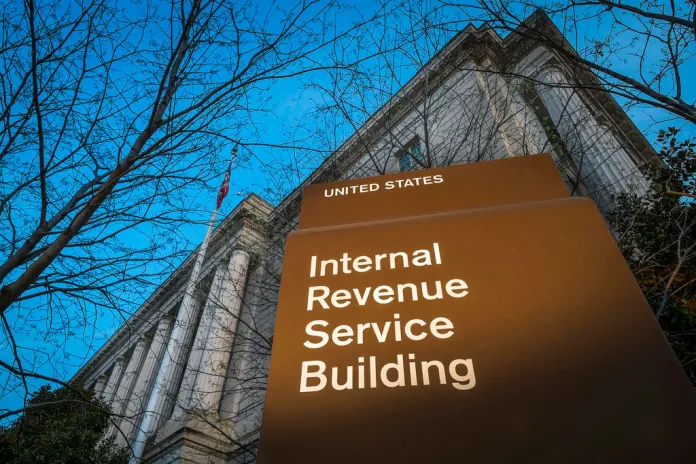
A federal judge in Florida on Monday dealt a blow to President Donald Trump over his landmark settlement with the Internal Revenue Service, barring him from citing the case in any future attempt to avoid scrutiny over his past tax filings.
U.S. District Judge Kathleen Williams, an appointee of former President Barack Obama, found that Trump and the IRS were not truly adverse to each other when the tax agency and the Justice Department agreed to settle a $10 billion lawsuit filed by Trump on Jan. 29. She also ordered sanctions for attorneys involved in the lawsuit.
“Court finds that this matter was brought for an improper purpose—to gain the imprimatur of judicial legitimacy for a ‘settlement’ that had no viable basis in law or fact,” Williams wrote in her 56-page decision.
The underlying leak at the center of Trump’s lawsuit traces back to former Booz Allen Hamilton contractor Charles Littlejohn, who pleaded guilty in 2023 to unlawfully disclosing Trump’s tax records and thousands of other confidential IRS files. Prosecutors said Littlejohn sought access to Trump’s returns because he viewed the president as “dangerous and a threat to democracy.” He previously leaked tax information connected to thousands of wealthy individuals to ProPublica.
Despite Littlejohn’s wrongdoing, Williams nevertheless found that there was not a sincere adversity between the plaintiffs — Trump and his adult children — and the IRS, based on her view that the president’s personal interests and his administration’s priorities were inextricably linked.
“Trump did not pursue his claims until he once again occupied the White House and had appointed his former lawyer, and the former lawyer of persons who are putative beneficiaries of the ‘Anti-Weaponization Fund’ to prominent positions,” wrote Williams, who reopened the lawsuit on May 29 to investigate whether the administration improperly handled the settlement.
The result of the settlement initially came with the stipulation that Trump and his adult children would be “forever” exempt from tax audits over their past filings, though it would not immunize them from audits over future filings. Barring any overturning of Williams’s decision, that benefit no longer stands following her Monday ruling.
Following the May settlement, rather than seek to collect the original request of $10 billion from the IRS, the DOJ instead proposed the formation of a $1.776 billion fund that would be subject to a public application process for those who believe the government was “weaponized” against them to submit requests for possible compensation. That plan was quickly upended earlier this summer when plaintiffs sued to stop it, and Democrats threatened to hold up Department of Homeland Security funding unless the DOJ agreed to cancel the planned fund. Congressional Republicans also expressed discomfort with the plan.
Acting Attorney General Todd Blanche testified to Congress last month that the fund would not move forward, though he has refused multiple requests to put that commitment in writing, which the DOJ has argued is unnecessary given the attorney general’s clear and public word.
However, Williams pointed out that Blanche’s own admission that the weaponization fund would not be “moving forward” was a tacit admission that the IRS and Trump were never actually adverse to one another, a requirement for bringing legitimate cases under the Supreme Court’s so-called “adversity doctrine” dating back to the mid-1800s.
The DOJ is still entrenched in two other lawsuits over the weaponization fund, though Williams’s decision further increases the likelihood that the administration will struggle to revive its plan to pay victims of government abuse or improper prosecutions.
The settlement was met with great opposition in amicus curiae, or “friend of the court” briefs, submitted to the docket. One of those briefs included 35 judges represented by Democracy Defenders Action, a left-of-center organization that opposed the terms of the settlement.
JAMIE RASKIN FILES PETITION TO KILL TRUMP’S $1.8 BILLION LAWFARE FUND
It is not immediately clear if the DOJ plans to appeal the decision on Monday.
The Washington Examiner contacted a representative for the department.