
Los Angeles Mayor Karen Bass was in office through one of the worst urban disasters in recent years as the Pacific Palisades fire destroyed more than 6,500 homes, according to city tallies. Despite ample warnings from the National Weather Service that potentially cataclysmic winds were bound for the city in the heart of its fire season, Bass headed to Ghana for a diplomatic event and was in Africa as the city burned.
Meanwhile, on her watch, Los Angeles fell deeper into the nation’s most severe homeless crisis. When the former Democratic congressional representative took power in City Hall circa 2022, the Los Angeles Homeless Services Authority reported more than 67,000 homeless people in the city. After four years under Bass and her $300 million “Inside Safe” program, a recent Los Angeles Times report found a reduction of fewer than 2,400 people, with more than 44% returning to the streets. An overwhelmed and understaffed LAPD continues to fight off the theft and violence generated by that surging homeless population.
Regardless, Bass easily found her way onto this autumn’s mayoral ballot and remains on course for reelection later this year. Los Angeles serves as a microcosm of a larger phenomenon — one example from a single American city of a pattern repeating itself in deep-blue regions across the country: Left-leaning urban voters seem remarkably tolerant of failed government.
Former New York City Mayor Eric Adams faced federal bribery, wire fraud, and conspiracy charges. In response, the five boroughs stood firm and went further left with Zohran Mamdani. While Minneapolis Mayor Jacob Frey served amid the $250 million childcare fraud case. In Minnesota’s largest city, he’s not facing major backlash from constituents.
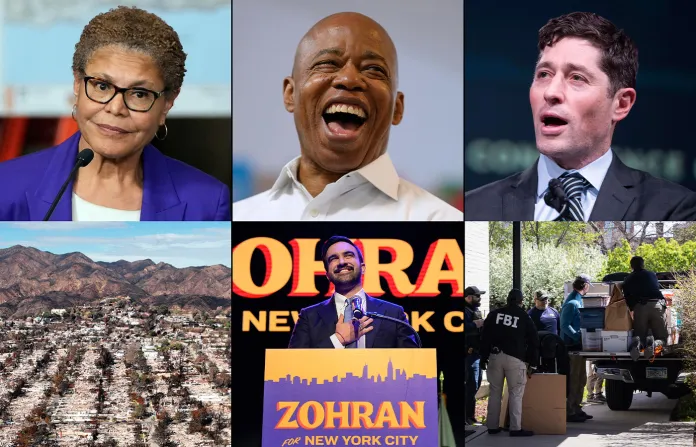
In each case, no amount of corruption, fraud, or crime discourages dedicated progressive voters from holding their course — as though questioning their candidates would equate to religious heresy.
Thom Hartmann is one of America’s most popular progressive talk show hosts and the author of the forthcoming Who Killed the American Dream? The Greatest Political Crime Ever Told. Also citing Los Angeles as a prime test subject, he acknowledges California’s cities have genuine problems, from budget woes to housing scarcity. Still, he denies blue city mayors are to blame in such cases.
“Let’s be precise about causes,” Hartmann said. “For example, the housing crisis isn’t a progressive policy failure — it’s rooted in decades of restrictive zoning, corporate real estate speculation. Homelessness requires federal funding for mental health services and addiction treatment. Blue cities can’t solve (problems like these) alone.”
Hartmann believes voters stick with Democrats despite these problems because Republican governance in comparable cities never offers credible solutions.
“When Republicans control Congress, they cut funding for (necessary) services. The question becomes: what would change if voters switched parties?”
While it seems to many that progressive voters aren’t accepting ineffectuality blindly, Hartmann insists they’re making rational choices within constrained options.
“(Voters) are choosing the party that attempts to address these problems — imperfectly, yes — over the party that denies they exist or blames them on the suffering people themselves,” he said.
Psychologist and author Scott Gibbs marks progressive loyalty (and endless conservative loyalty, when present) to defensiveness and a loss of distinction between identity and ideology.
“Admitting what failure means threatens progressive identity (‘who we are’ and ‘who we are not’),” Gibbs said. “For progressives, government is an instrument and an expression of ‘what matters — what I call an ‘Ethics of Care,’ including equality and justice. Admitting to a policy or operational problem or failure can feel like abandoning the core ideals and, thus, ‘who I am.’”
Gibbs, author of the upcoming book, Toward the Turning: Rethinking the Meaning of 9/11, the Clash of Civilizations, and a Post-Modern World, compared waiting for American progressives to consider a new path to asking a committed communist to admit that the bread lines were not … a disclosure of something problematic in the revolution itself.
“(The change) creates an anxiety-provoking disorientation,” Gibbs added. “Even worse, given that the alternative to the status quo seems to be only conservatism, admitting failure can feel like apostasy — abandoning the secular gospel of care and crossing over to perceived cruelty, punishment, exclusion, or indifference.”
Gibbs sees the resulting terror and aversion of moderating views creating a prospect that is viscerally avoided rather than reasoned through to some constructive end. Failure must therefore be denied, rationalized, or redirected outward.
“What begins as identity protection then hardens into a relational trap, as each side, liberal and conservative, states a partial truth in a form the other experiences as a threat,” he explained. “Conservative critics see corruption, incompetence, dependency, and failed enforcement. They say progressive governance has replaced standards and consequences with excuses, victimhood. and grievance. Progressives hear cruelty, contempt, victim-blaming, and exclusion, and then defend the care model more rigidly, explaining failure as systemic, underfunded or obstructed.”
To flip the script over to hard-line Republican enclaves such as Texas or states throughout the Southeast, Gibbs sees conservatives identifying disorder and ineffectuality in progressive cities that are tolerated in the name of compassion with a refusal to face reality.
“Conservatives respond by demanding order, discipline, and enforcement more aggressively,” he added. “That forcefulness confirms progressive fears, and the absurd cycle repeats, often intensifying, increasing polarization. Drama subsumes problem-solving. The reason progressives overlook government failures is defensiveness, while the alternative would be curiosity about conservative thinking or taking responsibility for failure before course-correcting.”
Back in Los Angeles, professional photographer Beau Ryan lived through multiple mayors and watched as the Palisades burned from his downtown home. He doesn’t think another term of Bass makes sense, but wonders what change of course would work moving forward. He saw conservative alternative Spencer Pratt as “a mini orange man” (another President Donald Trump) and just a reality TV star with too little experience.
“(Democratic Socialists of America member Nithya) Raman may not be the establishment’s choice come November, but she might be our only hope,” Ryan said. “It’s very ‘Bernie vs. Hillary’ at this point.”
PALISADES FIRE SUSPECT APPEARS AT EVIDENTIARY HEARING AHEAD OF TRIAL
Ryan reports a consensus from his friends that quality of life in Los Angeles and California’s major cities is low, with high rent, expensive gas made more expensive by the highest taxes in the Union, and unemployment. He sees that grind and LA culture’s hatred of Trump as draining his community’s faith in the system.
“All of it gives folks little to no optimism for an election,” Ryan said. “Most think it’s all just theater at this point and have no interest in being part of the voting process.”
John Scott Lewinski (@johnlewinski) is a writer based in Milwaukee.