
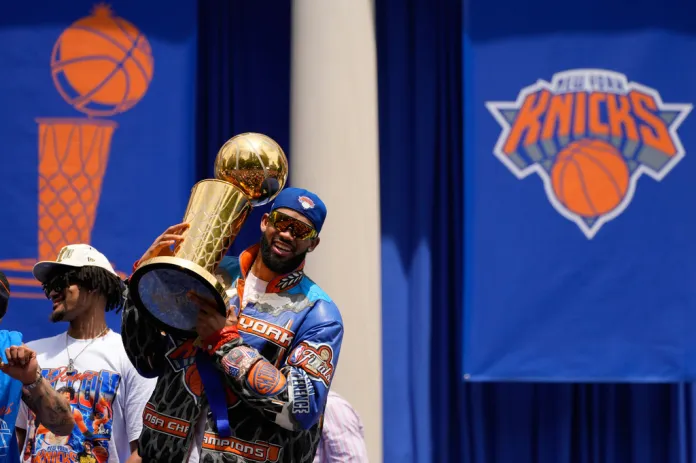
In the span of just 120 hours, from June 29 to July 3, we witnessed a cultural occurrence so unprecedented it was almost uncanny: all of the planets in the sports universe aligned. Four-time World Cup-winner Germany lost to Paraguay (Paraguay!). The Netherlands, so often the nearly men of international soccer, fell to Morocco, and the United States won its first World Cup knockout match in 24 years. Meanwhile, in the world of professional basketball, Kawhi Leonard returned to the Toronto Raptors — mere weeks after my New York Knicks won the NBA Championship for the first time in 53 years.
What made this stretch so incredible was not only the head-spinning number of huge sports stories during what is usually one of the slowest times on the sports calendar but that several of these stories overlapped. Some of the most transcendent figures across a range of sports were all gathered together on our screens at the same time. It was a real-life sports version of Midnight in Paris (2011) — but instead of meeting Earnest Hemingway, F. Scott Fitzgerald, Pablo Picasso, and Gertrude Stein in close succession, we were running into LeBron James, Serena Williams, Lionel Messi, and Kylian Mbappe.
Let’s start with soccer: Norway’s win over Ivory Coast offered us a glimpse of the figure who is quickly becoming one of the sport’s most popular players: Erling Haaland, or “Soccer Thor,” as I like to call him — a 6-foot-5-inch goal-scoring machine who is built like a Viking and who likes dressing up as a cowboy. (If you don’t know what I’m talking about, Google his social media and check out some of his posts from when the Norway national team was in Texas. You can thank me later.)
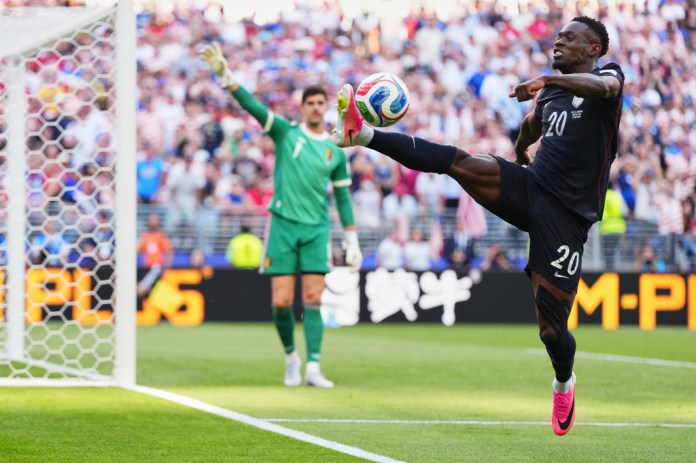
As for our very own Team USA, on July 1, we beat Bosnia and Herzegovina. (I’m not the one who came up with that joke, but I can’t resist repeating it.) Folarin Balogun scored his third goal of the tournament, only to be ejected after the most egregious officiating I can remember since … since, well, three weeks ago, when the referees somehow did not eject the San Antonio Spurs’ Victor Wembanyama for nearly decapitating the Knicks’ Jalen Brunson. (Team USA … the New York Knicks … you can’t tell what my sports biases are, can you?) The god-awful red card on Balogun forced us to play a man down for the final half hour of a World Cup knockout match. What was amazing was that we didn’t just hold our fragile 1-0 lead like we were a hockey team trying to kill a penalty. In the 82nd minute, Malik Tillman curled a free kick over the Bosnian wall in a thing of beauty that I could watch nearly as many times as I’ve seen the replay of the Knicks’ OG Anunoby’s tip-in during the NBA Finals. Given what was on the line, and what we had to do to get there, it’s the best win — and featured the single most spectacular goal — in U.S. men’s national soccer team history. Yes, I know: four days later in Seattle, Belgium beat us 4-1. It was ugly, and, frankly, we were lucky that it wasn’t 6-1. But losing to a good Belgium team on a rough night doesn’t undo all the good that U.S. soccer accomplished during these past two weeks.
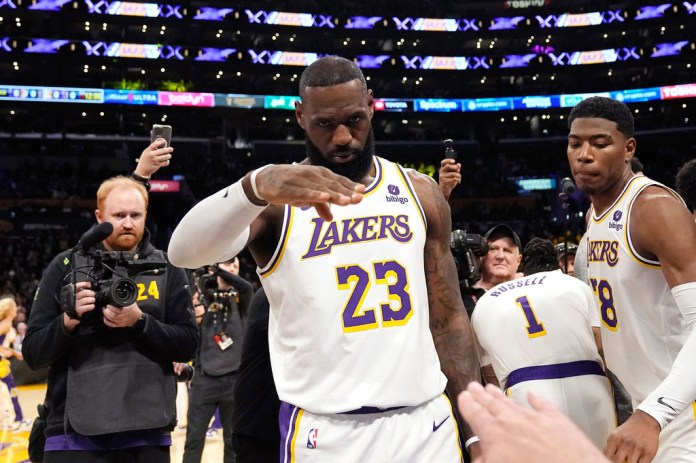
While national and international soccer was having a moment, one of the most famous non-soccer players in the world suddenly popped up on our news feeds and said, “Hey, don’t forget about me!” LeBron James told the NBA’s premier franchise that he would be moving on: After eight seasons with the Los Angeles Lakers, the player who has redefined longevity in professional basketball was choosing a new chapter for his upcoming, and unprecedented, 24th season. We still don’t know where that new chapter will take place, but two possible destinations remain in play: the Golden State Warriors and the Cleveland Cavaliers. Golden State would be the most exciting outcome, because it would mean LeBron finally getting to play with Steph Curry, his longtime rival and now close friend. Cleveland would be the most heartwarming outcome, because it would give LeBron a storybook homecoming ending to his career. Either one would be enormous; that both are on the table makes his decision to leave the Lakers a seismic one.
And then, while soccer and basketball were soaking up the spotlight, one of the most famous athletes in the world, who is neither a soccer nor a basketball player, came back into our lives again to say, “Hey, don’t forget about me!” Twenty-three-time Grand Slam champion Serena Williams made her singles comeback at Wimbledon after four years away from Grand Slam singles. Though she lost in three tight sets to 20-year-old Australian Maya Joint, her first-round exit doesn’t take away from the fact that Serena, a 44-year-old mother of two, took on a player half her age and was surprisingly competitive.
But then soccer quickly snatched the mic back. The man who can now lay claim to being the greatest English player of all time — Harry Kane — single-handedly saved England from what would have been a disastrous loss to the Democratic Republic of the Congo. David Beckham may have more commercials, but Kane is going to finish his career with more credentials. There’s also the fact that his stellar World Cup performance is cementing his status as England’s most beloved Harry (sorry, Prince Harry).
OPINION: WORLD CUP REVEALS HOW AMERICA WINS BACK THE WORLD

But wait — there was more. That’s because the all-time greatest player of the world’s most popular sport — Lionel Messi of Inter Miami and the Argentina national team — and the presumptive next GOAT once Messi walks away — Kylian Mbappe of Real Madrid and the France national team — both delivered during the stretch when their teams needed them most. Mbappe’s exploits were more ho-hum, in part because we’re becoming so accustomed to them but also because France was never in true danger. But Argentina needed every ounce of Messi’s brilliance to fend off Cape Verde — that’s right, Cape Verde, a country that (c’mon, admit it) you couldn’t find on a map before this World Cup. We overuse the David vs. Goliath metaphor in sports, but if ever there was a situation where it applied, it was in this match, where the soccer equivalent of the Jamaican bobsledding team in Cool Runnings (1993) somehow took the world’s No. 1-ranked team and the defending World Cup champions into extra time. And even after Argentina went ahead in extra time, Cape Verde somehow tied it yet again, this time with the goal of the tournament, an absolutely sensational strike from Sidny Lopes Cabral that was so unexpected and so out-of-this-world that he immediately ran off the field and leaped into the stands to hug his girlfriend as if he’d just won Wimbledon.
Was this the greatest 120 hours of sports of all time? I have no idea, but I do know this: it was incredible to watch as it unfolded. Do you believe in miracles? Maybe! Do you believe in sports? After these five days?! Yes!
Daniel Ross Goodman (@DanRossGoodman) is a Washington Examiner contributing writer and teaches theology and religious studies at St. John’s University. His next book, Dante’s Guide to Life: How The Divine Comedy Can Change Our Fortunes, Our World, and Ourselves, will be published this fall by Angelico Press.