
The Supreme Court’s decision striking down President Donald Trump’s birthright citizenship executive order has forced Republicans to rethink how — or whether — they can still achieve one of the administration’s top immigration priorities.
The high court ruled Tuesday in Trump v. Barbara that the president could not use executive authority to deny citizenship to children born in the United States to parents who are in the country illegally or temporarily. While his executive order was invalidated by a 6-3 decision, only a 5-4 majority reached the constitutional question, holding that the 14th Amendment protects birthright citizenship in those circumstances.
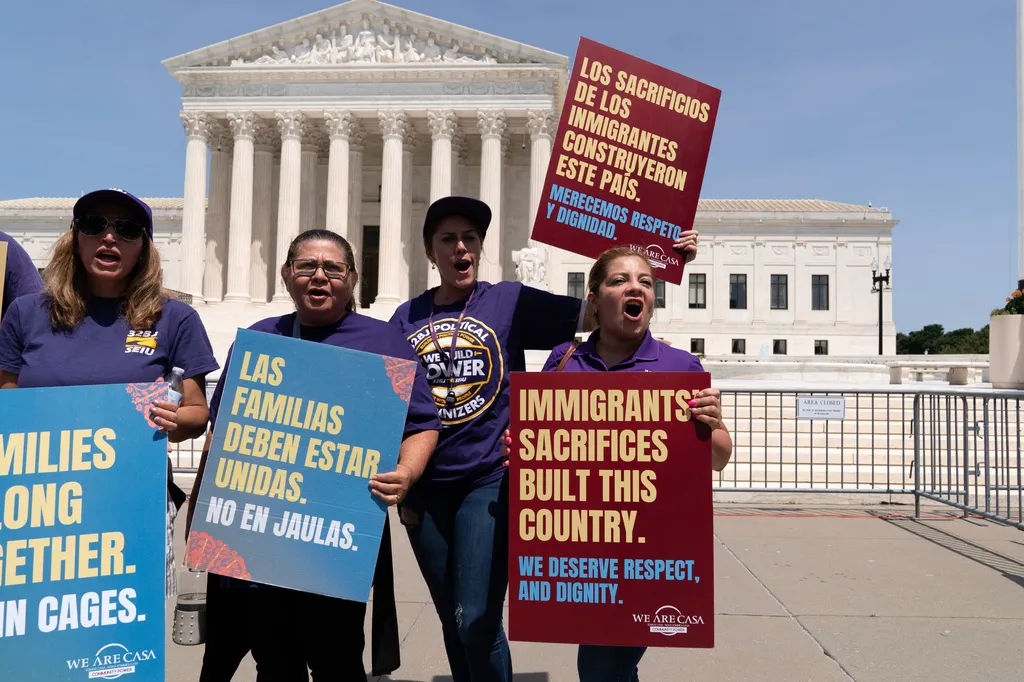
That split has sparked debate among Republicans over whether Congress still has any viable path forward to restrict birthright citizenship, or whether only a constitutional amendment could accomplish Trump’s goal.
What did the Supreme Court decide?
Chief Justice John Roberts wrote for the five-justice majority on the constitutional issue, joined by Justices Sonia Sotomayor, Elena Kagan, Amy Coney Barrett, and Ketanji Brown Jackson.
The majority concluded that the citizenship clause of the 14th Amendment extends citizenship to children born in the U.S., including those whose parents are in the country unlawfully or temporarily.
Justice Brett Kavanaugh agreed Trump’s executive order should be struck down but would have resolved the case on statutory rather than constitutional grounds. He argued Congress could amend the federal citizenship statute, 8 U.S.C. § 1401(a), to establish exceptions for children born to foreign nationals who are in the country illegally or temporarily.
Justices Clarence Thomas, Samuel Alito, and Neil Gorsuch dissented, arguing the Constitution does not require such a broad interpretation of birthright citizenship.
Has the Supreme Court completely shut the door?
That remains the central dispute among Republicans on Capitol Hill.
Trump argued shortly after the ruling that Congress could still end birthright citizenship through legislation.
“The Supreme Court upheld Birthright Citizenship … but we can easily make it up in Congress through Legislation,” Trump posted on Truth Social. “Congress should start TODAY.”
Several Republicans quickly agreed.
Sen. Eric Schmitt (R-MO) said the court “MAY have left Congress a door,” adding that he would introduce legislation while continuing to pursue a constitutional amendment.
“The Supreme Court has made its decision, now Congress needs to respond,” said Sen. Rick Scott (R-FL). “We need to be voting on these EVERY WEEK until we provide the American people with an answer.”
Meanwhile, House Speaker Mike Johnson (R-LA) also expressed disappointment, saying the ruling “subjects the country to serious challenges going forward.”
Reacting to the decision just hours after it came down, several legal experts said the majority opinion appears to leave little room for Congress to accomplish Trump’s goal through ordinary legislation.
Jonathan Adler, a professor at William & Mary Law School, said Trump’s interpretation stretches the opinion beyond what the court actually held.
“I do not share the president’s interpretation,” Adler said during a Federalist Society panel following the ruling on Tuesday. “The chief’s opinion of the court resolves the meaning of the 14th Amendment.”
“There are other things in immigration law that [provide] other tools, and certainly we’ve seen that the court has been very sympathetic to fairly strict readings of immigration statutes that might prevent entry of people, say, who are engaged in birth tourism,” said Adler, who wrote a Volokh Conspiracy blog last week saying the administration has swept all of its other immigration cases at the high court.
Also participating in the panel was Supreme Court advocate Kannon Shanmugam, who said, “I think the court was seemingly trying to shut the door” on any legislative approaches to ending birthright citizenship.
Eric Wessan, who helped represent Iowa after the state joined an amicus brief supporting the Trump administration, called the outcome “the worst-case scenario” for Trump.
“The legal holding is the worst-case scenario,” Wessan told the Washington Examiner following the panel discussion. “But the 5-4 vote is not.”
Why was the 5-4 vote significant?
Although the outcome against Trump’s birthright citizenship executive order itself was widely expected, the narrow 5-4 constitutional split was not.
“The default assumption, if you would have asked most law professors, is that the holding would have been 9-0,” Wessan said.
He said the narrower margin reflects growing originalist scholarship questioning the conventional understanding of the citizenship clause, even though a majority of the justices ultimately rejected those arguments.
Wessan also suggested the issue may not be permanently settled.
“A different case could present the question differently down the line,” he said.
Wessan’s position was reflected in the final part of Thomas’s written dissent, where Thomas accused the majority of “repurpos[ing] the Fourteenth Amendment to protect its own set of preferred rights that the Reconstruction Congress never contemplated and that cannot find support in its text.”
“I am not sure that today’s opinion will stand the test of time. The Citizenship Clause ‘added greatly to the dignity and glory of American citizenship,’” Thomas wrote. “Today’s opinion devalues that citizenship. I respectfully dissent.”
Would a constitutional amendment be realistic?
Not under the current political landscape.
A constitutional amendment requires approval by two-thirds of both the House and Senate before being ratified by three-fourths of the states.
Republicans currently lack those margins in Congress, making such an effort extraordinarily unlikely.
The Constitution also provides another avenue through a convention called by two-thirds of state legislatures. That method has never been successfully used to adopt an amendment, and any proposal would still require ratification by three-fourths of the states.
Are Republicans shifting their focus to birth tourism?
Rather than attempting to revoke citizenship for children born in the U.S. to illegal parents, some Republicans are turning their attention toward restricting so-called birth tourism — travel to the U.S. for the primary purpose of giving birth so a child acquires U.S. citizenship.
Rep. Andy Ogles (R-TN) announced Tuesday that he plans to introduce the Anchors Away Act, legislation that would prohibit pregnant foreign nationals from entering the U.S. for that purpose.
“We are literally going to be dropping Anchors Away,” Ogles said in an interview on Fox News’s The Will Cain Show. “It is time for Congress to pass a law that says you cannot come here. You cannot have a baby on U.S. soil and exploit this loophole.”
Federal policy already targets birth tourism in more limited ways.
The State Department amended its B visa regulations in 2020 to require consular officers to deny tourist visas when they have reason to believe an applicant’s primary purpose is traveling to the U.S. to give birth so a child will obtain U.S. citizenship.
U.S. Customs and Border Protection also says pregnancy alone does not prohibit someone from entering the U.S. According to agency guidance updated in November, admission remains at the discretion of CBP officers, who consider factors including the expected delivery date, intended length of stay, whether the traveler has sufficient medical insurance, and whether the traveler intends to return home. CBP says officers may deny entry if they determine a traveler is likely to become a public charge because the government would have to provide medical care.
The Justice Department also signaled Tuesday that enforcement against birth tourism will become a priority despite the Supreme Court’s ruling.
“Birth tourism schemes exploit our immigration laws and often violate our criminal laws,” the DOJ said in a statement. “The Department of Justice will prioritize the prosecutions of birth tourism schemes across the country. Actors seeking to exploit loopholes to obtain automatic citizenship for their children pose a national security threat and will be brought to justice.”
During the Federalist Society discussion, legal experts suggested those types of immigration restrictions are on much firmer constitutional footing than attempts to deny citizenship to broad swaths of children born in the U.S.
Adler said Congress and the executive branch likely retain broad authority over the admission of foreign nationals, while Wessan suggested the administration’s strategy following Tuesday’s ruling may increasingly focus on regulating birth tourism rather than attempting to strip citizenship from U.S.-born children.
What happens next?
For now, conservatives have won little more than a guidepost for future political battles over the issue.
The Supreme Court rejected Trump’s attempt to narrow birthright citizenship through executive action, and five justices appeared to close the door on doing so through ordinary legislation.
SUPREME COURT STRIKES DOWN TRUMP’S BIRTHRIGHT CITIZENSHIP EXECUTIVE ORDER
That leaves Republicans with less than desirable options. The unlikely route would be to persuade the Supreme Court to revisit the issue in a future case, or undertake the far more daunting task of amending the Constitution.
For now, the most realistic course may be to pursue narrower immigration measures targeting birth tourism and entry into the U.S.