
Despite demonstrating its dominance as the military power in the Middle East and weakening its adversaries, Israel finds itself more globally isolated about 1,000 days after Hamas’s attack, compared to where it was on Oct. 6, 2023.
Israel’s reaction to Hamas’s attack, in which roughly 1,200 Israelis were killed and 250 others were taken hostage and brought back to Gaza, was swift and immediate. Israeli Prime Minister Benjamin Netanyahu and others in his Cabinet determined immediately that the threats along their borders were no longer tolerable.
In the two and a half years since then, Israel, both with the U.S.’s backing and in some cases participation, has gone to war against Iran and its proxy forces across the region in Gaza, Lebanon, Syria, Iraq, and Yemen. Even though they have been able to significantly degrade the capabilities of Iran’s Islamic Revolutionary Guard Corps, Hamas, Hezbollah, the Houthis, and various militias based in Iraq and Syria, Israel finds itself more politically isolated globally based on its actions in the various fronts of this regional war that has consumed the region even more broadly since the start of the U.S.-Israel war on Iran.
Ned Price, who was the spokesperson for the Biden-era State Department at the time of Hamas’s attack, told the Washington Examiner: “Israel had an opportunity to emerge from October 7 with its enemies severely degraded, if not entirely vanquished, but because its strategy was military-first, and in many ways military-only, and because that military strategy was so over the top and in so many different ways, I think Israel really sacrificed so much of that potential strength and influence in the region and beyond, because it didn’t marry it with a diplomatic strategy, a political strategy, a humanitarian strategy, or a communications and messaging strategy.”
Israeli forces have killed the senior leaders of Hamas, Hezbollah, and Iran, yet those groups remain battered but intact. Hamas still refuses to disarm, as does Hezbollah, which is Iran’s primary proxy and is standing in the middle of a breakthrough Israel-Lebanon agreement, and Iran’s Guard has demonstrated it can still fire drones and ballistic missiles even after the ceasefire agreement.
Former Israeli Ambassador to the U.S. Michael Oren told the Washington Examiner: “I think Israel went to extraordinary lengths to minimize civilian casualties. That doesn’t mean there weren’t aberrations, doesn’t mean there weren’t war crimes, of course there were. The Israeli army’s made of human beings, but that was not the policy.”
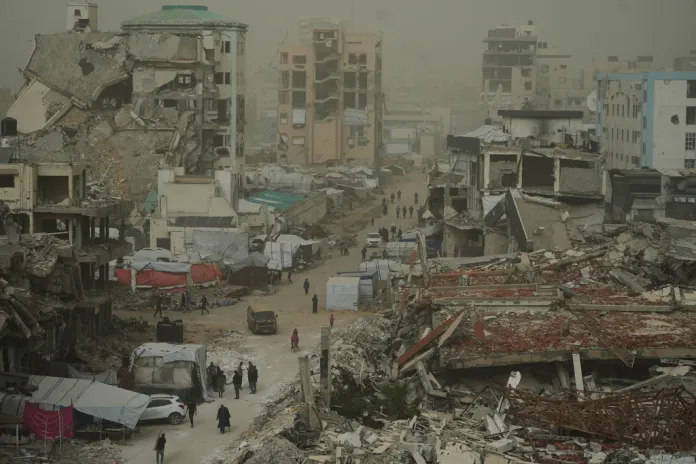
Israel is still periodically bombing Hamas and Hezbollah targets in Gaza and Lebanon, and their actions in Gaza have raised genocide allegations, which their leaders dispute.
The U.S. war against Iran has largely stagnated, where neither side seems interested in restarting the intensity of the conflict, while it’s unclear if the two sides can reach a long-term deal that includes components on Iran’s nuclear program. The Iran war also brought the Gulf States into the broader war, where they had largely avoided direct involvement in the conflicts nearby, but Iran fired missiles and drones at U.S. bases and commercial and energy targets in various Gulf countries.
Price, now the Interim Co-Director of the Institute of Politics at Harvard University, said: “One of the many ways recent months has been so, I think, tragic, because Israel in some cases with deep coordination with the United States, had managed to degrade many of its enemies, and that’s not to say we agreed or supported or condoned all of the tactics, but at the end of the day, Israel stood stronger, militarily stronger in a region where its enemies had been so very weakened, and to then squander that with continued military campaigning in Gaza, continued fighting in Lebanon, and then, of course, with what has happened in Iran that has only exacerbated tensions. It’s a real shame for Israel. It’s a shame for us.”
It’s also true that Israel demonstrated its willingness to fight alongside the U.S. in a conflict that several other U.S. allies not only declined to participate in but barred the U.S. from using their facilities for operations. Secretary of War Pete Hegseth said America’s NATO allies’ refusal to support the war was a contributing factor to the military’s review of its force posture in Europe.
Aaron David Miller, a former longtime State Department Middle East official, told the Washington Examiner: “There are no other examples of the United States partnering with any of its allies in as integrated and as seamless a fashion as the U.S. partnered with Israel in this war against Iran, you literally would have to go back to the US-British alliance during the Second World War.”
But, there have been differences in objectives and opinions in Washington, D.C., and Jerusalem, which have recently become clearer as it relates to President Donald Trump’s desire to end the war against Iran, even as Israel still views the Iranian regime as a threat worthy of mitigation. There are conversations in both parties on Capitol Hill about reducing or ending U.S. military aid to Israel.
Israel has to “diversify its foreign policy portfolio and be less reliant on one ally,” Oren said. “We should have multiple allies and multiple sources of armaments, too. I’ve been a long advocate of weaning Israel of American military aid.”
Vice President JD Vance put it bluntly earlier this month amid criticism from Israeli politicians about the U.S. and Iran memorandum of understanding.
“Donald J. Trump is the only head of state in the entire world who is sympathetic to the nation of Israel at this moment,” Vance said during a White House press briefing. “If I was in the Cabinet of the Israeli government, I might not be attacking the only powerful ally that I have anywhere left in the entire world.
“You’re a country of 9 million people,” he said of Israel in a New York Times podcast. “You can’t just kill your way out of solving every single national security problem that you have.”
AIR FORCE’S ‘NASCAR PIT CREWS’ FORCED INTO OVERDRIVE BY IRAN WAR
The vice president’s remarks highlight Israel’s apparent lack of strategic planning to go along with its military might, even as the country proved itself willing and capable of going to war alongside the U.S.
It has come at a cost geopolitically. Netanyahu is wanted by the International Criminal Court for alleged war crimes in Gaza. Several allies have chosen to unilaterally recognize Palestinian statehood in contravention of Israel’s stance.
Andorra, Belgium, Luxembourg, Malta, Monaco, France, the United Kingdom, Canada, Australia, and Portugal all recognized Palestinian statehood at last year’s United Nations General Assembly.