
Democratic campaigns fumed Tuesday at the Supreme Court for striking down limits on coordinated spending between political parties and candidates, a conservative 6-3 majority ruling that is set to open the donor floodgates for the midterm elections.
Democrats fear it will buoy Senate Republicans in particular, who mounted the legal challenge over First Amendment claims and often rely on larger donors, and say the latest rollback of campaign finance restrictions is an “invitation for corruption.”
The Democratic National Committee and the party’s campaign arms for the House and Senate said the ruling will “eliminate a key safeguard against corruption in our elections.” In a joint statement, the committees condemned Republicans for a “clear and blatant effort to rewrite election rules for their own benefit and spend more money from billionaires to prop up their candidates.”
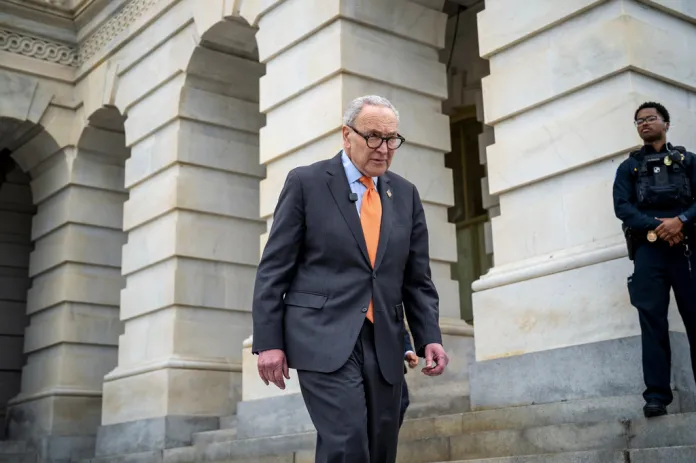
Senate Minority Leader Chuck Schumer (D-NY) said the high court, which made its determination along its ideological divide, gave “wealthy and big-money special interest groups the green light to buy elections.”
“Today’s decision eviscerates one of the last fragile guardrails on coordinated political spending and will unleash a new arms race of campaign spending, bringing in even more special interest money to our elections,” Schumer said.
In a ruling led by conservative Justice Brett Kavanaugh, the Supreme Court said restrictions established in 1974 on coordinated campaign spending violated free speech. Prior caps from the Federal Election Commission on such coordination, valued at anywhere from $130,600 to $4,071,800 for Senate candidates and up to $65,300 for most House candidates, were designed as guardrails against corruption. Now, candidates and party fundraising arms can spend unlimited amounts in conjunction with one another, including for events, staff, and travel. In 2010, the Citizens United v. FEC decision allowed unlimited super PAC spending.
The chairmen of the House and Senate GOP campaign arms said the court “restored core political speech and ensured parties can compete on a level playing field.”
“A massive win for the First Amendment that gives power back to political parties over dark money Super PACs,” said Sen. Bernie Moreno (R-OH), who is reportedly angling to become the next chairman of the Senate GOP campaign arm. “Voters deserve to hear directly from candidates, not shady, nameless outside groups.”
Democrats also sought to downplay the perceived victories for Republicans, which were largely anticipated given the court’s political leaning.
“No one’s really pissed since we’ve been anticipating for so long,” a Democratic campaign operative told the Washington Examiner.
“In terms of game plan, it’s likely that party committees DCCC and DSCC will do more TV than they ever have before since they can get candidate rate and HMP/SMP will expand digital budget,” that person added, referring to the chief super PACs for House and Senate Democrats.
TRUMP AND RNC PREPARED TO FLOOD MIDTERM ELECTIONS WITH CASH FOLLOWING SUPREME COURT WIN
It is also possible that the ruling could allow the committees access to cheaper ad rates at candidate-level pricing. But the Elias Law Group, the Democratic-linked firm that defended Democrats’ appeal, challenged that thinking.
“Even the Trump Administration’s own Solicitor General told the Supreme Court that broadcasters are required to offer those rates for candidate spending, not party spending, whether coordinated or independent,” lawyers Jacquelyn Lopez and Rachel Jacobs said in a statement.
Lauren Green contributed to this report.