
A federal appeals court on Wednesday heard arguments from Rep. LaMonica McIver (D-NJ) and the Trump administration over whether the New Jersey Democrat’s assault prosecution should be thrown out before trial, setting up a major test of congressional immunity and executive branch authority.
A three-judge panel of the U.S. Court of Appeals for the 3rd Circuit convened in Wilmington to consider McIver’s effort to dismiss federal charges stemming from a confrontation outside the Delaney Hall Immigration and Customs Enforcement detention facility in Newark last year.
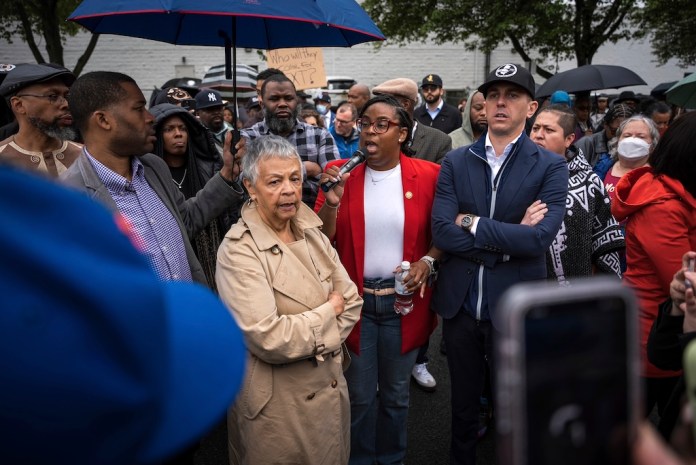
McIver, a first-term Democrat from Newark, faces two felony counts and one misdemeanor count accusing her of assaulting and impeding federal officers during the May 9 incident at the ICE facility last year. Federal prosecutors allege she attempted to interfere with the arrest of Newark Mayor Ras Baraka (D) and pushed officers during the chaotic confrontation.
The appeal follows a ruling by U.S. District Judge Jamel Semper, an appointee of former President Joe Biden who rejected McIver’s effort to dismiss the indictment on constitutional and prosecutorial misconduct grounds last November.
At the center of Wednesday’s hearing was McIver’s argument that her actions occurred while carrying out a congressional oversight visit and are protected by the Constitution’s speech or debate clause, which shields lawmakers from prosecution for legitimate legislative acts.
Her attorneys have argued that allowing the case to proceed would chill congressional oversight and undermine the separation of powers by exposing lawmakers to criminal liability for performing official duties.
The Justice Department has urged the appeals court to reject that argument, contending that the speech or debate clause does not extend to alleged acts of violence. In its appellate brief, the government framed the dispute as a straightforward question of whether members of Congress can claim immunity for allegedly assaulting federal officers. Prosecutors argued that McIver’s charges arose from “attempts to prevent those officers from arresting Newark’s mayor” and from allegedly pushing an officer while reentering the facility.
The government also argued that the appeals court lacks jurisdiction to immediately review several of McIver’s additional claims, including allegations of selective and vindictive prosecution. Prosecutors maintain that McIver failed to show similarly situated politicians were treated differently and failed to provide evidence that prosecutors acted out of political animus.
McIver has argued the prosecution is politically motivated and tied to her outspoken opposition to the Trump administration’s immigration enforcement policies. She has repeatedly characterized the case as an attempt to criminalize congressional oversight, according to her brief at the 3rd Circuit.
Before entering court Wednesday, McIver wrote on social media that President Donald Trump “wants to lock me up for 17 years for doing my job” and said she was fighting to hold the administration accountable for its immigration policies.
Several House Democrats, including Reps. Jamie Raskin (MD), Rashida Tlaib (MI), Jasmine Crockett (TX), Terri Sewell (AL), and Delia Ramirez (IL), publicly expressed support for McIver ahead of the hearing.
The three-judge panel did not immediately rule from the bench. The judges weighing her case were Judges Stephanos Bibas, an appointee of Trump, Cindy Chung, a Biden appointee, and Thomas Ambro, an appointee of former President Bill Clinton.
BIDEN-APPOINTED JUDGE RIPPED AFTER BLOCKING ICE ARRESTS AT IMMIGRATION COURTS
A decision is expected in the coming months and could determine whether McIver proceeds to a criminal trial or succeeds in ending the prosecution before a jury hears the case.
A ruling in her favor would mark a significant expansion of protections available to lawmakers conducting oversight activities. A ruling for the government would allow the criminal case to move forward in federal district court while clarifying that congressional immunity does not shield members from prosecution for alleged physical confrontations with law enforcement.