
Senate Judiciary Committee Chairman Chuck Grassley (R-IA) on Thursday accused Senate Democrats of engaging in “bad-faith obstruction” that he said is contributing to a growing standoff involving President Donald Trump’s nominee for director of national intelligence and efforts to renew key federal surveillance authorities.
During a committee meeting Thursday morning, Grassley pointed to Senate Minority Leader Chuck Schumer’s (D-NY) handling of judicial and U.S. attorney vacancies in New York as an example of what he described as an increasingly unsustainable use of the Senate’s blue slip tradition.
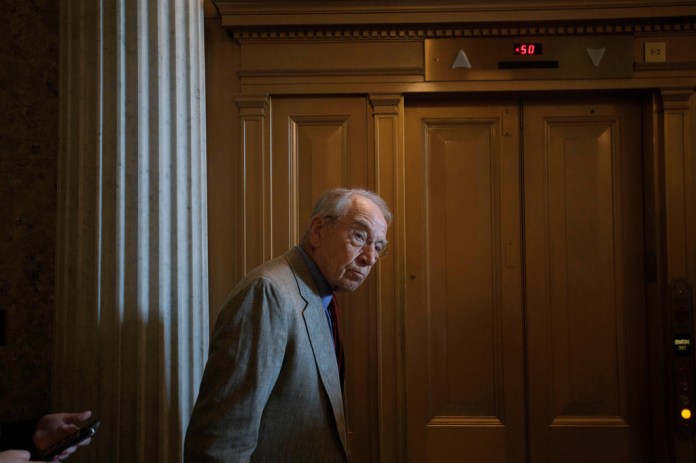
“This isn’t sustainable. This isn’t good faith,” Grassley said, marking some of his strongest public expressions of skepticism yet over the tradition thanks to Democrats’ continued blockade on key Trump nominees. “Democrats expect Republicans to adhere to precedent and norms while undermining them at every turn.”
The blue slip tradition allows home-state senators to block or delay consideration of district court judges and U.S. attorney nominees. Trump has called on Republicans to end the practice to facilitate the confirmations of his judicial and Justice Department appointments.
The chairman’s remarks come a day after Trump abruptly halted the confirmation process for Jay Clayton, his nominee to lead the Office of the Director of National Intelligence. Clayton had been scheduled to appear before the Senate Intelligence Committee on Wednesday before Trump announced he would not move forward with the nomination until Jamie McDonald is confirmed as U.S. attorney for the Southern District of New York.

Trump argued that he does not want to remove Clayton from his current role as the top federal prosecutor in Manhattan until a permanent replacement is installed. However, McDonald’s path to confirmation faces significant obstacles because New York’s Democratic senators, Schumer and Sen. Kirsten Gillibrand (D-NY), have not provided support through the Senate’s blue slip process.
“For more than a year, Senator Schumer refused to return a blue slip or consider the highly qualified nominee that the President put forth,” Grassley said. “Senator Schumer has also refused to consider any nominee for other U.S. attorney and district court seats in New York. In fact, Senator Schumer refused to even meet with the Administration to find a path forward.”
The dispute has also complicated negotiations over reauthorizing Section 702 of the Foreign Intelligence Surveillance Act, a surveillance authority used by intelligence agencies to collect foreign intelligence information. The authority lapsed last week, and Senate negotiations have stalled amid disagreements over intelligence leadership.
Some Democrats had viewed Clayton as a compromise nominee for DNI and were more open to discussing a FISA renewal if he replaced acting DNI Bill Pulte. Trump’s decision to pause Clayton’s nomination has cast additional uncertainty over those talks.
“Our Senate practices and norms will only survive if there’s good faith on all sides,” said Grassley, who has in recent months bucked Trump’s calls to ignore the blue slip tradition. “If the blue slip practice is going to continue, Senate Democrats must stop bad-faith obstruction, and they must stop it now.”
VANCE PUSHES SENATE TO FORCE SAVE AMERICA ACT SHOWDOWN OVER FISA: ‘WHY DON’T WE TRY?’
Grassley’s comments came at the start of a Senate Judiciary Committee executive business meeting where lawmakers advanced six judicial nominees, DOJ inspector general nominee Don Berthiaume, and Sean Costello, Trump’s nominee for U.S. attorney for the Southern District of Alabama.
The committee also took up the bipartisan NO FAKES Act, legislation aimed at combating unauthorized artificially generated replicas of a person’s voice or likeness, which advanced unanimously out of committee Thursday.