
A federal appeals court appeared skeptical Friday of the Trump administration’s bid to build the proposed White House ballroom, but it also sharply questioned whether a preservationist group can even sue to stop the project.
A three-judge panel on the U.S. Court of Appeals for the D.C. Circuit heard arguments from both the Department of Justice and lawyers for the National Trust for Historic Preservation on whether to reverse a lower federal judge’s order halting construction of the East Wing renovation project. The DOJ has largely argued that halting construction would jeopardize the security and safety of the president and the White House complex, but during Friday’s hearing, the judges focused their questioning on whether the preservationist group has proven enough of an injury to sue over the construction project.
DOJ lawyer Yaakov Roth opened his arguments by taking aim at the fact that the Trust’s lawsuit rests on the concerns of a board member of the group, who claimed in the initial lawsuit that the new ballroom would permanently alter the landscape of the White House area for the worse and would harm her “use and enjoyment of President’s Park.”
“It is simply that she thinks she will not like how it looks after the building is built. That is a classic generalized grievance,” Roth said, urging the appeals court to find that the group does not have standing to sue over the ballroom project.
One of the judges asked a hypothetical question about whether, if the administration wanted to level the executive mansion part of the White House, which is not affected by the ballroom project, a descendant of a slave who helped build the White House would have the ability to sue over the project. Roth responded that if the person in that situation sued before demolition, he or she could, but if the structure had already been destroyed, then there would be no standing to sue.
“The answer is no, they can’t sue as long as the government goes too fast before anyone can file a lawsuit, or in fact says there’s going to be a public input process, and then moves immediately quickly before that process even starts, correct,” one of the judges said, appearing concerned by Roth’s answer.
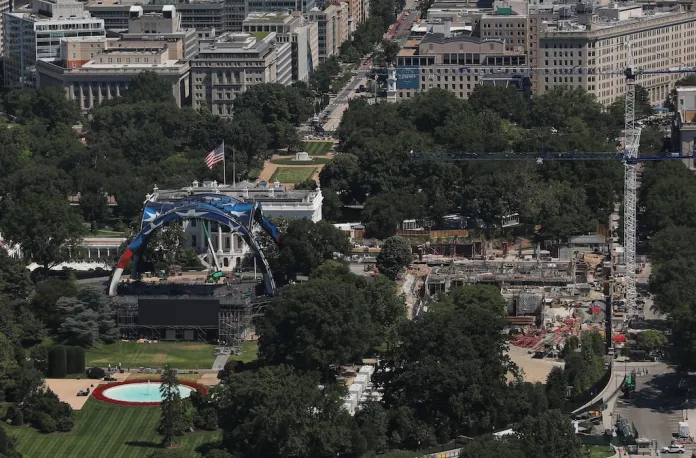
Roth noted that with the ballroom litigation, the trust waited nearly half a year after the project was announced, and two months after demolition began, to file a lawsuit. The judge asked if the DOJ believes that if the government were to demolish the Statue of Liberty, people with a connection to the statue would be unable to sue if the government demolished it before they could file a lawsuit. Roth responded that that is indeed the DOJ’s stance.
Thaddeus Heuer, lawyer for the conservationists, was also grilled by the panel on the trust’s ability to sue over the project, with one of the judges opening questioning by saying she had a “hard time seeing” how the group has standing when compared to other high-profile cases where groups were found by courts not to have standing. The judge questioned the trust board member’s reliance on the aesthetic harm she might experience when she walks by the White House “maybe once a month” as the basis of her legal injury.
Heuer focused on how the President’s Park, where the White House complex sits, is under the governance of the National Park Service and therefore should be preserved for what the NPS designed it to be, which he claims is to “preserve the cultural resource of the White House.” One of the judges asked how the project would not promote the NPS mission and use of the President’s Park, noting that the new East Wing would be important for national security, hosting state dinners, and other events. Heuer pointed to an environmental assessment of the ballroom project, which noted it would have adverse effects on the park, a point Roth would later dismiss as cherry-picking a single line out of an extensive report.
Another point brought up in the judge’s questioning was over why past White House projects, such as the tennis pavilion or the swimming pool, were not subject to the same congressional approval that the trust argues the ballroom project needs. Heuer said the projects likely needed the same amount of approval, but no one ever sued over them.
The three-judge panel included U.S. Circuit Judges Patricia Millett, an appointee of former President Barack Obama; Neomi Rao, a Trump appointee; and Brad Garcia, an appointee of former President Joe Biden. The appeals court did not say when they would issue a ruling on the Trump administration’s appeal or how they would rule.
DOJ INVOKES WHITE HOUSE SHOOTING IN APPEAL TO CONTINUE BALLROOM CONSTRUCTION
Trump’s proposed ballroom project has been met with uproar from Democrats and left-wing activists since it was announced last year. The preservationist group’s lawsuit is the main effort to halt the project.
While Trump had insisted the project would be fully financed by private donations, his administration attempted to secure federal funding from Congress for the security improvements to the White House complex as part of the East Wing project. Despite the president’s push, the Senate axed Trump’s proposal for security funding in the wider immigration enforcement funding bill earlier this week after concerns from several GOP senators about the optics of approving such funding.