
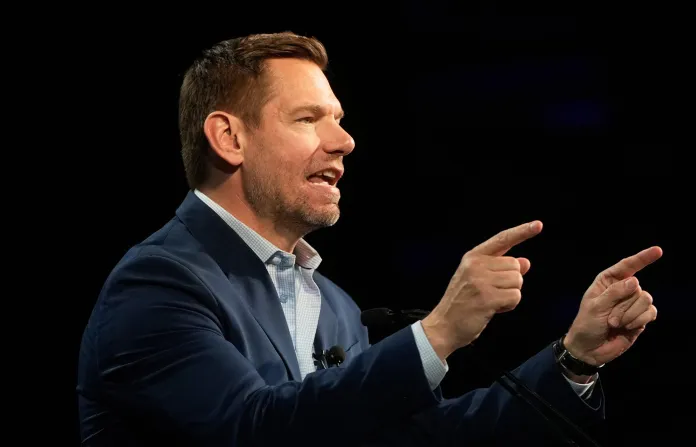
When the first allegations of sexual assault fell on then-Democratic Rep. Eric Swalwell while he was still the anointed favorite in California’s governor’s race, his camp’s first strategy to fend off the controversy was to blame President Donald Trump and his supporters.
Swalwell eventually faced public claims of harassment and rape from more than five women and calls for his congressional resignation from more than 50 former staffers.
As the charges emerged, former campaign spokesman Micah Beasley said: “This false, outrageous rumor is being spread 27 days before an election begins by flailing opponents who have sadly teamed up with MAGA conspiracy theorists because they know Eric Swalwell is the frontrunner in this race.”
How Republican agents could somehow influence former Democratic staffers and progressive social media influencers to accuse a then-high-ranking Democrat of serious misconduct was not made clear. Within days of the alleged victim’s statements emerging, Swalwell no longer clung to the MAGA theory, ending his gubernatorial campaign and resigning from the House.
The ugly public theater remains one of the best examples of Democrats using the Left’s hatred of Trump as a cure-all and defense against any questionable policies or corruption charges. With hatred of Trump standing as a primary political philosophy and a motivator for the Left, it begs the question of who or what could replace the president once he heads a lame duck administration before eventually leaving the White House.
According to Emma Alves, senior attorney at Alves Law and a student of election strategy, Democrats are effectively running on Trump’s unpopularity. She cites a May 2026 NPR/PBS News/Marist poll showing the president’s overall disapproval rating at 59%
“It is the largest disapproval in Marist’s history for both of Trump’s terms, and that’s the number on which Democrats are running — and it’s working,” Alves said. “But is ‘blame Trump‘ now a reflex, rather than a stance?”
She points to the Swalwell situation this spring as an example of the blame pattern. The first MAGA plot didn’t stick. It gained time, but lost credibility.
“If the Democrats flip the House after 2026 and it’s two years of lame duck governance, do the Democrats become a party that hasn’t established a forward-looking identity?” she asked. “The blame Trump tactic has an expiration date.”
John Phillips is a former CNN commentator and a radio host with a daily show on KABC in Los Angeles and KSFO in the Bay Area. He believes nothing supersedes Trump hatred as a focus for Democratic voters in his native and Democratic-dominated California. Even with its nationally-publicized problems of crime, poverty, homelessness, and affordability.
“I have a good friend whom I won’t name,” Phillips said. “She’s on the Left, but she’s smart and fun to talk to over a couple of drinks. She’ll look around and admit she hates the crime. She hates the homelessness. She moved out of Los Angeles because of it. But she considers all of that just the reality of living in California. The only thing she cares about as a voter is resisting Trump.”
Phillips calls the obsession “orange man bad” and sees a convenience in the Trump obsession for Democrats.
“In that way, (Trump) is the best thing that ever happened to (Democrats),” he added. “Look at the disaster California has become under one-party blue control for a couple of decades now, with its population declining for the first time in history. (Democratic officials) and liberal voters avoid reevaluating their policies by blaming everything on Trump.”
A deflection strategy
Offering a legal analogy in place of a political take, former U.K. Crown Prosecutor and current defense attorney Michael Kruse cites the all-encompassing Trump blame as a form of classic deflection.
“The pattern of political deflection strategy follows the same logic that I see argued in courtrooms,” Kruse said. “Blaming Trump works the same way deflection works in a trial, as it buys time, but it has a hard limit. Deflection tactics provide temporary confusion and uncertainty for an audience to continue listening, but once it becomes too obvious that the actual underlying facts are indisputable, the deflection tactics cease to be effective.”
Kruse believes Democrats will stop using Trump as a fall guy and will need to find something else to blame. It’s a question of when and who or what they’ll accuse.
“In court, when a defense has exhausted its ability to deflect blame, it will begin to attack the process as opposed to addressing facts,” Kruse explained. “This tactic is predictable and easily recognized by juries. Voters will also recognize this tactic as blaming a system (in place of a person) is much less likely to invoke emotion and much less likely to stick.”
James Christopher is a New York-based political strategy and public relations consultant for Democratic campaigns throughout the state. He acknowledges Trump is one of the Democratic Party’s most effective political foils but does not reduce that dynamic to mere scapegoating.
“Democrats do not invoke Trump simply because he is polarizing,” Christopher said. “They invoke him because he represents an unprecedented concentration of political, judicial, and economic power.”
Christopher holds that what makes Trump politically durable as both a target and a mobilizer is not just his rhetoric, but the perception that nearly every major lever of federal power has increasingly aligned around him.
“Republicans control Congress. The conservative supermajority on the Supreme Court has expanded executive latitude, and the executive branch itself has become more centralized and confrontational under Trump than under perhaps any modern presidency. Trump remains such a powerful political focal point for Democrats beyond simple outrage politics.”
TRUMP ENDORSEMENT TRACKER: HERE’S WHO THE PRESIDENT HAS PICKED IN GOP MIDTERM ELECTION PRIMARIES
Christopher sees some truth to the criticism that Trump has become such a dominant political “gravity well” that many Democratic officials reflexively invoke him to redirect attention away from local governance failures.
“The danger for Democrats is that anti-Trump politics alone is rarely durable without a compelling affirmative vision,” he said. “Running against Trump is politically easier than governing in a country where trust in institutions continues eroding across the board.”
John Scott Lewinski (@johnlewinski) is a writer based in Milwaukee.