
The week began with Sen. Bill Cassidy (R-LA) losing his primary to a Trump-backed challenger. It went only downhill from there for Senate Republicans.
On Monday, the Department of Justice unveiled a $1.8 billion “anti-weaponization” fund to compensate Biden-era “lawfare” victims, including possibly for U.S. Capitol rioters. President Donald Trump snubbed Sen. John Cornyn (R-TX) to endorse GOP opponent Ken Paxton on Tuesday. By Wednesday, the GOP’s $70 billion immigration enforcement bill was on shaky ground over $220 million in ballroom security funding that Trump wanted.
The turbulent week ended on Thursday, when senators headed for the exit, following contentious closed-door meetings with administration officials. GOP leadership decided it would rather pause deliberation over the reconciliation legislation, rather than risk a full-scale rebellion over politically toxic provisions. Lawmakers won’t return until June 1, after a more than weeklong Memorial Day recess.
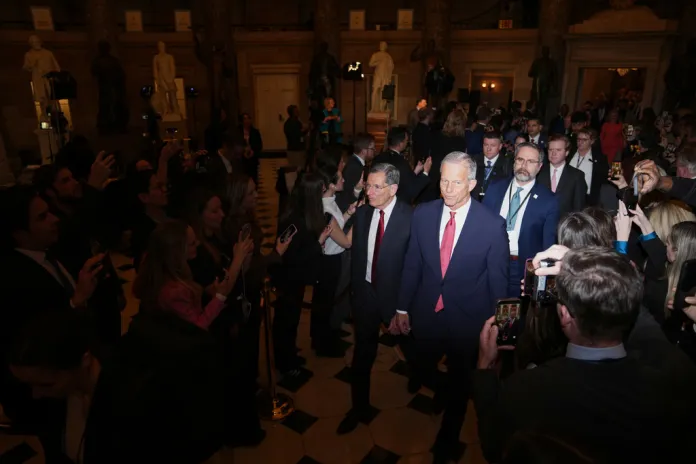
“It was something that was supposed to be very narrow, targeted, focused, clean, straightforward,” Senate Majority Leader John Thune (R-SD) said. “It’s hard to divorce anything that happens here from what’s happening in the political atmosphere around us.”
Thune’s predecessor offered a more blunt assessment.
“So the nation’s top law enforcement official is asking for a slush fund to pay people who assault cops?” Sen. Mitch McConnell (R-KY), the former longtime GOP leader, said of the DOJ fund in a rare statement. “Utterly stupid, morally wrong — Take your pick.”
In the Oval Office, Trump deflected whether he was “losing control” of the GOP-led Senate.
“I don’t know, I really don’t,” the president told reporters. “I can tell you, I only do what’s right.”
Handwringing over the ballroom security funding, part of a broader $1 billion tranche to better secure the White House complex, was compounded by the anti-weaponization fund. Republicans remain deadlocked over how much of the security money to strip from the measure and how to place restrictions on who may qualify for fund payouts, such as Capitol rioters accused of assaulting police.
Democrats were at the ready to blitz Republicans with a series of tough amendment votes during a marathon session that leadership was forced to scrap. Although reconciliation is a filibuster-skirting process that does not require Democratic buy-in, votes to ban the DOJ payments and strike the ballroom funding may have been able to pass with GOP defectors and turn the bill into a nonstarter for Trump or some House Republicans.
“Republicans are in complete disarray,” Senate Minority Leader Chuck Schumer (D-NY) said. “They’re at each other’s throats, and the American people are suffering for it.”
But the timing of the anti-weaponization fund, created as part of a settlement over Trump’s lawsuit against the IRS for leaking his tax returns, came amid underlying tensions from the campaign trail and Trump’s ballroom that pushed Republicans to their limit. They placed the blame on the White House, which canceled a Thursday meeting with GOP lawmakers in response to the uproar.
“There is a tremendous amount of frustration because DOJ didn’t need to settle the case when they did and didn’t need to announce this fund,” a senior GOP aide told the Washington Examiner.
Thune placed the onus on the administration or the DOJ “to come up with some suggestions and ideas” for policy guardrails on the settlement fund.
A White House memo on the fund and private lobbying from acting Attorney General Todd Blanche failed to assuage concerns. Roughly an hour after Blanche left the Capitol, senators threw in the towel on their reconciliation bill until after the holiday recess.
“Yeah, we’re going home,” Sen. John Kennedy (R-LA) said.
Senate Appropriations Committee Chair Susan Collins (R-ME), facing a battleground reelection, raised the alarm to Blanche about Capitol rioters receiving compensation. Collins said she needed more clarity after Blanche “seemed” to commit such individuals would be ineligible for a settlement. Thune confirmed the White House did not consult with Hill GOP leadership about the DOJ fund prior to its announcement.
To make matters worse, Republicans were already stewing over Trump’s revenge tour against those he’s accused of being insufficiently loyal, including Cassidy and Cornyn.
“There’s a political component to everything we do around here,” Thune said. “You can’t disconnect those things.”
SENATE PUNTS IMMIGRATION ENFORCEMENT VOTE OVER ‘ANTI-WEAPONIZATION’ FUND OUTRAGE
Over in the House, Speaker Mike Johnson (R-LA) kept his powder dry. His focus was on crafting a possible third reconciliation bill — the first was Trump’s mega tax law last year, and the ongoing immigration measure is their second — that Republicans could focus on next before the November midterm elections.
“The Senate clearly needs a little bit more time to find consensus on reconciliation 2.0,” Johnson said. “Meanwhile, in the House, we’re working on reconciliation 3.0 to have that one ready to go.”
Lauren Green and Hailey Bullis contributed to this report.