
The Iranian blockade of the Strait of Hormuz has tanked the global economy and driven oil prices up dramatically, raising the question of what other vital waterways could cause this type of fallout if another bad actor sought to exert control over them.
There had always been the possibility that the Iranian regime could try to control the strait due to the geography of the region, but it wasn’t until the United States and Israel declared war against them on Feb. 28 that they tested the theory, and it’s worked.
Prior to the start of the war, approximately a fifth of the world’s oil would travel through the strait daily and with Iran’s threats to fire drones and ballistic missiles at vessels that don’t meet their demands, which includes payment, traffic through it has plummeted.
Ahead of the joint strikes in February, as many as 180 vessels could be spotted transiting the waterway daily, with typical levels around 130-140. Just hours after the attacks, dozens of ships anchored and traffic dropped by around 70% that first weekend of the way. Since then, traffic has dropped by as much as 97%.
This major disruption in flows of crude and other petroleum products has caused oil and gasoline prices to surge. The national average gas price was $4.53 a gallon as of Tuesday, according to the AAA motor club, which is significantly higher than where it was two days before the war began, when gas cost $2.98 a gallon.
Even if the U.S. and Iran are able to come to an agreement to end the stalemate, the Iranian military still has the capability to do this again in the future.
Laws of the high seas
There are international laws that govern how countries and vessels can operate on the water. The twelve nautical miles from land is considered the sovereign territory of that country, and its sovereignty extends both in the airspace over that area and the seabed below it.
Countries can exert their own laws within the territorial sea — that 12 nautical mile zone — but the United Nations Convention on the Law of the Sea requires all ships be allowed the right of safe passage through it, though those vessels are also forbidden from threatening, surveilling, propagandizing against the state, and more.
No country is permitted to seek control of the high seas outside that 12 nautical mile zone. Vessels outside that zone are legally provided freedom of navigation. The U.S. Navy frequently conducts freedom of navigation operations in which American vessels sail through contested waterways.
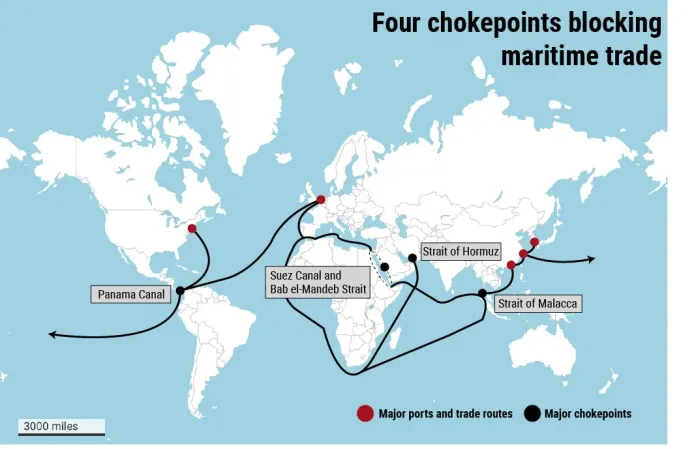
At the Strait of Hormuz’s most narrow point, it’s roughly 20 nautical miles or so between Oman and Iran, meaning the area outside Iran’s territorial sea is much smaller than that. The small waterway also makes those vessels easier targets for Iranian forces.
“The freedom of navigation has to be restored to the Strait of Hormuz, and that’s just not possible under the current Iranian regime, and the reason why I say freedom of navigation has to be restored is because that’s the fundamental principle that underpins 11 billion tons a year of seaborne trade,” Michelle Wiese Bockmann, a senior maritime intelligence analyst with Windward, told the Washington Examiner.
She added, “If you have a choke point like the Strait of Hormuz under the effective blockade or control of a country contrary to the long-established norms of international maritime law and the principles that underpin trade, then what’s to stop other” countries from trying to leverage those choke points.
Other strategic waterways
Iran is not the first country to close an important waterway, though its impact far exceeds any previous one in the Red Sea.
The Bab al-Mandab Strait, which separates the Red Sea and the Gulf of Aden, is the only entry point to the Red Sea from the Indian Ocean, and through the Suez Canal, it connects to the Mediterranean Sea. On one side of the Red Sea is the African coastline of Egypt, Sudan, and Eritrea, while on the other side is Saudi Arabia and Yemen. More than 4 million barrels per day of crude and other petroleum products pass through the strait each year.
Iranian-backed rebels in Yemen, known as the Houthis, began attacking commercial vessels transiting the Bab el Mandeb Strait in November 2023 — in the aftermath of Hamas’s Oct. 7, 2023, attack in southern Israel, and their subsequent war in Gaza. The Houthis targeted those ships in solidarity with Gaza, they said, and they stopped those attacks once a ceasefire was agreed upon. The U.S. went to war with the Houthis last year until President Donald Trump abruptly announced a ceasefire last May.
Between the recent threats to the Red Sea and Strait of Hormuz, Bockmann, said “What it has underscored is the vulnerability of these choke points to threats and attacks, so in the case of the Houthis, it was like very low, low technology drones, the threat of attacks that more effectively closed off the Gulf of Aden and the Red Sea and the Suez Canal, that that waterway to Western affiliated vessels, and it’s the same with Strait of Hormuz.”
Nearly 5 million barrels per day of crude oil and petroleum liquids travel through the Suez Canal each year, attracting up to 15% of global trade. At its very narrowest, the channel stretches less than 700 feet wide.
In March 2021, a massive container ship known as the Ever Given, which was nearly twice the length of the canal’s width, was pushed sideways in the channel and ran aground, blocking traffic in either direction.
The vessel obstructed the canal for six days, blocking the flow of nearly 13 million barrels of crude, causing a rapid spike in international and domestic oil prices as well as a loss of up to $15 million in daily revenue for the canal, according to the Atlantic Council.
The Suez Canal has also faced piracy threats in the past, including from Somali pirates in the early 2000s.
It’s not a strait, but the Panama Canal is another choke point that has seen increased crossings in light of the war in Iran and their demands for ships to transit the Strait of Hormuz, Bockmann said.
Average auction prices for Panama Canal crossings were usually around $135,000 to $140,000 prior to the war and have since increased nearly threefold to roughly $385,000, according to Reuters, which also reported that some companies had paid more than $1 million for a slot due to the increased demand.
In 2024, around two million barrels per day of crude oil and petroleum liquids passed through the Panama Canal, according to the EIA.
Another major waterway for global shipping commerce is the Strait of Malacca, which connects the Indian Ocean to the South China Sea. It’s governed by a series of agreements between Singapore, Malaysia, Indonesia, and Thailand, and roughly a third of global trade and more than a quarter of the world’s seaborne oil travels through it, according to the Council on Foreign Relations. In 2024, the EIA estimated that nearly 23 million barrels per day of crude passed through the strait, the most of any major waterway.
At its narrowest point, the Strait of Malacca is less than two miles wide. If this strait were to close, ships would seemingly need to sail further south, such as through the Lombok Strait, around the Java Sea near Jakarta, or they could seek to avoid the Indonesian archipelago entirely.
Amid the tension with the Strait of Hormuz, the Indonesian Finance Minister Purbaya Yuchi Sadewa suggested last month that they place tolls on ships transiting the Strait of Malacca — following Iran’s playbook. He walked back the comments, and Indonesian Foreign Minister Sugiono also publicly rejected the idea.
For Arsenio Dominguez, secretary general of the U.N.’s International Maritime Organization, the Turkish Straits connecting the Black Sea to the Mediterranean should also be considered a major choke point, as they are the only maritime link connecting much of Eastern Europe to global sea trade.
These straits, which include the Strait of Istanbul, the Strait of Çanakkale, and the Marmara Sea, see roughly 3.7 million barrels of crude and petroleum products flow through each day. This is roughly equivalent to 5% of global maritime trade, according to the EIA.
“Any disruption in these areas would have major global consequences for trade and for food security for populations worldwide,” Dominguez said at the end of April.
VANCE CAN’T SAY IF IRAN IS NEGOTIATING IN GOOD FAITH
The Arctic is an emerging area for contested waterways. Not only does melting ice in the Arctic make way for new possible maritime routes through the region, but it also provides growing access to the region’s virtually untouched fossil fuel and mineral reserves.
The Arctic Council, the preeminent organization for international mediation in the Arctic, consists of eight members: the U.S., Russia, Canada, Denmark, Finland, Iceland, Norway, and Sweden. While Russia is the only nonWestern country that has a claim to the Arctic, China has unilaterally given itself the title of a “near-Arctic state.”