
A growing sense of dread is spreading through Democratic circles as a rapidly shifting political landscape threatens to complicate the party’s path back to House control in November.
Democrats entered the year with momentum after California voters approved Proposition 50, a mid-decade redistricting overhaul that redrew congressional lines to benefit the party through the 2026, 2028, and 2030 election cycles. Under the new map, Democrats could potentially capture as many as 48 of California’s 52 House seats. The move was in response to President Donald Trump urging Texas to redraw its maps to potentially net five more Republican House seats ahead of November’s general election.
Following the California Democratic victory, led by outgoing Gov. Gavin Newsom (D-CA), Utah Democrats won a long-running legal fight over the drawing of House districts. It’s led to a new map that could give Democrats one of four House seats in the Beehive State after years of a 4-0 Republican romp.
But the early optimism Democrats felt has been tempered by a series of setbacks.
Two court rulings — one from the U.S. Supreme Court and another from Virginia’s highest court — combined with an aggressive GOP-led effort to redraw congressional maps in several red states, have handed Republicans their strongest burst of momentum in months, putting Democrats on shaky ground.
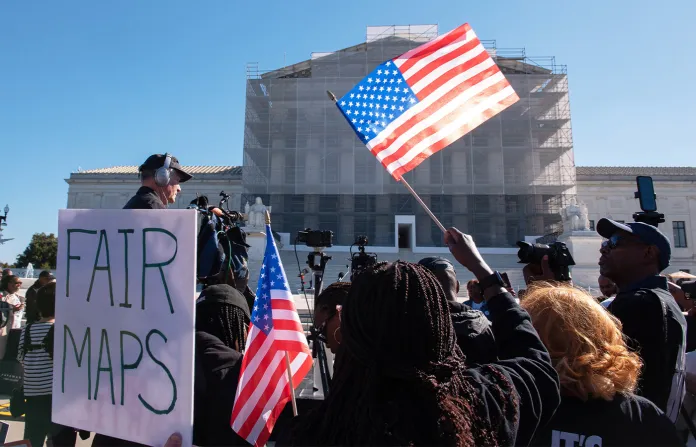
“Redistricting is one of the most powerful political weapons in America, and these rulings just gave Republicans a major opening at exactly the right time politically,” political analyst Mike Fahey told the Washington Examiner.
Despite the wins, Republicans are hardly guaranteed a smooth path in the midterm elections. Trump, approaching the midway point of his second, nonconsecutive White House term, seems increasingly like a drag on House Republicans. And the opposition party to the president has picked up seats in every midterm election cycle but three over the past century.
House Republicans are defending their majority amid a difficult political environment marked by sagging presidential approval ratings, exorbitant White House spending requests for a proposed ballroom sought by Trump, rising inflation, persistently high gas prices, and an unpopular, erratic war with Iran that shows no sign of ending soon.
Republicans currently hold a razor-thin 217–214 House edge, with several vacancies. It amounts to House Democrats needing to net at least three seats in the 435-member chamber to claim their first majority in four years.
Last month, the Cook Political Report’s House ratings gave Democrats a relatively straightforward path to the majority, with 217 seats categorized as safely Democratic or leaning their way, enough that flipping a single toss-up district could have handed them control of the chamber. Democrats are now favored in only 208 seats, leaving them with the far more difficult task of capturing 10 out of 18 competitive toss-up races to win back the House.
Court throws out Virginia vote
Virginia voters in April narrowly approved an expensive Democratic-backed redistricting effort designed to potentially net the party as many as four additional congressional seats. The Democratic edge is currently a mere 6-5, and ballot measure supporters sought to make it deeply blue, to the tune of 10-1.
The measure’s approval by voters briefly shifted momentum in Democrats’ favor in the escalating national fight over congressional maps. It was a big part of Democrats’ strategy to counter Republican gains in Florida, Missouri, and North Carolina. In Ohio, where redistricting had to take place in 2026 due to a voter-approved ballot measure, Republicans are looking to pick up two seats.
So, for a moment, the redistricting battle had appeared roughly even. Yet that advantage did not last long.
Republicans filed suit against the Virginia redistricting ballot measure approved by voters. The Virginia Supreme Court on May 8 dealt Democrats a major setback, ruling 4-3 that lawmakers failed to follow the state’s constitutional amendment process properly. The decision forced Virginia to revert to its existing congressional maps for the midterm elections, erasing what Democrats had hoped would be a crucial edge.
The state’s Democratic attorney general, Jay Jones, recently filed an emergency appeal with the U.S. Supreme Court, asking the justices to overturn the ruling, arguing that the Virginia court had effectively overridden the will of voters who approved the amendment at the ballot box. It’s unlikely the high court, which has historically been reluctant to interfere with state courts’ interpretations of their own constitutions, will get involved.
Democrats do, still, have a shot at beating two of four Republicans targeted by the would-be redistricting plans, Reps. Jen Kiggans (R-VA) and Rob Wittman (R-VA). Both have long been on House Democrats’ target list.
Kiggans is likely to face a rematch in the suburban Hampton Roads 2nd Congressional District against the former Democratic congresswoman she ousted in the 2022 midterm elections, ex-Rep. Elaine Luria. Voters there in 2024 backed Trump over Democratic nominee Kamala Harris by a sliver, 49.5% to 49.3%.
To the north, several Democrats are competing in the 1st Congressional District, which includes the Western Chesapeake Bay and suburbs north and west of Richmond. Trump won more easily there, 51.8% to 46.9%. But persistent sprawl from the outer Washington, D.C. area has led many Democratic and independent voters to move there, giving Democrats hope of beating the incumbent.
Still, the late-game Republican redistricting wins — the pair of court decisions and a Florida map that could increase the Sunshine State’s House delegation from 20-8 to 24-4 — quashed Democratic boasts that they had evened the redistricting score. Roughly akin to a basketball team that falls behind in the first quarter and then, through smart play and hustle, evens it up in the second quarter, even taking the lead for a short time. But after holding the other team even in the third quarter, it falls way behind in the fourth and loses big.
Supreme Court guts key section of Voting Rights Act
The Virginia Supreme Court decision came just days after the U.S. Supreme Court signed off on weakening a key section of the Voting Rights Act that for decades had protected black representation in the South. The ruling gave Republican-controlled legislatures a new opening to redraw congressional boundaries in ways critics warned would weaken minority voting influence while expanding GOP opportunities in the House.
Several red states moved swiftly to capitalize on the court’s decision.
In Tennessee, lawmakers redrew the state’s congressional map in a way that may effectively dismantle the last Democratic-held district, shifting from an 8-1 Republican edge to a 9-0 shutout. In Louisiana, the Republican governor postponed congressional primaries after ballots had already been distributed so lawmakers could approve a revised map more favorable to the GOP. The Bayou State’s House delegation is likely to move from a 4-2 advantage to 5-1.
Alabama officials also turned to the Supreme Court, seeking permission to use a proposed map that could place another Democratic seat at risk. Justices signed off on the request, and the state’s delegation is set to increase from 5-2 to 6-1.
South Carolina Republicans, who dominate the state legislature, are considering a new redistricting plan targeting the state’s only Democratic-held congressional district in the Columbia area. The seat has long been held by Rep. Jim Clyburn (D-SC), a two-time House majority whip.
The changes could hand Republicans a sizable built-in advantage in the House, potentially allowing the party to remain competitive or maintain control, even if Democrats win the national House vote by a significant margin in November.
Conservative radio host Sam Mirejovsky crowed about the outcomes.
“Play stupid games, win stupid prizes,” Mirejovsky, a partner at Sam & Ash, told the Washington Examiner. “Democrats spent 15 years gerrymandering states they controlled and expected Republicans to play dead. They didn’t. The lesson, which applies in politics and in life, is that if you do something, expect a response. And if your side is running the shady playbook and you’re cheering it on, do not act shocked when the pendulum swings back and hits you in the face.”
Still, Republicans may not max out on redistricting for the 2026 elections. Alabama and Louisiana could have each tried to draw out all Democrats from their states’ congressional delegations. Doing so might endanger the reelection prospects of some Republican lawmakers by diluting GOP voting bases.
A few states over, Rep. Bennie Thompson (D-MS) got a reprieve from the elimination of his district, the 2nd, covering Jackson and the Mississippi River and Delta. Thompson is the only Democrat in Mississippi’s four-member House delegation, and the lone African American lawmaker. Gov. Tate Reeves (R-MS) said May 13 that any redrawing of maps for the state, which already held primaries, would have to wait until 2027.
Unrecoverable body blow?
How much these redistricting fights matter in the battle for the House will largely depend on Democratic performance in November. Even before the latest round of gerrymandering, Democrats already faced a difficult map, due to geographic sorting among voters and other factors. The massive blue wave in 2018, when Democrats flipped 40 House seats during Trump’s first term, was never considered very likely this year.
Political pundit Jamie E. Wright believes the Nov. 3 elections will reveal whether the Supreme Court and Virginia decisions were temporary setbacks or unrecoverable body blows to Democrats.
“Losing district opportunities in a state such as Virginia adds another layer of difficulty to the already-difficult road Democrats face,” she told the Washington Examiner. “Furthermore, losing those map opportunities in key battlegrounds requires Democrats to expend far more resources to defend districts that they previously considered safe.”
But Wright said that she didn’t believe the recent rulings would be “fatal” for Democrats. Wright pointed to candidate qualifications, message development, get-out-the-vote efforts, fundraising, and national sentiment, which she said played enormous roles in elections.
James Christopher, founding and managing editor of New York-based James Christopher Communications, said he agrees that politics is not purely structural, but added that the judicial branch stepping in sends a “complicated message to voters about the courts, redistricting, and democratic legitimacy itself.”
“In states like California and Virginia, contentious redistricting disputes have at least involved visible court proceedings, public scrutiny, or voter-facing mechanisms,” he told the Washington Examiner, as opposed to several Republican-led states that have been “pursuing increasingly aggressive top-down remapping efforts.”
“That distinction matters because voters increasingly view voting rights, district maps, and representation itself as active political battlegrounds rather than neutral democratic frameworks,” he said.
Christopher added that aggressive redistricting can “absolutely affect turnout, enthusiasm, and public trust.”
Historically, political anger has been one of the strongest drivers of turnout in American elections.
“At this point, Republicans likely retain the upper hand because of structural leverage, institutional control, and redistricting flexibility,” Christopher said. “But Democrats’ path remains viable, particularly if economic frustrations deepen and if these legal and map fights become symbolic of a broader public concern that democratic participation itself is increasingly under strain.”
Veteran Democratic strategist Garry South told the Washington Examiner that the midterm elections could ultimately expose unexpected risks for Republicans pursuing aggressive redistricting efforts.
VIRGINIA DEMOCRATS ASK SUPREME COURT TO REINSTATE NULLIFIED REDISTRICTING AMENDMENT
South argued that redrawing congressional boundaries in Republican-led states may force dozens of GOP incumbents, once considered politically secure, to compete in unfamiliar territory before voters with little connection to them.
“We’ll have to see how it plays out, but there’s a real possibility this strategy could backfire on Republicans,” he added.
Barnini Chakraborty (@Barnini) is a senior political reporter at the Washington Examiner.