
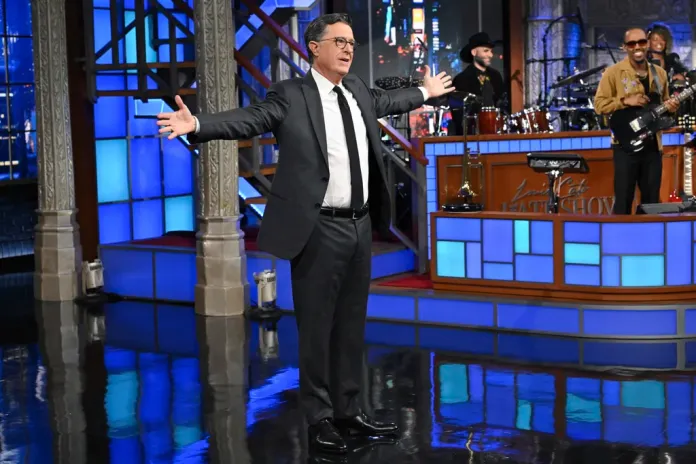
On May 21, Stephen Colbert will host his final episode of The Late Show on CBS, bringing down the curtain not only on his own 11-year run but on the entire Late Show franchise, a CBS institution since David Letterman launched it in 1993. The finale will feature an all-star parade: Jimmy Kimmel, Jimmy Fallon, Seth Meyers, John Oliver, Letterman himself, Tom Hanks, Julia Louis-Dreyfus, Pedro Pascal, and the Strokes. Kimmel, in a nod to their friendship, will air a rerun rather than compete. The send-off will be suitably grand.
But here is the uncomfortable truth that no amount of celebrity cameos can paper over: The show ending is not quite the one many of us, those who were devoted fans of Colbert in his Comedy Central heyday, had hoped it would become. When Colbert took over from Letterman in 2015, I was genuinely excited. I had written in Public Discourse, in January 2015, about the genius of his nine-year Colbert Report, how it ranked among the most brilliant and daring achievements in the history of American television comedy. My expectations for what he might do with CBS’s larger platform were enormous. My disappointment over the decade that followed was commensurate. The Late Show is ending in circumstances that are murky, contested, and deeply revealing about where political comedy, and the broader landscape of American discourse, stands in the age of Trump.
To understand the disappointment of the CBS show, you must first understand how extraordinary the Comedy Central show was. The Colbert Report, which ran from 2005 to 2014, was built on one of the most audacious conceits in television history: Colbert played a pompous, self-aggrandizing cable news pundit, transparently modeled on the Bill O’Reilly school of blowhard bravado, with such conviction and deadpan command that millions tuned in nightly to watch what amounted to a one-man theatrical performance. As I wrote a decade ago, it was like watching a Tony Award-winning actor reprise his role for a nine-year Broadway run. Except where theater actors are at least able to recite the same lines show after show, Colbert was working from a brand-new script every night. His appearances beyond the studio — testifying before Congress in character in 2010, roasting President George W. Bush at the 2006 White House Correspondents’ Association dinner — were acts of genuine artistic and civic courage. The Report was, at its best, not just funny. It was revelatory.
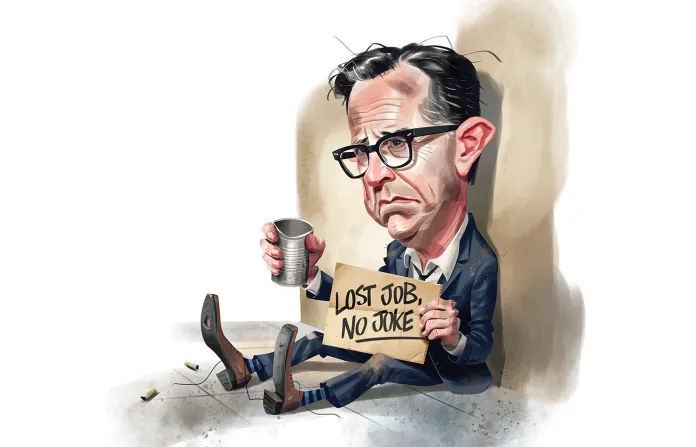
And then came CBS. On Comedy Central, Colbert was a must-watch. You never quite knew what he was going to do, because the character he had built was expansive and strange enough to go anywhere and say anything. On CBS, you always knew exactly what he was going to say. The monologue would skewer President Donald Trump. The desk piece would skewer Trump. The guest interview would pivot, at some point, to Trump. The format was not revelatory — it was reactive. When you strip away the character, you strip away the distance. Satire requires a certain remove from its target — the Colbert of Comedy Central had that remove built into his form. The Colbert of CBS was, increasingly, just a smart and angry man behind a desk, preaching to a choir that already knew every hymn. Variety, reviewing the final season, called the show “not very good TV” and “out of touch with everyday Americans.” That verdict, however harsh, is not wrong.
CBS announced in July 2025 that it would end The Late Show franchise entirely in May 2026, calling it “purely a financial decision against a challenging backdrop in late night” and stressing it was “not related in any way to the show’s performance, content, or other matters happening at Paramount.” The cancellation came just three days after Colbert went on air to call Paramount’s $16 million settlement of Trump’s lawsuit over the editing of a 60 Minutes interview a “big fat bribe.” Paramount was awaiting Federal Communications Commission approval for its merger with Skydance Media, which required the blessing of a Trump-appointed regulatory apparatus. “I absolutely love that Colbert got fired,” a celebratory Trump posted on Truth Social. “His talent was even less than his ratings.”
Colbert himself, in a diplomatically ambiguous New York Times interview, said he believed “two things can be true”— that the economics of broadcast late night had genuinely become unsustainable, and that something more ominous may also have been at work.
“Less than two years before they called to say it’s over,” he said, “they were very eager for me to be signed for a long time. So, something changed.”
The economics are real: Late Show viewership had declined from a peak of over 3 million six years ago to roughly 2.4 million by mid-2025, and ad revenue dropped about 25% from 2022 to 2024. CBS’s replacement for the franchise is Byron Allen’s Comics Unleashed, a roundtable comedy program deliberately designed to avoid political humor — the TV programming equivalent of stuffing yourself with plain white bread and chugging a quart of milk after you’ve mistakenly eaten a jalapeno pepper because your mouth is on fire and you’re desperate to avoid anything that might renew the sensation that had been causing your tongue to burn.
If Colbert’s cancellation was the most dramatic front in the war between the Trump administration and late-night television, it is hardly the only one. In a story I covered in these pages in September 2025, ABC briefly suspended Jimmy Kimmel Live! after Kimmel made comments about the assassination of conservative activist Charlie Kirk. FCC chairman Brendan Carr threatened punitive regulatory action, including potential revocation of broadcast licenses, if Kimmel was not reprimanded. Broadcast station owners Nexstar and Sinclair pulled the show from their ABC affiliates. ABC eventually brought Kimmel back, whereupon he addressed the controversy on air but explicitly “made no apologies” for his ill-fated joke.
The confrontation has since escalated. In a parody routine last month, Kimmel, riffing on the upcoming White House Correspondents’ Association dinner, quipped that Melania Trump had “the glow of an expectant widow,” a joke about the age gap between the first lady and the president. (Even attempting to explain the joke still can’t cover up its awful taste and even poorer judgment.) Days later, the dinner itself was cut short when an armed man attempted to enter the Washington ballroom. Both Trump and Melania then called on Disney and ABC to fire Kimmel immediately, with Melania calling his words “hateful and violent rhetoric” and Trump declaring the joke “something far beyond the pale.” Kimmel responded in his monologue that it was “not, by any stretch of the definition, a call to assassination.” Reports emerged of an FCC review of Disney’s broadcast licenses. This is the context worth remembering: In December 2024, ABC had already paid $15 million toward Trump’s future presidential library to settle a defamation lawsuit over remarks by anchor George Stephanopoulos. The pattern is difficult to ignore.
Late-night television is currently in the intensive care unit of the TV world, and it’s doubtful whether it’ll make it out alive. Oliver’s HBO deal concludes in 2026. Kimmel has hinted at retirement. Fallon and Meyers remain at NBC through 2028, but their shows have absorbed significant budget cuts — Meyers lost his house band, and Fallon has cut to four taping days a week. Jon Stewart’s Daily Show contract has been renewed for another season, but unlike Fallon, Kimmel, and Colbert, Stewart is only on the air once a week, and it’s unclear how much longer he’ll want to continue after 2026. After Stewart goes, the Daily Show could very well go with him. Letterman himself recently said he “would be surprised” if late-night television “lasts more than a year” in its current form. The economics of streaming have gutted the advertising model that once sustained these productions, and that is a real part of the story. But economics alone cannot explain why a president publicly celebrates the cancellation of a program that criticized him, or why a regulatory agency threatens broadcast licenses over a comedian’s monologue. There is something more than market forces at work here.
What is at stake is the role comedy has historically played in American public discourse — a role going back to Mark Twain and finding its late-20th-century expression in Johnny Carson, Letterman, and then, most brilliantly, in the Stewart-Colbert axis of the early 2000s. Political comedy is not merely entertainment. At its best, it is a form of critique that reaches audiences pure journalism cannot, saying things straight that reportage cannot say because it operates under the cover of the joke. When that space is constricted — by regulatory threat, by corporate timidity, by audiences migrating to fragmented podcasts and streaming alternatives — something real is lost. Podcast hosts and YouTube commentators have picked up parts of the mantle, but their reach is different in kind, not just in scale. The nightly late-night broadcast, addressing a genuinely mass national audience, performed a specific and irreplaceable function in the democratic conversation.
None of this diminishes what Colbert achieved. The Late Show won a Peabody and its first Emmy for Outstanding Variety Talk Series in 2025 — the final season of its existence. Colbert was number one in his timeslot for nine straight seasons. And yet the CBS show, for all its accolades, never recaptured the electric, slightly dangerous quality that made The Colbert Report essential. It settled into a groove of anti-Trump leftism perfectly calibrated for its base but rarely surprising. The Colbert of Comedy Central encompassed the entire panorama of American political and cultural absurdity. The Colbert of CBS became, increasingly, a spokesman for one side of a binary argument. The difference is not trivial. It is the difference between art and advocacy, between a show that illuminated something true about the human condition and one that confirmed what its audience already believed.
In his New York Times interview, Colbert was characteristically gracious about the end: “Eleven years is a long time to work here. And almost ten years before that — almost twenty-one years altogether, in late night. I feel so much better to be ‘grateful for’ than to be ‘mad about.’” That equanimity reads less like complacency than the considered perspective of a man who understands, better than anyone, that the best work of his career happened at an earlier hour, on a smaller network, under a stranger set of constraints.
When I wrote about the end of The Colbert Report in 2015, I asked whether Colbert would be remembered as one of the greatest television characters of all time, alongside Cosmo Kramer and George Costanza. I answered yes. I still stand by that judgment. The character he built on Comedy Central was one of the most brilliant and durable satirical creations in the history of the medium. The man who inhabited him remains one of the most gifted performers of his generation. But the CBS version of Stephen Colbert — the real man, without the character’s protective armor of irony — never quite found a form equal to his gifts.
On May 21, the lights will go down at the Ed Sullivan Theater for the last time as a late-night venue. Letterman will be there, though the franchise he built will not be passed to anyone — it will simply cease, replaced by Comics Unleashed, a program whose apolitical guiding philosophy is the inverse of everything Colbert represented.
STEPHEN COLBERT DESPERATELY WANTS TO BE A CENSORSHIP MARTYR
Colbert, in his final New York Times interview, said: “I don’t have any problem with Trump being a Republican. I have a problem with Trump being a complete narcissist who is only working for his own interest and does not appear to care if the entire world burns.”
Regardless of whether or not this is true, and regardless of whether or not you agree with Colbert, it is honest insofar as it’s perfectly reflective of what he believes. And it’s precisely this honesty that reveals the ocean-wide chasm between the enervated earnestness of his CBS show and the comic genius of his Comedy Central work. On The Colbert Report, Colbert would not have said this. He would have found a way to make it funnier, and stranger, and more devastating. That is the measure of what was lost when the character went away.
When Colbert ended The Colbert Report in December 2014, he staged a mock resurrection — defeating death and ascending to heaven in a sleigh driven by Santa Claus carrying Abraham Lincoln, Captain America, and Alex Trebek, leading a chorus of “We’ll Meet Again.” It was a finale worthy of the show: biblical, mythological, and absurd all at once. On May 21, as The Late Show credits roll for the last time, there will be no such mythology on offer — only the elegiac fact of a disappointing show ending, and behind it, the frustrating image of the great one that might have been.
Daniel Ross Goodman (@DanRossGoodman) is a Washington Examiner contributing writer and the Allen and Joan Bildner Visiting Scholar at Rutgers University.