
There are men who build companies, and then there are men who build entire categories of human experience. Ted Turner, who died on May 6 at the age of 87, was decidedly the latter. The founder of CNN and the architect of modern cable television, Turner took a grief-stricken young man’s billboard inheritance and turned it, over the course of roughly three decades of volcanic ambition, into the most consequential media empire of the 20th century.
Robert Edward Turner III was born on Nov. 19, 1938, in Cincinnati. When he was 9, his family relocated to Savannah, Georgia, where his father was building a billboard business. Turner enrolled at Brown University in 1956 but was expelled for sneaking a coed into his dormitory room. He returned to Georgia to work in the family’s billboard operation — a detour that would eventually lead to everything.
Turner was just 24 when his father died in 1963, leaving behind a company that had fallen deeply into debt. Turner refused to follow his father’s dying advice to sell, worked tirelessly to pay off the millions in debt, and eventually turned the firm into the largest billboard company in the Southeast. He buried his grief in work, but Turner wasn’t content to push other people’s products forever.
In 1970, he bought an independent UHF station with a weak signal that didn’t even cover Atlanta. In 1976, he began transmitting the station to cable systems around the country via satellite, and it became the TBS SuperStation. Its motley collection of old movies and The Andy Griffith Show reruns was augmented by Turner’s acquisition of the Atlanta Braves, then a perennial doormat. Through their national superstation exposure, the Braves slowly attracted fans across the nation, including yours truly. Growing up in the ’90s, when the Braves were becoming a powerhouse, even I — deep in the heart of Red Sox territory in western Massachusetts — developed an affinity for Turner’s team, thanks to how often I’d see them on TV. (To this day, the Red Sox are my American League team and the Braves are my National League team.)
Turner’s sports interests extended well beyond the baseball field. In 1977, he bought the Atlanta Hawks, later broadcasting them on TNT and TBS as well, thereby ensuring that Mookie Blaylock and Stacey “Plastic Man” Augmon — all-time-great sports names — would also become household names. In the very same year, Turner captained the U.S.’s winning America’s Cup yachting crew.
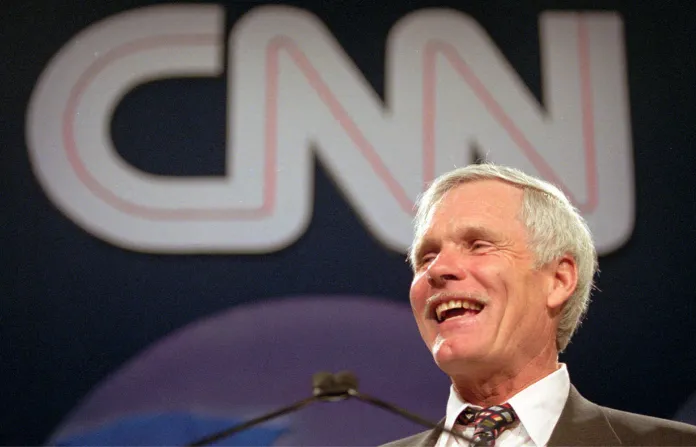
But perhaps no achievement better captures the sheer audacity of the man than the launch of CNN in 1980. At a time when news was available only at specific broadcast hours, the idea of letting consumers decide when they chose to learn what was going on in the world was considered revolutionary — and by many, insane. The venture was derided in its early days as the “Chicken Noodle Network.” (No, that wasn’t a Trump nickname, but it sounds like it could have been.) Turner pressed forward anyway.
The Gulf War of 1991 silenced the skeptics for good, as CNN’s live coverage from behind Iraqi lines transformed the network into the then-global standard for breaking news. There was virtually no major sector of American media in which Turner didn’t have a hand. If you (like me) love basketball and the now-iconic studio show Inside the NBA with Ernie Johnson and Charles Barkley (now licensed to ESPN/ABC but still broadcast out of Atlanta), you owe a big thank you to Turner, who created TNT.
If you (like me) love movies, you should thank Turner for founding Turner Classic Movies (TCM) and for going into debt to buy MGM’s vintage film library. And if you (like me) love Family Guy, you owe Turner a great deal of thanks for having launched Cartoon Network, which saved (and then helped revive) the funniest animated sitcom of our time. We may all, in one way or another, owe a significant debt of gratitude to Turner. The question is, what do you get someone who was worth $7.34 billion? A fruit basket?
A prolific philanthropist and environmentalist, Turner sometimes ran into trouble for injudicious comments about world affairs or religion. While sitting for a Reader’s Digest profile, Turner compared himself to Alexander the Great, Napoleon Bonaparte, Mahatma Gandhi, and Jesus Christ. That sort of flamboyant overstatement became central to his personal brand — as did the self-awareness that occasionally peeked through it. He once bragged, “If only I had a little humility, I’d be perfect.”
It’s hard to think of a more fitting epitaph, and harder still to imagine anyone filling the particular kind of space he occupied: the larger-than-life American original who bet on satellite dishes and 24-hour news when everyone said it couldn’t be done, who skippered his own yacht to victory and then collapsed on the floor of the victory party, who turned his father’s tragedy into one of the great entrepreneurial stories of the modern era. Turner told TV interviewer Charlie Rose in 2004: “I had one of the most incredible runs in human history.” The irritating thing, for those inclined to roll their eyes at such a remark, is that he wasn’t wrong.
Daniel Ross Goodman is a Washington Examiner contributing writer and the Allen and Joan Bildner Visiting Scholar at Rutgers University. Find him on X @DanRossGoodman.