
Don’t use the dreaded B-word to describe new White House security funding.
Republicans are avoiding the “ballroom” label as they forge ahead with $1 billion in taxpayer money to harden security for President Donald Trump’s new East Wing reconstruction as part of a party-line budget bill.
The messaging is meant to push back on Democratic claims that the White House security upgrades are subsidizing the $400 million ballroom project. Trump has repeatedly said the ballroom will be completed through private donations, not taxpayer funds.
Instead, Republicans are settling on variations of the ballroom construction’s official name — East Wing Modernization Project — to describe the tranche of security money. They say the rhetoric more accurately depicts the funding’s intent for Secret Service training and security upgrades across the White House grounds.
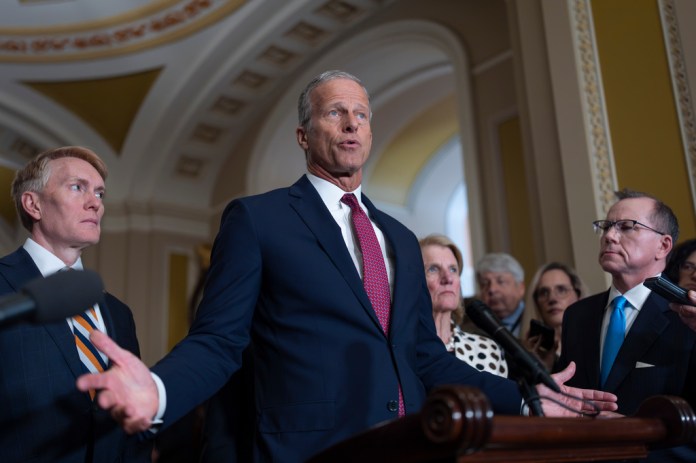
“It’s not about the ballroom,” Senate Majority Leader John Thune (R-SD) said. “It’s about the East Wing and the new construction and ensuring that that building is secure.”
Following a meeting between Secret Service Director Sean Curran and Senate Republicans on Tuesday, Thune said about 20% of the $1 billion will be to “secure the modernization of the East Wing.”
The figure is in line with a summarized breakdown circulated to congressional Republicans about how the Secret Service would use the funding, including $220 million for above- and below-ground security for the East Wing and ballroom. That entails bulletproof glass, drone detection technologies, chemical filtration systems, and “other national security functions.”
The document also lays out $180 million for a “long overdue” visitor screening facility; $350 million to be split evenly between training enhanced security for protectees; $150 million for emerging drone and biological threats; and $100 million for increased security at high-profile events.
“When you use that word, I can tell you haven’t read the bill,” Sen. Chuck Grassley (R-IA), who crafted the $1 billion funding provision, said of calling it “ballroom” security. “The word’s not in there.”
But across town at the White House, Trump was doing little to assuage GOP fears that the money is another case of out-of-touch Washington spending that lends Democrats an easy attack line in the midterm elections, particularly as the public faces higher inflation and prices at the pump from the war against Iran.
“The only thing that matters, when I’m talking about Iran: They can’t have a nuclear weapon. I don’t think about Americans’ financial situation,” Trump told reporters. “I don’t think about anybody.
“I think about one thing,” he said. “We cannot let Iran have a nuclear weapon. That’s all. That’s the only thing that motivates.”
Democrats were at the ready to use the latest remarks as a campaign cudgel that Trump “just said the quiet part out loud,” the Democratic National Committee said.
GOP lawmakers seek to include the $1 billion in a broader party-line $70 billion immigration enforcement legislation. But its ability to remain in the bill is in question on two fronts: whether enough Republicans can stomach the policy and if it can survive the so-called Byrd Rule, which governs spending restrictions in such budget reconciliation measures.
The messaging pivot is meant to make the security funding more politically palatable for on-the-fence GOP lawmakers who say it undercuts their midterm elections affordability rhetoric.
Republicans across the ideological spectrum in the Senate, ranging from centrists such as Sens. Thom Tillis (R-NC), Susan Collins (R-ME), Lisa Murkowski (R-AK), and John Curtis (R-UT) to conservative fiscal hawks such as Sens. Rick Scott (R-FL) and John Kennedy (R-LA), have expressed reservations and a need for more answers on the price tag. Leadership can only afford three defections in their 53-47 majority in what the GOP hopes will be a successful party-line vote next week.
“It was one thing when private dollars were building it. If you’re asking me for $1 billion, I have some really hard questions,” Curtis said. “If I were a businessman and an employee came and said, ‘I have a project and it’s a billion dollars,’ I’d say, ‘You made that number up, right? Like, where did the number come from?’ I want to see data.”
Another emerging GOP talking point centers on the pitch that the money is for a bipartisan cause that benefits future presidents and their administrations of both parties.
“It shouldn’t be a partisan issue,” Sen. John Hoeven (R-ND) said. “This is for security, and it even includes funding for the Secret Service, separate and apart from security at the White House. And it’s going to serve presidents of both party, administrations of both parties, for not just now, but for the future.”
TRUMP SAYS PEOPLE’S ‘FINANCIAL SITUATION’ NOT MOTIVATING TALKS TO END IRAN WAR
On the other side of the Capitol, House Speaker Mike Johnson (R-LA) punted on the security funding. He suggested the Senate should take the lead on the policy details in the reconciliation bill, but also defended the $1 billion.
“We’re gonna see what product comes out of the Senate,” Johnson told reporters as he made his way to meet with Senate Republicans at their Tuesday lunch. “They have three more steps to go through before we get it, so we’ll see. But I mean, the language is very clear. It could only be used on security measures.”