
The Supreme Court of Virginia invalidated a voter-approved redistricting referendum on Friday, ruling that lawmakers failed to follow the constitutional process required to place the measure on the ballot and halting Democrat-led efforts to implement a new congressional map.
The majority held that lawmakers acted too late when they approved the amendment proposal after more than a million early ballots had already been cast in last year’s Virginia elections, according to the decision released Friday morning. The state constitution requires the legislature to vote on any proposed constitutional amendments in two stages with an election in between to give voters the opportunity to hold their representatives accountable if they don’t like the proposed amendment, and the state Supreme Court found that Virginia Democrats did not follow that process.
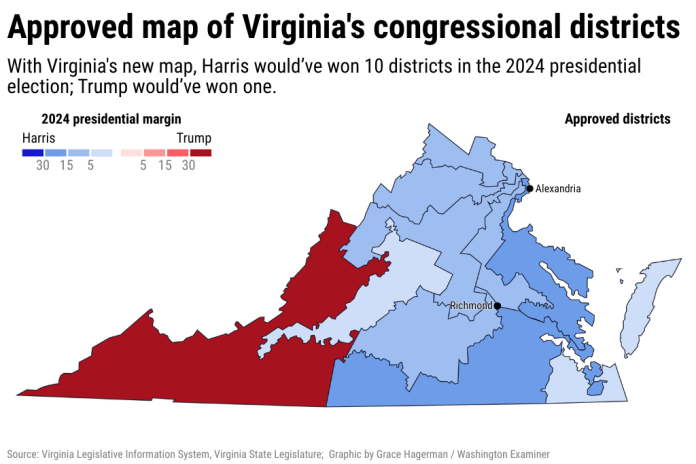
The decision resolves a high-stakes legal fight over whether the Democrat-controlled General Assembly complied with the Virginia Constitution when it moved to place the amendment before voters in a special election last month, and means Virginia will keep the map that is favorable to Republicans in five of its congressional districts.
At the center of the dispute is a technical but consequential question about timing: What qualifies as the “next general election” under the state constitution, and whether lawmakers acted too late by advancing the amendment after early voting had already begun in the state’s elections last year.
The state constitution requires the legislature to advance a proposed constitutional amendment in two steps — one legislative vote must take place before a general election, and the other must take place after — before lawmakers can place the proposed amendment before voters via a referendum. The requirement builds in accountability for lawmakers by giving voters the chance to oust representatives who voted for the state constitutional amendment if they don’t want the amendment to advance, and it is meant to prevent the state legislature from rushing through a referendum without that input from voters.
The General Assembly did not approve the proposed constitutional amendment until after early voting in the 2025 elections had already begun. Republican-backed challengers argued that once early voting was underway in fall 2025, the election had effectively started, meaning the legislature missed the required constitutional window to act. Attorneys defending the amendment countered that the state constitution contemplates a single Election Day in November, with early voting treated as participation ahead of that fixed date.
The case also raised questions about whether lawmakers improperly expanded the scope of a special session to include redistricting, as well as whether statutory notice requirements tied to the amendment were properly followed.
During oral arguments earlier this week, several justices pressed attorneys on the real-world implications of both sides’ positions, particularly as early voting has become a dominant feature of modern elections. Questions from the bench suggested the Virginia Supreme Court had concerns about how to reconcile long-standing constitutional language with evolving voting practices.
The court did not clearly signal how it would rule, with only a subset of justices actively questioning counsel and probing different aspects of the case.
The litigation has unfolded against a tight timeline. Under state law, the election must be certified within 14 days, creating pressure for a decision as election officials warned they were nearing a point at which certification could become impracticable.
A lower court previously blocked certification of the referendum, finding that the amendment process violated constitutional requirements. The state Supreme Court allowed the vote to proceed while it considered the case but declined to lift the certification block in the interim.
The referendum itself narrowly passed in a special election. The outcome has major political implications, as the proposed districts could significantly reshape Virginia’s congressional delegation ahead of the midterm elections in favor of Democrats.
VIRGINIA REDISTRICTING BALLOT AMENDMENT FACES TENSE QUESTIONING FROM STATE SUPREME COURT
The broader dispute is part of an escalating national redistricting fight, with both parties pursuing mid-decade map changes in key states as control of the House hangs in the balance.
In siding with the challengers, the court concluded that the General Assembly failed to comply with the state constitution’s sequencing requirements, determining that the amendment was advanced after the relevant election process had already begun.