
Cuba watchers are trying hard to get into President Donald Trump’s head and figure out where the country is on his regime-change pros and cons list.
Pro: Trump has developed a surprising taste for projecting American power and for removing toxic leaders.
Con: The results, in Venezuela and in Iran, have been decidedly mixed.
The question has become more acute in recent days, as Trump has added sanctions on the Caribbean communist nation 90 miles from Florida, which recalls Cold War maneuvering. And his top foreign policy and security official, Secretary of State Marco Rubio, has suggested that with Cuba, it’s regime change or nothing.
Whether U.S. action against Cuba is on the horizon, and what form the aftermath will take, has been preoccupying the communities of exiles and Latin American policy experts. Politicians have for decades been steeped in the fraught relations between the superpower and the island nation, where community revolutionary Fidel Castro seized power on Jan. 1, 1959, when President Dwight D. Eisenhower had just over two years left in the White House.
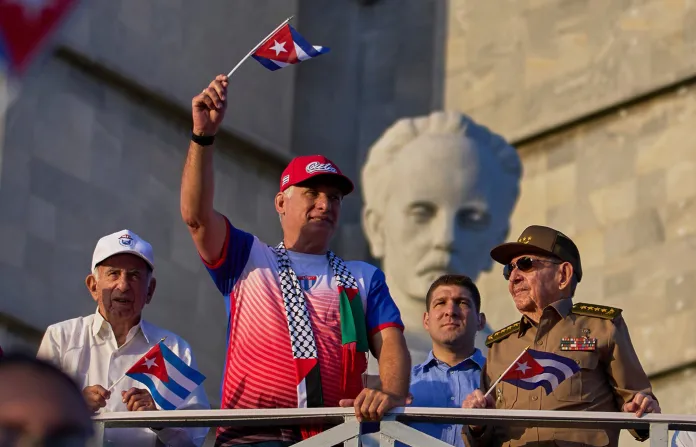
“For the first time since Eisenhower, the United States is no longer just a passive observer waiting for the regime to fall on its own, but instead an active engine of change,” Sebastián Arcos, the interim director of the Institute for Cuban Studies at Florida International University, said in an interview.
What that means, however, is not at all clear: Is Trump fully committed to removing the Castro regime as Miami-based exiles such as Arcos want him to be? Or will he go for regime change-lite, as he has done in Venezuela, where the socialist regime remains in power even as its former leader, Nicolas Maduro, languishes in an American prison? Are Americans prepared for a third conflict in a year, especially as the Iran war remains hugely unpopular? And who would replace the Castro regime?
“I believe that the only way to achieve what the United States wants is to achieve is complete regime change,” said Arcos, who, when he lived in Cuba, was imprisoned for his human rights activism.
“There are other interpretations, though — the MAGA side of the equation says, ‘I’m happier with Venezuela than with Iran,’” Arcos said, referring to Trump’s base and its preference for short military engagements with clear outcomes rather than extended wars.
Limited straits of Florida detente
Since Trump first imposed new sanctions in January, Cuba has been in talks with administration officials. Trump has, as is his diplomatic tendency, been bellicose in his remarks, speeches, and on social media.
“Whether I free it, take it, I think I could do anything I want with it,” Trump told reporters of Cuba on March 16.
In recent days, however, he has matched action to rhetoric, and his more sober advisers, including Rubio, are also suggesting total regime replacement.
Cuba has been subject to punishing sanctions for decades, through the dictatorial leadership of Fidel Castro, who died in 2016 at 90; his brother and successor as strongman, Raul Castro, age 94; and the nation’s current leader, Miguel Diaz-Canel.
But the sanctions Trump added in an executive order on May 1 accuse Cuba of assisting Iran.
The order does not provide details of what the purported assistance constitutes. Yet attaching Cuba to Iran places the island nation at the center of Trump’s most consequential foreign policy action: the war against the Islamic Republic.
“Cuba maintains close ties to other major state sponsors of terrorism, including the Government of Iran, and provides safe haven for transnational terrorist groups, including Hezbollah,” the order reads.
More ominous for the Cuban regime, the order ends with a greatest-hits list of Trump’s military adventures.
“President Trump continues to demonstrate his commitment to directly addressing national security threats from abroad,” the order reads. Notably, reports emerged two weeks earlier that the Pentagon was drawing up contingency plans for a military engagement with Cuba.
Days before the most recent executive order, Rubio, himself a Cuban American, appeared on Fox News and said the purported Cuba-Iran ties made change exigent.
“They have rolled out the welcome mat to adversaries of the United States to operate within Cuban territory against our national interests with impunity,” Rubio said. “We are not going to have a foreign military or intelligence or security apparatus operating with impunity 90 miles off the shores of the United States. That’s not going to happen under President Trump.”
As Trump has repeatedly stated since January, Rubio said nothing less than regime replacement would do.
“In order for it to get better, they do need very substantial and serious economic reforms,” said Rubio, 54, whose Castro-regime animus has been a mainstay of his rapid ascent in Florida and national politics, from state House speaker from 2006 to 2008, to Republican senator from Florida from 2011 to 2025, to now wearing multiple foreign policy hats in Trump’s second, nonconsecutive White House term.
“Those serious economic reforms are impossible with these people in charge. It can’t happen,” added Rubio, who, in addition to being secretary of state since Jan. 21, 2025, has been acting national security adviser since May 1 of that year — the first person with those dual roles since Henry Kissinger from 1973 to 1975, in the Nixon and Ford administrations.
The same day Trump issued the executive order, he told a Florida club near his Mar-a-Lago residence that he would be “taking over” Cuba “almost immediately.” Trump said he was considering sending an aircraft carrier to park offshore. That was one means of pressure he used with Iran before joining Israel in launching the current war in February.
Cuba’s government is just as adamant that the regime is going nowhere.
“No aggressor, no matter how powerful, will find surrender in Cuba,” Diaz-Canel said in a statement on May 2, the day after Trump speculated about sending an aircraft carrier. Trump ”will find a people determined to defend sovereignty and independence in every inch of the national territory.”
Cubans are feeling the effects of the increased sanctions and of an embargo on oil reaching the island, though Trump recently made an exception for a Russian tanker, a signal of his friendly relations with Russian President Vladimir Putin, who opposes the squeeze on Cuba.
Decadeslong sanctions
The U.S. has sanctioned Cuba since 1962, three years after a revolution against an American-allied autocrat led to a communist takeover.
Former President Barack Obama relieved some of the pressure during his second term. In 2014, he lifted some sanctions and removed restrictions on American travel to the country. Trump reimposed many of those restrictions in his first term.
Cuba’s 10 million people, already mired for six years in an economic crisis, are suffering severe food, electricity, and fuel shortages under the latest sanctions.
Still, Trump is not employing every tool available to him. There is still limited U.S. trade with Cuba. Flights are allowed, albeit under restrictions still in place. Americans are still banned from purely touristic visits to the island. Some investment is allowed as well.
Cuban American Republican lawmakers in Congress, the political vanguard of a community that voted largely for Trump, have called on the administration to cut off these lifelines as well.
“Now is not the time to let up,” Rep. Maria Elvira Salazar (R-FL) said on social media last month after a defiant appearance by Diaz-Canel on NBC’s Meet the Press. “It’s time to finish it. The Cuban people are calling for FREEDOM!”
Cuban Americans are nervous about Trump’s resolve, despite his tough talk, Ricardo Herrero, the executive director of the Washington-based Cuba Study Group, said in an interview.
“The Trump administration is listening to the community, but they’re also not doing a lot of what the community wants,” Herrero said.
Contributing to the anxiety of the key Republican constituency is a lack of knowledge of what exactly is on the table in the talks, Herrero said.
“The talks have continued, but I still don’t know if there’s actual if there’s an actual negotiation taking place,” he said.
There are reports that members of the Castro family, who are seen as the power behind Diaz-Canel, are taking part in the talks. They reportedly met last month with a high-level American delegation to the island. The Castros are reviled by much of the Cuban American community.
What the Cuban regime is offering also falls short, said Arcos, the former human rights activist — so far, reports have only indicated Cuba offers limited compensation for the estimated $10 billion in modern-day currency seized by the communists decades ago, expanded investment opportunities, as well as the release of prisoners.
Even if it introduces far-reaching economic reforms, Arcos said, “They will continue to be an enemy, a thorn on the side of the United States, and open to any other enemy of the United States to come into the Western Hemisphere. The only thing that solves the problem is full transition to democracy.”
Hopes for a full transition to democracy would be frustrated by the lack of existence of a viable opposition, as opposed to Venezuela, where the relatively recent experience of democracy in the first years of this century has left in place a viable civil society.
“If you decapitate Cuba, what are you left with? If you look at the rungs of power in Cuba, it’s Raul at the top,” Herrero said, referring to Fidel Castro’s brother, who is still considered the leading power behind the throne, “followed by the military and intelligence services and the business conglomerate guys, and then below that is the party and bureaucracy. It seems that if you take out Raul and you take out the current president because he’s very unpopular, you’re still left with the military as the next layer.”
There is talk that Trump is looking for someone like Delcy Rodriguez, Maduro’s vice president who turned on him, said Joel Rubin, a former assistant deputy secretary of state in the Obama administration who liaised between the State Department and Congress. She is now, as the acting president of Venezuela, cooperating closely with Trump in opening up American investment.
“They’ll try to maximize military pressure to see if some transitional figure pops up so they can liberalize that country, or get the Cubans themselves to liberalize and open up,” Rubin said.
That would be deeply unsatisfying to Cuban Americans, Arcos said.
“There is a very broad, very deep consensus in the Cuban American community about what needs to be done and the order in which it needs to be done, because Cubans believe that it has to be, No. 1, a full transition to democracy, unlike Venezuela,” said Arcos, whose institute polls Cuban Americans routinely. “And No. 2, it needs to start with political reforms, not economic ones.”
Trump does not have the same incentives to take the risks he did with Venezuela and Iran, or for that matter with Panama and Greenland, where he is seeking to increase the American presence and control in regions that have strategic significance for the U.S., said Eric Jacobstein, a senior fellow at the Inter-American Dialogue, a think tank that promotes democratic values across the Americas.
“From a Trump administration perspective, Cuba has a lot less to offer geopolitically than Venezuela or Iran with oil, and it has a lot less to offer geopolitically than Panama with the canal,” said Jacobstein, a deputy assistant secretary of affairs in the State Department’s Bureau of Western Hemisphere Affairs during former President Joe Biden’s administration.
The Castro infrastructure is more deeply embedded than Maduro was in Cuba, Jacobstein said.
“There’s no central node of power, certainly not Miguel Diaz-Canal, but even if you took him out of the equation, there’s no natural Delcy Rodriguez or Maria Carina Machado,” the leader of the democratic opposition, Jacobstein said.
Another worry for Trump: The prospect of masses of Cubans seeking entry to the U.S. in the event of a crisis would be unpalatable to a president whose signature domestic policy is rolling back immigration.
Despite the unknowns that war brings, Rubin said Trump may be too committed to regime change to back down now.
“I do think we’re ultimately heading there,” he said. “It’s just they’re going to explore a lot more diplomatic ways out before they move into a military phase.”
GORSUCH STRESSES ‘CANDID CONVERSATIONS’ AMONG JUSTICES AFTER SUPREME COURT LEAKS
Rubin said Trump also had an eye on legacy. Just as Trump reportedly told associates that he believed this war with Iran would make up for President Jimmy Carter’s failed Iran hostage rescue effort in April 1980, Trump likely has President John F. Kennedy’s disastrous Bay of Pigs venture in mind.
“He’d want to ensure that he’s more effective than Kennedy was,” Rubin said.
Ron Kampeas (@kampeas) is a journalist based in Arlington, Virginia. He was the Jewish Telegraphic Agency‘s Washington bureau chief for more than 20 years and previously reported for the Associated Press from its Jerusalem, New York, London, and Washington bureaus.