
Amid months of concerns by California Democrats that their party’s gubernatorial candidates could get locked out of a chance to lead the nation’s dominant blue state, some leaders want to change a Golden State election rule that is making such an unlikely scenario possible.
Rep. Robert Garcia (D-CA), a major Democratic antagonist of President Donald Trump, wants to abolish California’s “top-two,” or “jungle,” primary. Garcia, the top House Oversight and Government Reform Committee Democrat, is linking up with Republicans to scrap it in a rare bipartisan push, even though for starkly different reasons.
“In 2028, Californians should get rid of the jungle primary,” Garcia said in an April 17 X post. “It has not worked out as intended, and it’s time to get back to real primaries.”
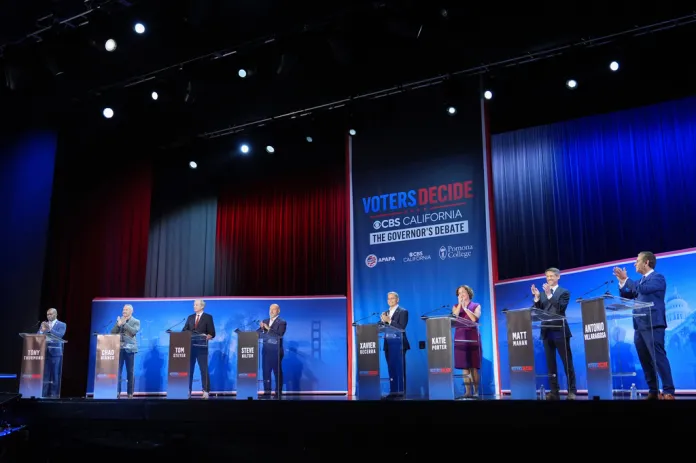
In the top-two election system, the best-performing primary vote-getters advance to the general election, regardless of party. For California Democrats, it’s caused heartburn this spring ahead of the June 2 primary. For months, it seemed two Republican candidates, former Fox News host Steve Hilton, and Riverside County Sheriff Chad Bianco, could nab the top two spots in the open California governor’s race.
That would have been a major embarrassment in a state where Democrats dominate, and many consider themselves a tip-of-the-spear of the “Resistance” movement against Trump in his second term. Democrats hold all statewide offices and dominate California’s congressional delegation and legislature.
Democratic top-two lockout worries have receded somewhat since former Rep. Eric Swalwell’s political career imploded amid sexual assault allegations by multiple women, all of which he denies. Swalwell led the all-party pack, or ran about even with Republicans Hilton and Bianco, in some polls.
With Swalwell gone, the race’s tentative leader is Xavier Becerra, a Democratic congressman who represented the area around Downtown Los Angeles for 24 years. Becerra was also California’s attorney general and Health and Human Services secretary in former President Joe Biden’s administration.
But Becerra is hardly a lock, with rival Democrats slamming his record over the primary fight’s final months. Among them are billionaire hedge fund manager Tom Steyer and former Rep. Katie Porter, a doyenne of the populist left and protegee of Sen. Elizabeth Warren (D-MA).
California Republicans were never big fans of the top-two election system, and it’s drawing renewed Republican ire from California Republicans in top-tier races, including Hilton.
Reps. Ken Calvert (R-CA) and Young Kim (R-CA), who are running against each other for a newly configured House seat in the outlying Los Angeles exurbs and beyond, are also not fans of the system. Each told the Washington Examiner the election system is structured in a way that disadvantages GOP candidates.
Garcia’s call to end top-two resurrects long-standing concerns among California Democrats. Many were suspicious of the system’s creation by Proposition 14, which voters approved in 2010 and first used in the 2012 elections. At that time, House Speaker Nancy Pelosi (D-CA) urged California voters to reject Proposition 14, a suggestion they roundly ignored by approving the proposal 54% to 46%.
The top-two election system was pushed in 2010 by outgoing Gov. Arnold Schwarzenegger and Lt. Gov. Abel Maldonado, GOP centrists who frequently clashed with their own party establishment. They and other supporters argued it would expand voter choice and curb polarization by forcing candidates to appeal to a broader electorate. The theory was that it would reward moderation and coalition-building. But critics like Lance Christensen, vice president of government affairs and education policy at California Policy Center, say that promise has not materialized.
“Republicans have largely been driven out of legislative seats and had their voices silenced to super-minority status by Democrats who have gamified the primaries by either propping up terrible Republicans or simply running Democratic candidates as moderates only to swing to the left on nearly every issue,” Christensen told the Washington Examiner. “The top-two primary has effectively marginalized thoughtful candidates who are no longer vetted and supported by the local party apparatus that should know them best. Rather, we get the most narcissistic candidates who are willing to say anything to anyone to get elected.”
Law of the ‘jungle’ primary
Despite nagging Democratic concerns, top-two has often worked to the party’s advantage in deep-blue California, frequently producing Democrat-versus-Democrat general elections that gave the party a win either way. But this year’s volatile governor’s race has upended that dynamic.
The contest to succeed Gov. Gavin Newsom (D-CA) has produced a sprawling Democratic field without a clear front-runner. In that vacuum, the race saw the rise of Republicans Hilton, a London-born-and-raised former adviser to former British Prime Minister David Cameron, and Riverside Sheriff Chad Bianco, the top law enforcement official in California’s fourth-most populous county, which stretches from exurban Los Angeles to the Arizona state line.
With that possibility on the horizon, members from both parties want the system gone. Republicans, outnumbered in the state, have long argued that they want a more level playing field and said the system shuts them out of general elections. Democrats now say the system sidelines ideologically pure candidates who represent the largely Trump-despising electorate. It instead rewards those with more name recognition, they add, along with big-money donors in their corner, while ignoring grassroots movements.
California-based political pundit Jamie E. Wright told the Washington Examiner that at first glance, the marketing pitch for the top-two primary seemed appealing.
“On paper, this is pure democratic theory. In reality, systems rely on incentives, voter turnout patterns, campaign finance, media coverage, and candidate behaviors to function,” Wright said. “Right now, what we are seeing is that the top-two system can create fragmentation among candidates in a party just as easily as it does moderation. When one party supports multiple legitimate candidates and splits the vote, it opens up opportunities for a second party with significantly fewer registered voters to receive more total votes. This is exactly what is occurring right now in California.”
Political strategist Matt Klink, who worked on the original campaign to pass the system, said the top-two system “was sold to California voters as a way to get more moderate candidates,” but that the “exact opposite has happened.”
“In reality, it has produced more extreme candidates,” he told the Washington Examiner. “Districts at the state and federal level are mostly drawn so that the most extreme candidate wins and moderate/centrist candidates get squeezed out.”
Republican strategist Jeff Burton described the system more bluntly as “chaos.”
“Case in point, California’s next governor is likely to advance with less than 20% of the total vote in the June primary,” he told the Washington Examiner.
But Burton, founding partner at Maven Advocacy, added that undoing the system would be difficult.
“If people want to get rid of top-two, they’re writing a very big check and going to the ballot,” he said. “And right now, there’s not much evidence voters are demanding that change.”
Campaign strategy contortions
Even at the congressional level, the top-two system is shaping campaign dynamics.
In California’s 40th Congressional District, Calvert and Kim are locked in a high-stakes intra-party fight and have spent heavily attacking one another while navigating a crowded field that includes five Democrats. The possibility that Democratic votes could split, allowing both Republicans to advance and face off again in November, has raised concerns about the long-term impact of such bruising contests.
“The problem with these jungle primaries is that people play games and they get involved in trying to split votes and do this and do that,” Calvert said. “That’s exactly what’s going on now, and I don’t think that it serves the Republican Party well. I don’t think it serves the Democratic Party well either.”
California election reformers are split on how to move forward but have pushed alternatives like ranked choice voting, which avoids vote-splitting entirely. Under the system, voters would be able to choose among all candidates in a race, regardless of party.
In Alaska, which uses the system, voters get one choice in the primary, and the four candidates who receive the most votes advance to the general election. In the general election, voters were allowed to rank candidates for a particular position.
For example, in the first round of counting, if no candidate reached the 50% mark, it went to a second round, which started with the candidate who received the fewest votes in the first round being eliminated. If the eliminated candidate was a voter’s top pick, their next choice would get their vote in the round. This would continue until a candidate reached the 50% threshold and a winner was declared.
Other options include open access primaries with party nomination, in which a party chooses its nominees, and independent voters have another means or crossover ability to participate in their party’s nomination contest.
But Chad Peace, the legal advisor for the Independent Voter Project, which advocates for more open elections, maintains that California’s top-two primary system has more positives than negatives and should be protected.
“So our viewpoint is that this is not about the parties,” Peace told the Washington Examiner. “We’re very party-agnostic. It’s about voters, and the system we offered is the only one, aside from Washington and Alaska, where every voter and every party is treated the same, and the rules are the same for everybody. So sometimes a Democratic district might send two Democrats to the general election.
CALIFORNIA GOVERNOR’S DEBATE TURNS CHAOTIC AS CANDIDATES CHASE BREAKOUT MOMENT
“We argue that’s the first time Republicans have a meaningful vote, because in the gerrymandered Democratic district, they otherwise wouldn’t have a meaningful vote,” he added.
Peace said that unusual circumstances can occur in any election, simply due to the composition of the field. He added that, going forward, his group will look at places like Alaska, but remained strongly opposed to returning to a system of closed primaries “where you disenfranchise half of your electorate at the first stage of the process.”
Barnini Chakraborty (@Barnini) is a senior political reporter at the Washington Examiner.