
Those pretty faces might always make the United States stand out in the crowd, but rest assured, the free world will desperately want it back in charge should it ever go its own way.
And make no mistake, there are those who would like to see it do just that. While President Donald Trump has proven eager to turn his sirens on after once decrying his country’s role as world police, his administration’s interventions abroad have only further radicalized the Republican Party’s isolationist wing.
Tucker Carlson, for example, no longer advocates a foreign policy pivot out of the Middle East toward China, but a total abdication of the throne.
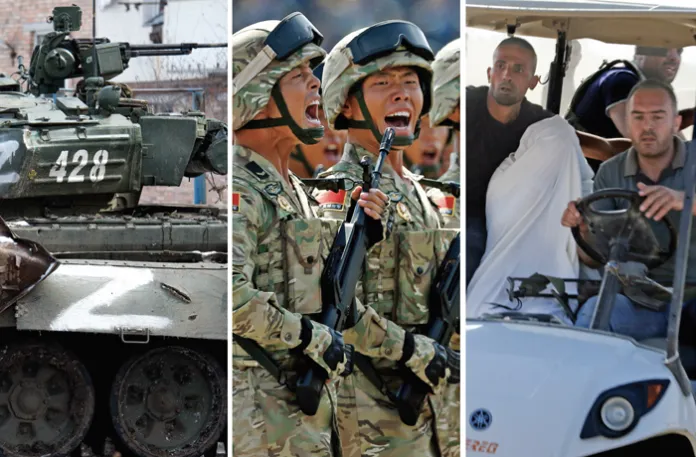
(From left: Anadolu Agency/Getty; Rolex Dela Pena/AP; AP)
“The U.S. is not going to defend and cannot defend Taiwan,” Carlson asserted during a recent sit-down with the Economist’s Zanny Minton Beddoes. The demoralizing monologue that followed may as well have been plucked, Inception-style, out of Chinese President Xi Jinping’s most euphoric dream.
“I think we’ve reached the limits of our power,” the cable news journeyman declared. “In the end, big powers want to and get to control their regions. We have something called the Monroe Doctrine. This was another problem I had with Russia. It’s like Russia, of course, is going to demand influence in Ukraine. And you could say, ‘Oh, it’s a sovereign country, they can’t have any influence there.’ Be real. A big power wants to control, hopefully in a nonbrutal, enlightened way, but they want some influence over their neighbors. We can no longer be the sole author of terms, of commerce, of anything. We have to share power.”
“With China?” Beddoes inquired.
“Of course! Because of their scale!” came the incredulous reply.
He expanded on this thought in a recent episode of his show, lamenting the U.S.’s entrance into the war Iran has been waging on it for nearly half a century.
“The death of the unipolar moment and of the institutions within the evangelical movement, American Protestant Christianity, are going away,” Carlson submitted. “But they will be replaced by something better, and purer, more true to itself, constructive, unifying, healing. Institutions that build and don’t just destroy. That’s going to happen. And God willing, we will live to see it.”
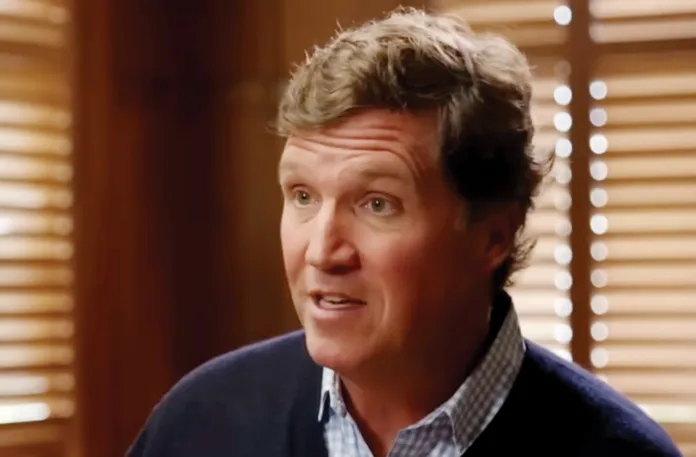
And what is this better, purer, truer something? Carlson was enamored with the answer provided by Jiang Xuequin, a Chinese high school teacher and conspiracy theorist: “What I would do is basically sit down everyone, OK, including Russia, China, Iran, and say it’s time for a new world order where we are partners in this relationship, right? Before America was hegemon, before the U.S. dollar was a world reserve currency. But now, what we want to do is open a dialogue where everyone is respected. Where America is no longer the bully, but a willing partner in creating a new economic order that benefits everyone, and not just a few.”
“I think that’s the wisest possible advice and probably the only path that preserves civilization,” Carlson marveled.
He’s joined by strange bedfellows in this project: the U.S.’s own allies, who have spent the last several months griping, grousing, and groaning over a stunning string of Trump administration successes.
After the remarkable operation that brought former Venezuelan dictator Nicolas Maduro to justice, Spain joined with Mexico, Brazil, Chile, Colombia, and Uruguay to condemn it, arguing that “these actions constitute a dangerous precedent for peace, regional security and pose a risk to the civil population” in a statement that’s already aged like milk.
More recently, France and Spain have gone so far as to deny the U.S. military access to their airspace and bases for combat operations in Iran, which the Spanish defense minister described as being “profoundly unjust.”
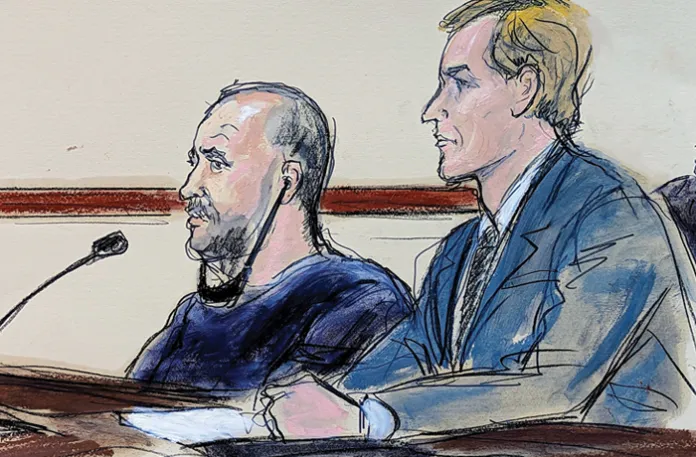
The more posh half of the special relationship, too, has begun to pine for its partner to take a step back. British Prime Minister Keir Starmer has said he’s “fed up” with the Trump administration amid the increase in energy prices attributable to the war in Iran, even straining so far as to draw a false equivalency between Operation Epic Fury and Putin’s yearslong effort to absorb Ukraine.
They ought to be careful about what they appear to wish for. A multipolar world in which America leaves Russia, China, and Iran to act with impunity, whether it be inside their “spheres of influence” or not, is no dream, but a nightmare
America must “share power,” we hear. The power to do what, exactly, though? The power to invade and occupy an American ally of geostrategic importance? “Share power,” that’s a euphemism for looking the other way while explicitly anti-American powers carry out barbaric, unprovoked acts of aggression. And unpunished acts of aggression only ever beget more.
Carlson’s greatest aspiration for his country — for it to cooperate in its own managed decline to make room for a KGB-trained oligarchist, genocidal communist, and Islamist eschatologist at the adult table — is one so foreign to the experience of modern man that even those opposed to it underestimate just how dark such a future would be. Boots stamping on human faces aren’t illustrative enough.
Under Putin, the Russian Federation has invaded Georgia, invaded Ukraine twice, and interceded on behalf of Bashar Assad, the brutal ex-Syrian dictator who deployed chemical weapons on his own people to hold on to power. Estimates suggest that well over half a million people have died in the second Ukraine conflict alone, during which the Russian military has systematically kidnapped children and employed sexual violence as a weapon. And when he’s not launching wars of aggression, Putin can be found carrying out assassination attempts of political rivals on foreign soil, hobnobbing with terrorists, and arming America’s other enemies across the globe.
Under Xi, China has prosecuted an inhuman genocide against its Uyghur Muslim minority at home and made no bones at all about its desire to forcefully expand beyond its borders. “Across much of the Indo-Pacific region, the Chinese Communist Party (CCP) is using military and economic coercion to bully its neighbors, advance unlawful maritime claims, threaten maritime shipping lanes, and destabilize territory,” reads one comprehensive State Department report about its trespasses. You can also take it straight from the horse’s mouth. “The reunification of our motherland, a trend of the times, is unstoppable,” Xi declared in his New Year’s address, immediately following the completion of a two-day military drill session simulating an attack on Taiwan.
And under the fanatical control of the mullahs, Iran has emerged as the world’s largest state sponsor of terrorism. That’s no trivial title. In addition to providing material support to the Houthis, Hamas, and Hezbollah, the regime has soaked its hands in American blood over the last four-plus decades, including by killing at least 603 American soldiers during the Iraq War. All the while, it has pursued a nuclear program that, if successful, would, at best, ensure the survival of the regime over the long-term and, at worst, might yield a nuclear Holocaust, given the radical form of “Twelver” Shiaism practiced by its leaders. Its disregard for human life is such that it slaughtered an estimated 30,000 of its own citizens during the most recent round of mass protests against it in January alone.
All this with the U.S., the richest and most powerful nation on the planet, standing in the breach.
Now imagine the carnage if Uncle Sam ever stepped out of the way.
Ukraine, Taiwan, Israel: These are lines worth holding for not just moral, but prudential reasons. The moment when two of the unholy triumvirate of Moscow, Beijing, and Tehran observe as the other swallows another country whole while Washington shrugs is the moment that the doomsday clock — not the punchline operated by the Bulletin of the Atomic Scientists, but the one that counts down to a third world war — begins in earnest.
Skeptics of American hegemony protest comparisons to the outbreak of World War II. Not every dictator is Adolf Hitler, and not every compromise is Munich, they say.
It’s an obtuse objection that misses the point entirely. Nazi Germany’s rise was just the most recent, stark version of a lesson man has had to be taught and retaught over and over again since time immemorial. The appetite of authoritarian, expansionist regimes with designs on more land, more resources, and more glory, regardless of their varied ideological underpinnings, cannot be satiated by concessions, only curbed through deterrence.
If the line isn’t held in Kyiv, it’ll have to be in Warsaw. If it’s not in Taipei, it’ll have to be in Tokyo or Seoul. And if Islamists are allowed to murder, pillage, and rape on the kibbutz, they’ll eventually arrive at the cul-de-sac.
America’s reflexive critics at home and abroad survey its reach, and its mistakes, and conclude that it is the wellspring of the world’s problems. If the U.S. would only set aside its arrogant, cowboy-esque bravado, then its enemies would accept some kind of reasonable accommodation of their whims. This is folly.
Europe may not, and need not, endorse every decision made at the White House to recognize that its bias toward action is an asset, not a liability to the free world. After all, remember that Putin invaded Ukraine on the much more palatable watch of former President Joe Biden, whose unwillingness to offend the delicate sensibilities or take decisive action came at a heavy price.
The stars and stripes are no barrier to peace — it’s the muscle behind the extended era of relative peace that most take for granted without being aware of it. And should it atrophy, the isolationist American Right and weak-kneed European Left will find they’ve invited the very death, destruction, and chaos they fear.
Isaac Schorr (@isaac_schorr) is an editor at Mediaite.