
The VIP-configured Airbus took off from Joint Base Andrews in Maryland on the afternoon of April 28, bound for Bermuda. King Charles III and Queen Camilla had kept calm and carried on.
After the chaos of the attempted assassination of President Donald Trump at the White House Correspondents’ Dinner on April 25, they had conjured a spectacle of unity. They had reciprocated the 21-gun salute and the congressional ovations with charm and compliments. The effusions of mutual affection were genuine affirmations of the historical affinity of America and Britain. But could the pomp match the circumstance?
Soft power is nothing without the hard stuff. The second Trump administration doubts that Britain is still willing or able to give political and military support to the U.S. In Britain, Sir Keir Starmer’s Labour government strains to talk the walk of trans-Atlantic amity, but its actions suggest distrust and incapacity. When American and Israeli jets attacked Iran on Feb. 28, Starmer did not send a symbolic contingent from the Royal Air Force. He reportedly blocked American planes from launching offensive strikes from British bases on grounds of international law.
“The war, Starmer said, was “not our war.” Though the Iranian regime had launched some 20 terrorist plots in Britain, joining America was not in Britain’s “national interest.” Starmer and his ministers defined the national interest in purely domestic and economic terms. When Labour won the 2024 elections, the party inherited a stalled economy and a state on the verge of bankruptcy. British consumers already pay some of Europe’s highest energy prices, and Britain imports most of its energy and much of its food. The International Monetary Fund warns that if energy prices stay high, Britain will have the highest inflation rate and the lowest growth rate among the G7 economies.
Still, Starmer ceded to American pressure by committing to what he called a “defensive” role. American bombers and transporters now launch attacks from British bases. Britain shares intelligence with the U.S., sends jets to intercept Iranian drones, and sent troops to garrison Bahrain. But Britain’s once-legendary Royal Navy failed to show. Britain withdrew its permanent naval presence from Bahrain as war loomed in early 2026. Its fleet is so small, aged, and undermanned that the nation that invented “gunboat diplomacy” was unable to rush a single destroyer to the Gulf.
“This is not Winston Churchill we’re dealing with,” Trump said of Starmer.
“Last time I checked, there was supposed to be a big, bad Royal Navy,” Secretary of War Pete Hegseth said on March 31. On the same day, President Trump posted marching orders on Truth Social. Countries “like the United Kingdom” that needed oil to pass through the Strait of Hormuz should “build up some delayed courage, go to the Strait, and just TAKE IT.”
Starmer declared that British forces would not join the American blockade of the Strait. On April 24, a leaked Pentagon email outlined options for punishing the NATO allies that had failed to support America. The proposals include suspending Spain from the alliance and reconsidering American recognition of Europe’s vestigial “imperial possessions.” These include the Falkland Islands, the South Atlantic British territory that is claimed by Argentina.
Two hundred fifty years after the Americans shook off George III, the Trump administration was considering whether to reallocate Charles’ possessions to punish his ministers.
Royal tea
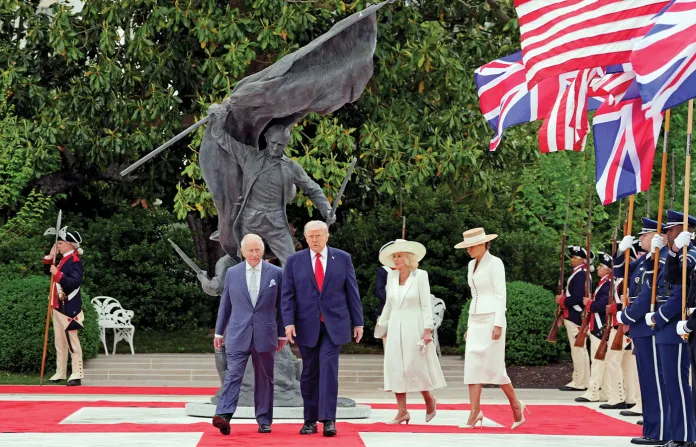
The king and queen landed at Joint Base Andrews on April 27, changed at Blair House into something less comfortable, then joined the president and first lady for a walk in the White House Garden. The king is a keen apiarist and supplements his income by selling honey from his Cornish estates under his Duchy Organic brand, and the queen keeps her own bees as well as her own house. They appreciated the beehive shaped like a miniature White House that the first lady has installed on the South Lawn in a bid to make the White House kitchens as self-sufficient in honey as the nation is in energy.
The president has yet to state his position on honey, but he looked energized. A brush with death has that effect. So does a brush with royalty. He prompted the king to admire a linden tree planted by his mother, Queen Elizabeth II, when she visited in 1991. This “living symbol” of the “centuries-old bond” between their peoples was a reminder, the president said, that the mightiest of trees, like the greatest of nations, must be anchored by the strongest and deepest of roots.” The king is a mystic philosopher as well as a keen gardener, so he would have enjoyed the arboreal imagery.
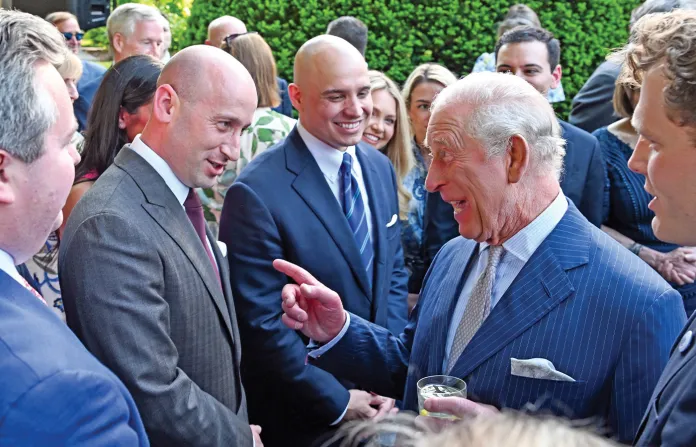
Next, a private tea in the Green Room of the White House, just the four of them, the butler and the photographer. Like ancient priests inspecting a pigeon’s innards, the royal handlers pronounced it a good augury that the quartet lingered over the scones for more than the allotted 30 minutes. The jetlagged royals then headed from the White House to a garden party at the British ambassador’s residence for 650 guests. Three thousand sandwiches with a choice of four fillings (roast beef and horseradish, smoked salmon with lemon butter, egg mayonnaise, and the trusty cucumber), scones with clotted cream, cakes, British-grown sparkling wine, and even more tea. The king and queen sealed a time capsule in the ambassador’s library. Its contents, like their private thoughts, are unknown.
Like Trump, the British monarchy should be taken seriously, but not literally. They are symbols, and are most successful when, like symbols, they allow others to fill them with meaning. Not all members of the royal family are entitled halfwits. The Firm, as they call themselves, are skilled performers. The comedy of protocol is the feint that covers the advance of serious diplomatic ambition. The serious performance of speeches and personal meetings advances crabwise by irony, the one export that Britain never ceases to produce. The centerpiece of the state visit, a joint address to both Houses of Congress, was a masterclass in charm.
After warming up with mutual affirmations at the White House on April 28, Charles became only the second British monarch to address a joint session of Congress. His mother, as in most matters royal, got there first.
We live, Charles said, in “times of great uncertainty.” The relationship of the British and American nations goes back four centuries, to when they were one nation. The principle on which they diverged, taxation without representation, was both the source of “a fundamental disagreement between us, and at the same time a shared democratic value which you inherited from us.”
The two nations, Charles said, remain “instinctively like-minded” as products of the “common democratic, legal and social traditions in which our governance is rooted to this day.” When they act together, they create “great change” for themselves and the world. These legacies are the “special ingredient in our relationship.” He did not mention that this relationship is relatively young. Though Charles is the 19th British monarch since the “Tale of Two Georges” in 1776, he is only the third to visit the U.S. The first was his grandfather, George VI, who visited in 1939, when war in Europe was imminent, and Britain knew it would need American support.
“King George never set foot in America,” Charles joked, “and please, rest assured, I am not here as part of some cunning rearguard action.” This, as the British might have said when they ruled India, was the elephant in the room. Since 1941, Britain has compensated for its slow decline through a close alliance with the U.S. Charles’ charm offensive is a rearguard action for a Britain teetering on the edge of economic crisis and strategic irrelevance. It is true that, as Charles said, the burden of world affairs is “too great for any one nation to bear alone,” and that an alliance cannot solely “rest on past achievements.” Nor can it survive through talk alone.
“Renewal today starts with security,” Charles said. His government recognizes that there needs to be a “transformation in British defense” and has committed to “the biggest sustained increase in defense spending since the Cold War.” Charles, who reminded Congress that he had served in the Royal Navy like his father, grandfather, and great-grandfather before him, volunteered as the symbolic linchpin of the trans-Atlantic alliance that Winston Churchill called the “Special Relationship.”
Royalty and reality
Churchill coined that phrase in his “Iron Curtain” address at Fulton, Missouri, in March 1946. The U.S., he said, was “at the pinnacle of world power.” It needed an “overall strategic concept” that could order the world in favor of the “fraternal association of English-speaking peoples” while shielding all from “the gaunt marauders, war and tyranny.” If the “populations of the English-speaking Commonwealths be added to that of the United States,” and their governments cooperated “in the air, on the sea, all over the globe and in science and industry,” there would be no “quivering, precarious balance of power” for the enemies of English-speaking liberty to exploit. Britain, Churchill said, was up to the task.
Britain’s imperial rearguard action aligned with America’s forward footing in the Cold War in Europe. But the two aligned only partially in the Middle East. The Eisenhower administration used the Suez Crisis of 1956 to replace Britain and France as regional arbiters, though Britain remained influential in the Gulf monarchies.
English-speaking interests did not align in the Far East, either. The Commonwealth states of Australia and New Zealand sent troops to the Vietnam War, but when President Lyndon Johnson asked Labour’s Harold Wilson to send a regiment of the Black Watch, Wilson refused. Johnson’s pique explains why he was the only American president whom Elizabeth II did not meet during his term in office.
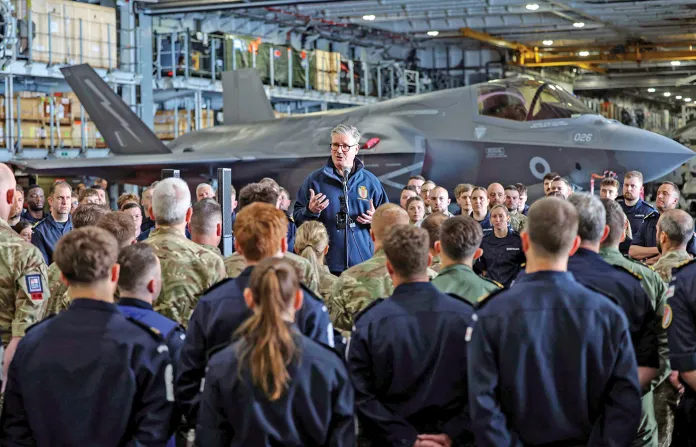
Though Britain took part in American-led interventions in the 1990s and early 2000s, its military reach slowly atrophied. Today, the Royal Navy’s fleet has shrunk from 1,400 vessels in 1945 to just over 60 vessels, the smallest fleet since the days of Oliver Cromwell. The British army has fewer men at arms than at any time since 1823, and the peace dividend that followed the defeat of Napoleon Bonaparte. The Royal Air Force, which had 55,000 planes in 1945, is down to 119 planes.
Britain’s defense budget for 2025-26 is $84 billion (£62.2 billion). The government allocates more to pensions ($371 billion, or £275 billion), the National Health Service and social care ($270 billion, or £200 billion), education ($180 billion, or £134 billion), and running the Department of Treasury ($108 billion, or £80 billion). Servicing the national debt will absorb more than 8% of government spending in 2025-26 (at least $153 billion, or £114 billion), and more if the Iran war leads to high inflation.
Labour’s plan is to raise defense spending from 2.4% of GDP in 2025, which exceeds NATO’s previous minimal target of 2%, to meet NATO’s new target: 3.5% of GDP, by 2035. This would require cutting welfare subsidies and the National Health Service’s budget, which would anger key blocs of the Labour vote and probably spark a revolt in the parliamentary party. Starmer and his ministers have not denied the Ministry of Defence’s assessment that it faces a funding gap over the next four years. Despite the wars in Ukraine, Gaza, and Iran, in mid-April, Keir Starmer refused to say when the government would release its long-term plans.
Britain’s infirmity is not solely caused by underfunding and the collapse of political vision into domestic debt servicing and welfarism. Britain’s 2025-26 defense budget of $84 billion (£62.2 billion) is far higher than Israel’s defense budget for 2025: a record-setting $32 billion (9 billion shekels), not including supplemental funding. Since Oct. 7, 2023, the Israeli military has reshaped its region and proven itself to be a key force multiplier for American policy. Britain’s military has a far higher budget, but a fraction of the capacity. The “corrosive complacency” that Lord Robinson, a former NATO chief, diagnosed in Britain’s defense establishment is consistent with the rot in Britain’s civilian ministries.
While Charles and Camilla worked their mission impossible, the Financial Times leaked some undiplomatic remarks from Sir Christian Turner, the new British ambassador to Washington D.C. Back in February, Turner told a group of British students that he disliked the phrase “special relationship.” “It’s quite nostalgic, it’s quite backwards-looking, and it has a lot of baggage about it.” If America has a special relationship with any of its client states, Turner said, it is “probably with Israel.”
After the party
“These things are never easy,” a courtier whispered to the Telegraph newspaper. “But if they were, it wouldn’t need the king to do it. We could leave it to the politicians.”
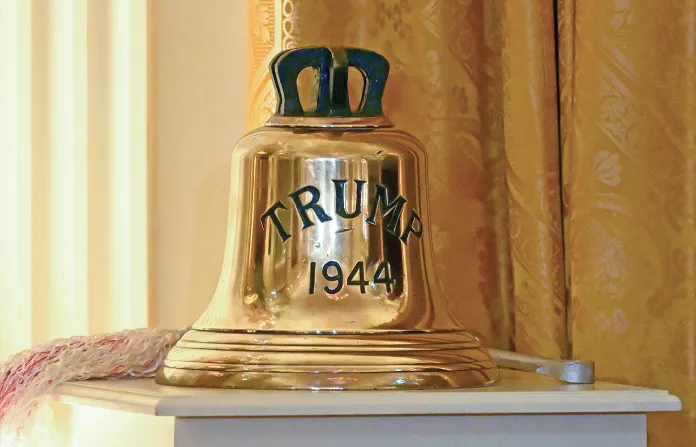
The white-tie dinner in the East Room of the White House went off perfectly. The first lady supervised the menu: a garden-herb velouté with hearts of palm salad, spring herb ravioli, Dover Sole meunière, and a chocolate gateau shaped like a beehive. Toasts were exchanged, and the king gave the president a bell from the World War II-era submarine HMS Trump, which was built in Britain and sailed by Australians.
As in ancient times, the emperor was gratified by the tribute of a client king, and the client king returned to his satrapy, checking that his territories were intact.
Trump likes Britain. At the White House on April 28, he ad-libbed that his Scottish mother adored Elizabeth II and had “a crush” on the young Charles. Trump’s two Scottish golf resorts make him the only American president to own property in Britain, though in 1902, three decades before becoming president, Herbert Hoover rented a house near London called, funnily enough, The White House. In September 2025, Trump became the only American president to receive a second state visit to Britain.
THE CAMPAIGN AGAINST ‘THE CAMP OF THE SAINTS’
Trump dislikes what Britain has become. He has criticized its immigration policies as “insane,” called London’s Labour mayor Sadiq Khan a “disaster,” and lamented how Britain hosts “radical Islamist terror.” Most British people feel the same way, but Trump caused offense by falsely claiming that British troops were “a little off the front lines” in the Afghanistan war. This was not the way to stir the British public to call for action against Iran. Perhaps the British public, sharing Starmer’s perception that the country is one economic squeeze away from disaster, is as beyond persuasion now as it was in the “locust years” of the 1930s.
In April polling by the Ipsos firm, 65% of Britons disapproved of American strikes on Iran and 77% feared the economic consequences. More than 60% feared a disruption in the supply of food and toiletries. Support for launching American strikes from British bases had declined from 31% to 23% in a month.
On Iran, Starmer finally found a policy that both his party and the public like. But prime ministers come and go ever more quickly in Charles’s distempered kingdom, and Starmer may be gone soon. Britain’s problems will continue to grow. Charles, the front man for an ever more shabby operation, may be reminded of Shakespeare’s plaint:
“O, how shall summer’s honey breath hold out
Against the wrackful siege of battering days?”
Dominic Green is a Washington Examiner columnist and a fellow of the Royal Historical Society. Find him on X @drdominicgreen.