
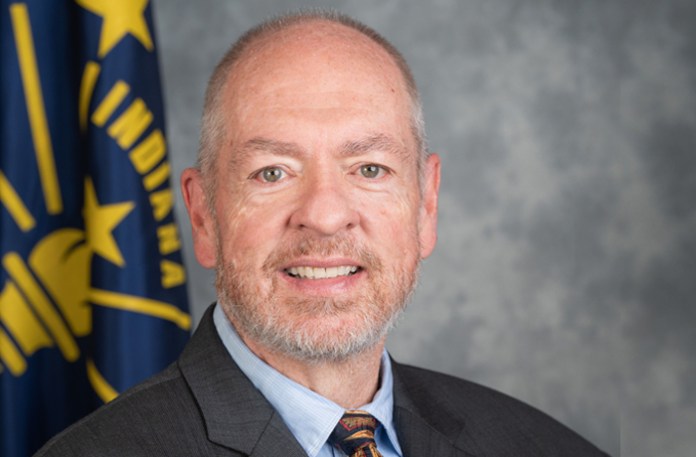
It used to be that Indiana state Sen. Greg Walker was the one poaching big game inside the GOP.
In 2006, he bagged the biggest “RINO” possible, taking out the long-serving state Senate leader, Bob Garton. Walker toured the state Senate district centered on Columbus, Indiana, in a refurbished orange 1970 Slant-6 Plymouth Valiant, encouraging supporters to scrawl in permanent marker on the campaign sedan.
He argued it was long past time to trade in Garton, who had been in office since 1970, to the dealer.
On May 2, 2006, Walker upset the Indiana honcho, who had helmed the Senate GOP since just after the 1980 elections, by just 611 votes, out of 13,573 cast. It was an outcome which, in a twist of political fate, ultimately paved the path for the rise of the current state Senate leader, Rodric Bray.
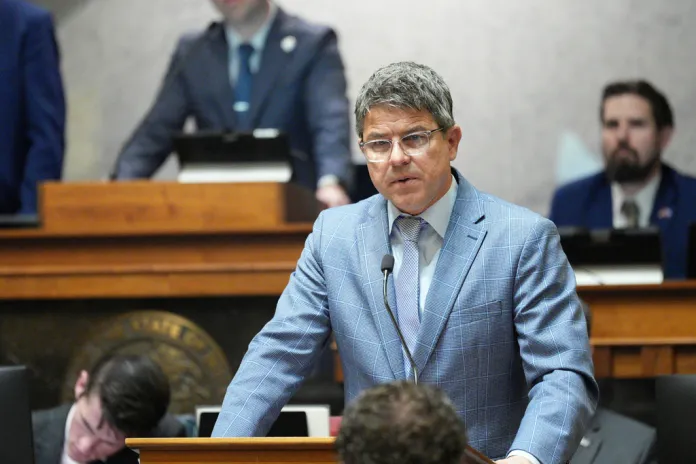
Son of a longtime state legislator, Richard Bray, and grandson of a congressman from 1951 to 1975, William G. Bray, Rodric Bray briefly became a political household name in December 2025. And not necessarily on a policy issue that the stalwart conservative would have chosen. Rather, it was his role in blocking President Donald Trump’s monthslong effort to squeeze two new Republican House seats from Indiana. Bray, first elected to the state Senate in 2012, rallied 21 of the state Senate’s 40 Republicans against redistricting.
Combined with unified Democratic opposition in the 50-member chamber, that was enough to sink the Trump White House redistricting plan. It proved a stinging defeat for MAGA forces after launching what became a fierce political arms race through redistricting.
House Republicans likely will hold a 220-215 edge over Democrats, with safe red and blue seats to be filled by special elections in the coming months, leading up to the Nov. 3 midterm elections. And with Trump growing increasingly unpopular amid high gas prices, the war in Iran, hourslong airport security lines, and other factors, MAGA coalition Republicans deem each seat gained through redistricting as crucial as a bulwark against Democratic House control.
Republicans have passed more favorable maps in Texas, North Carolina, and Missouri — though voters may have the opportunity to reject the Missouri map in a special election. Ohio’s bipartisan commission compromised on a new map that could help Republicans pick up one or two seats. Florida Republicans plan to take up redistricting in an April 20-24 special session.
But Democrats’ efforts to overrule independent commission-drawn maps in California, and possibly, Virginia, if voters approve and the state Supreme Court signs off on it, have offset new Republican-drawn maps. A new court-ordered map in Utah will also allow Democrats to pick up a seat.
The proposed Indiana House redistricting plan aimed to grow the Hoosier State’s Republican delegation in Washington from 7-2 to a 9-0 shutout. That was eminently doable in a state where Trump beat 2024 Democratic rival Kamala Harris 58%-40%. The redistricting plan targeted House districts held by Democrats in Indianapolis and northwest Indiana.
Having been thwarted in Indiana redistricting, Team Trump is seeking political revenge against state legislators who defied the White House. Ahead of the May 5 GOP primaries in Indiana, which often effectively determine general elections in the deep-red state, Walker and five other incumbent Republicans are being targeted for defeat.
Walker, in particular, is being painted as one of the “RINOs” who have been in office too long, an ironic charge 20 years after his epic takedown of a then-Indiana political institution in a GOP primary.
The difference, of course, is that the current campaign to remove them has a lot more than a busted-up old Plymouth at its back. An estimated $10 million has been promised so far from the nation’s most powerful Republicans to remove the recalcitrant state senators.
Walker, in an interview, described himself as a good fit for the south-central Indiana state Senate district he’s represented for going on two decades, both on policy and temperamentally.
“I’m a social conservative, and I’m a fiscal conservative, but being a social conservative doesn’t mean you have to hate people because you disagree with them,” Walker said.
Old political feuds get new life
In less than a month, Hoosiers will decide whether it’s time for Walker and others to go. Or, as they argue, it’s time to tell outside groups to stay out of Indiana.
The stakes wouldn’t seem to be huge for a White House rapt in a war in Iran, a toning down of immigration enforcement, inflation, historically long lines at airports, the Epstein scandal, and a host of other top-line issues — all of which could swing control of the House to Democrats in November.
Instead, Indiana’s contested Senate races look to be more about old feuds among some very powerful Republicans. It’s turned what used to be sleepy little state Senate primaries into a conflagration not seen since 2016, when Trump cemented his path to the White House in the Hoosierland.
A powerful trio of Indiana state Senate alumni, Sen. Jim Banks (R-IN), Rep. Erin Houchin (R-IN), and Trump 2024 Indiana co-chairman Carlin Yoder, have been working closest with the White House on the political revenge plan. The trio is guiding endorsements, landing on support for six state challengers running in districts where incumbents voted against the White House map.
The Club for Growth, under the direction of veteran Indiana politician David McIntosh, has poured $1.5 million into the cause. Veteran Republican election lawyer Jim Bopp, one-time counsel to Citizens United and a former, longtime Republican National Committee member, has been working the courts in his native Terre Haute.
Turning Point USA has hired a handful of field organizers across the state, battling incumbents — much like big Tea Party groups used to bring on state organizers more than a decade ago.
Americans for Prosperity has jumped in on other races against long-standing incumbents who haven’t drawn formal Trump challengers.
And even one-time GOP titan Mitch Daniels, who flirted with a 2024 Senate run, has forgone his famous “vow of political celibacy” from his time as president of Purdue University, a position he held after being Indiana governor from 2005 to 2013. Daniels is supporting the reelection bid of his former aide-de-camp, state Sen. Spencer Deery.
About the only Hoosier honcho missing is Trump’s own former vice president, Mike Pence, who has been conspicuously quiet in the all-out GOP war.
Hard redistricting sell from the Trump White House
For months, last summer into fall, Trump and his top deputies warned there would be great pain if the Indiana Republicans didn’t do what he wanted on redistricting.
Vice President JD Vance, a one-syllable “-nce” last-name running mate like Pence before him, warned the state Republicans there would be pain. Trump warned there would be pain.
A group led by one of Trump’s 2024 co-campaign managers, Chris LaCivita, and veteran Trump fundraisers, including Indiana operative Marty Obst, built the case in public.
Among the top arguments from Trump’s Indiana supporters was that he would invariably face another impeachment and endless investigations if Democrats retake the House in November — some pundits have equated a Democratic-led House with the de facto end of Trump’s second term.
“Anyone naive enough to believe that Democrats won’t use the majority in Congress to obstruct and impeach the president and attempt to bring back policies that will hurt the U.S is sadly mistaken,” said Tony Samuel, Indiana co-chairman of Trump’s 2016 campaign, in an interview.
“The responsibility of state legislators is to set the U.S. congressional districts. It is the one time they have a national responsibility, where their state politics should not have played into their decision, but some did not realize it,” Samuel said. “If you are a Republican state legislator and you voted for President Trump in 2024, then why would you vote to tie his hands behind his back two years later?”
But Bray and others said the support wasn’t there. Among the months of wrangling, Gov. Mike Braun (R-IN) initially promised that Indiana would get redistricting done and called lawmakers back to the state Capitol in November. Bray and others initially rejected that, telling Braun and the White House that it was a bad idea, before relenting and returning in December 2025.
For months, opponents of redistricting mid-decade touted multiple polls showing Hoosiers opposed the measure. One poll from native Hoosier turned national pollster Christine Matthews of Bellwether Research even flashed a warning for lawmakers that they could endanger their reelection if they voted in favor of the new map.
For a few days in December, Indiana held the singular attention of the nation’s political class and the Trump White House. Yet on Dec. 10, 21 Senate Republicans joined with the chamber’s paltry 10 Democrats to block the new map.
Redistricting a mixed bag for Republicans nationally
Republicans have had some redistricting success, starting with the political jackpot of Texas, where the new map could yield up to five seats. Yet some efforts to secure more Republican House seats in other GOP-dominated states have flopped. And even a few top state-level Democrats have balked at joining the fray. Maryland’s Democratic state Senate president appears likely to win in his effort to block a further-gerrymandered map that would squeeze out the state’s lone remaining House Republican, Rep. Andy Harris (R-MD).
The only other GOP-led state that could flatly buck Trump is Florida, where Gov. Ron DeSantis (R-FL), who was famously pummeled by Trump into near oblivion during the 2024 Republican presidential primaries, is bringing lawmakers back to Tallahassee for the special session.
No state has enraged Trump quite as much as Indiana. And no group of Hoosiers enraged the president as much as the recalcitrant state Senate Republicans. In part of his cajoling last year, the president promised any Republican who supported redistricting his endorsement.
With estimates from some Indiana Republicans that the battle could exceed $10 million in spending from White House-affiliated groups and national-style attack ads already targeting smart TVs and cellphones around the state, the vestiges of “Hoosier nice” could finally die this campaign.
Pence himself famously rehabbed his career in the 1990s by eschewing the barnstorming tactics of then-House Speaker Newt Gingrich and Reagan-era Republicans, building an image as the consummate nice guy — something which ultimately made him the perfect balance to Trump in 2016. And throughout the monthslong redistricting battle last year, veteran lawmakers groused at the raging national political debate encroaching on their culture.
They were shocked that the swatting, death threats, and feral rage which has permeated national politics for a decade now had pierced their Indianapolis sanctum.
State senators, much like their federal counterparts, expect a level of decorum — sometimes even chastising lobbyists who make personal insults to them in committee hearings, said Jacob Stewart, a former press secretary for Indiana Senate Republicans, now working as deputy opinion editor at the Indianapolis Star.
“These people are all very involved in their communities outside of the Senate,” Stewart said. (Indiana, like most state legislatures, is a “citizen legislature”, part-time, requiring that lawmakers hold other careers outside the Capitol.) “A lot of them are older, and I think they feel they have earned that respect.”
Violent scare tactics
In mid-November 2025, the Terre Haute Police Department and the Vigo County Sheriff’s Office responded to what turned out to be a fake report of a domestic violence emergency. Officers arrived at the home of state Sen. Greg Goode. When Goode, his wife, and his children rushed to see what had happened, the police were immediately apologetic.
Meanwhile, longtime conservative state Sen. Jean Leising, who’s best known for her annual proposal to mandate teaching cursive in school, said on Dec. 1 that her home was the target of a bomb threat. Leising, 77, who first entered the state Senate in 1989, attributed the incident to Indiana’s brewing redistricting battle.
As for Walker, he wasn’t even planning to run again. Two years after his wife died, having been in office nearly 20 years, and with his children grown up, he was ready to hang it up.
But last December, after the state Senate Republicans decided against supporting the White House map, someone left a wrapped box on his doorstep with his name scrawled in magic marker. He called the Columbus police, and they called in their bomb squad. They worked until past midnight before determining it was a fake. In the early morning hours, Walker and officers laughed with relief at the real-world training offered by the incident.
After that, Walker got back in the race. He said he wasn’t about to let a bunch of outsiders bully him into submission.
“That’s what bullies do, they make empty threats,” Walker said. “Do I want to see Indiana legislators responding to empty threats from Washington?”
A spokesperson for the Indiana State Police said they are still investigating the threats against lawmakers and have nothing to update the public yet.
Closing in on primary Election Day, it’s hard to tell who will win the Hoosier throwdown over redistricting.
Hundreds of votes win state Senate primaries, sometimes a few thousand, with a little over 10,000 primary voters showing up for most races.
Trump allies contend they have the upper hand. One person close to the White House campaign operation being spearheaded by Banks, Houchin, and Yoder noted that the political team’s vaunted data operation, flexed on full display in 2024, has been used in identifying and helping challengers.
And one longtime Indiana Republican said the decision to target races in Lafayette, around Purdue, and Terre Haute could also stem from the ability to get more bang for their advertising buck, because each city has its own modest media market, where campaign cash is spent more efficiently than in Indianapolis and the Chicago exurbs of Lake County, Indiana.
SENATORS DISCUSS HOW TO PUT OFF SOCIAL SECURITY BANKRUPTCY — WHAT TO KNOW
Still, others have speculated that the simple act of showing up regularly for decades at Veterans of Foreign Wars halls, parades, and other events should be enough to insulate the veteran lawmakers in these traditionally low-vote battles.
Walker himself noted that it was conservative diehards who showed up to put him over the line two decades ago. Now, though, it’s uncertain if enough veteran Republicans will show up next month to protect Walker and the other targeted incumbents or if they will become the latest big game bagged by angry Trump voters.
Tom LoBianco is editor and co-founder of 24sight News, based in Silver Spring, Maryland. He is the author of the biography about President Donald Trump’s first vice president, Piety & Power: Mike Pence and the Taking of the White House, and was an Indiana statehouse reporter for the Associated Press.